
Somebody in the Gold Empire group asked this last week, and the way they asked it is the reason I am writing a whole article about it. The question was raw spread account vs standard account, which one is better, and they had already read four forum threads that all disagreed. That is not surprising, because almost every answer you find online is an opinion about which one feels more professional. It is not a matter of opinion. It is a subtraction, and you can do it on the back of a receipt in about thirty seconds once somebody shows you which two numbers to subtract.
So that is what this is. No brand names, no affiliate links, no recommendation about where to open an account. Just the arithmetic that decides it, the point where one becomes cheaper than the other, and the much more important thing that this argument usually distracts people from.
What the two account types actually are
A standard account charges you nothing that looks like a fee. The broker’s cost is built into the spread, the gap between the price you can buy at and the price you can sell at. You pay it silently, on every entry and every exit, and it never shows up on your statement as a line item.
A raw spread account, sometimes called raw, ECN or zero, does the opposite. It shows you a much tighter spread and charges an explicit commission per lot instead. The cost is visible. Many people read that visibility as honesty and stop thinking there, which is exactly the mistake.
Neither structure is generous and neither is a trick. They are two ways of billing you for the same service. The only question that matters is which one bills you less for the trading you actually do, and that question has a numerical answer.
The one calculation that settles raw spread account vs standard account
Take the standard retail gold contract, where one lot is 100 troy ounces. Check your own contract specification rather than trusting me on that, because it is the assumption everything below rests on and platforms do vary.
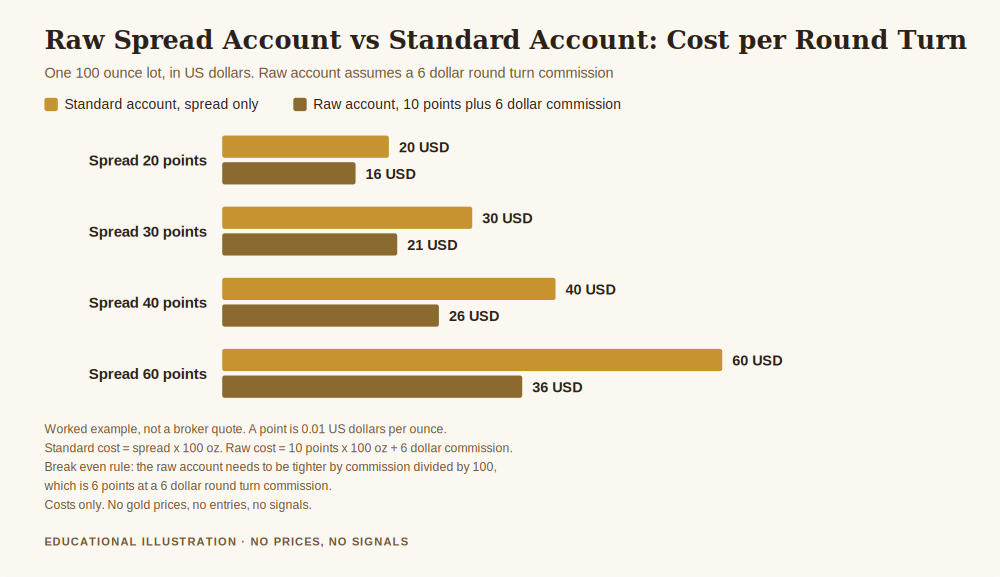
On the standard account, your round turn cost is the spread multiplied by 100 ounces. On the raw account, it is the tighter spread multiplied by 100 ounces, plus the commission. Set those equal and the commission cancels into something very simple:
The spread saving you need, per ounce, equals the round turn commission divided by 100.
That is the whole thing. If a broker charges 6 dollars per lot round turn, the raw account has to be at least 6 cents per ounce tighter than the standard account before you are one cent better off. In platform terms, where a point on gold is a hundredth of a dollar per ounce, that is 6 points. A 3 dollar commission needs 3 points of saving, a 10 dollar commission needs 10 points, a 12 dollar commission needs 12.
Notice what is absent from that formula. Your account size is not in it. Your win rate is not in it. Your timeframe, your strategy and your broker’s marketing are not in it. The break even point between the two account types depends on two numbers only, and both of them are published before you deposit a penny.
Putting real spreads through it
Here is the same subtraction across a grid, with a 6 dollar round turn commission assumed. Each cell is the raw account’s cost minus the standard account’s cost, in dollars per lot. A negative number means the raw account is cheaper.
| Standard spread | Raw 5 pts | Raw 10 pts | Raw 15 pts | Raw 20 pts | Raw 30 pts |
|---|---|---|---|---|---|
| 20 points | -9.00 | -4.00 | +1.00 | +6.00 | +16.00 |
| 30 points | -19.00 | -14.00 | -9.00 | -4.00 | +6.00 |
| 40 points | -29.00 | -24.00 | -19.00 | -14.00 | -4.00 |
| 60 points | -49.00 | -44.00 | -39.00 | -29.00 | -24.00 |
The break even line runs diagonally through that table, exactly where the raw spread sits 6 points below the standard spread. Below and left of it the raw account wins, above and right of it the standard account wins. There is no cell where one structure is universally better, which is why the forum arguments never resolve. Both sides are describing a real cell of the same table.
Why the honest answer is often that it barely matters
Now the part the comparison articles leave out. Suppose the two accounts are exactly 6 points apart, so on paper they are identical. How much money is actually in dispute over a year?
| Round turns per year | At 0.01 lots | At 0.10 lots | At 1.00 lot |
|---|---|---|---|
| 50 | 3 | 30 | 300 |
| 250 | 15 | 150 | 1,500 |
| 1,000 | 60 | 600 | 6,000 |
Those are dollars, and the assumption is stated in the header: 6 points of difference, that is all this table prices. If you trade 0.01 lots fifty times a year, the entire raw spread account vs standard account debate is worth 3 dollars to you. You could spend a fortnight researching it and lose more in opportunity cost than you could possibly win. If you trade a full lot a thousand times a year, it is worth 6,000 dollars and deserves a spreadsheet.
The size of the decision scales with your volume, not with how strongly people argue about it online. Most retail traders are in the top left of that table and behave as though they are in the bottom right.
The number that should worry you instead
Here is where I want to change the subject slightly, because this is the part that keeps accounts alive. Stop comparing your costs to each other and start comparing them to your risk per trade.
Say you risk one percent of your account on a position. Call that amount 1R, the unit that everything in risk management for gold trading is measured in. Now express the round turn cost as a percentage of that 1R:
| Account equity | 6 dollar cost | 12 dollar cost | 30 dollar cost |
|---|---|---|---|
| 1,000 | 60.0% of 1R | 120.0% | 300.0% |
| 5,000 | 12.0% of 1R | 24.0% | 60.0% |
| 10,000 | 6.0% of 1R | 12.0% | 30.0% |
| 25,000 | 2.4% of 1R | 4.8% | 12.0% |
Read the top row again. A thousand dollar account risking one percent puts 10 dollars at risk per trade. If the round turn cost is 6 dollars, every single position starts 60 percent of the way into its own stop before the market has done anything at all. At a 30 dollar cost, which is what a full lot on a wide spread looks like, the cost is three times the entire risk budget of the trade.
When that is your situation, the account type is not your problem. Your position size is enormous relative to your account, and no fee structure on earth fixes that. The arithmetic for getting it right is in how to calculate lot size for gold and forex and in how much to risk per trade, and it will do far more for your survival than any broker comparison.
What it looks like over a year
Run 250 round turns through the same assumption and the drag becomes visible. At a 6 dollar cost, a 1,000 dollar account pays 150 percent of its own equity in trading costs over a year, a 5,000 dollar account pays 30 percent, and a 25,000 dollar account pays 6 percent. Same fee, same trades, wildly different outcome, and the only variable that changed was how much capital was standing behind each ticket.
That is the real cost lesson, and it has nothing to do with which account type you picked.
Some context on how big these numbers are
It helps to know what the market itself does in a day. Using the LBMA gold price benchmark, I pulled every afternoon fixing from 4 January 2016 to 24 August 2026, which is 2,669 sessions and 2,668 consecutive price steps, about 251 fixings per year. The median absolute move from one fixing to the next is 0.4998 percent, call it 50 basis points.
Against a day that typically moves 50 basis points, a few points of spread difference is small. That is genuinely true, and it is the argument standard account defenders make. What it misses is that you do not pay the cost once per day, you pay it once per round turn, and the tables above are what happens when you multiply a small number by a large frequency.
Costs do not kill accounts on their own. They kill accounts in combination with trading too often at too large a size, which is the same combination behind most of the failures documented by regulators. The European Securities and Markets Authority, when it introduced its retail intervention measures, cited evidence that between 74 and 89 percent of retail accounts typically lose money, and capped retail leverage on gold at 20 to 1. Not because spreads were the villain, but because size and frequency were.
How to answer this for yourself in ten minutes
Forget reviews. Do this instead.
Open both account types with the same broker on demo, at the same hour of the day, and write down the live spread on gold in each, several times across a normal session and once around a scheduled news release. You are looking for the average gap between them, in points. Then look up the round turn commission and divide it by 100. If the gap is bigger than that number, the raw account is cheaper for you. If it is not, it is not.
Two cautions from watching people do this badly. First, compare like with like, because a spread quoted at three in the morning on a quiet Tuesday is not the spread you will trade. Second, remember that spreads widen, and they widen on both account types, usually at the exact moment you most want to act, which is one of the reasons trading gold through high impact news is its own separate problem.
If you are still at the stage of choosing where to trade at all, cost structure is somewhere around fifth on the list of things that matter. Regulation, withdrawal reliability, execution quality and how the firm behaves in a bad week all come first. We went through that ordering in how to choose a broker for gold trading, and the underlying mechanics of what you are paying for are in what the spread in gold trading really costs you.
Get the free Gold Empire survival sheet, a one-page guide to protecting your account from the costs and habits that quietly drain it. One email, no spam, unsubscribe anytime.
Frequently asked questions
In raw spread account vs standard account, which is cheaper for a beginner?
Usually neither, by enough to matter. Beginners trade small and infrequently, which is the top left corner of the cost table above, where the annual difference is a few dollars. The account type becomes a real decision once your yearly volume is high enough that a few points per round turn compounds into a number you would notice.
Is a commission always worse than a wider spread?
No, and that is the point of the divide by 100 rule. A commission is only worse if it exceeds the spread you save. A visible fee is not inherently more expensive than an invisible one, it is just easier to see, and being easier to see is a feature rather than a warning.
Do raw spread accounts have better execution?
That is a separate question and it is not answered by the pricing model. Execution quality is about how your orders are filled, especially in fast conditions, and you can only judge it by trading the account and watching what happens to your fills. Do not let a tight advertised spread stand in for evidence about execution.
What about swap charges, do they change the comparison?
They do if you hold positions overnight, and they are charged separately from both structures. If you carry trades for days, the swap can easily be larger than the whole spread and commission argument. We covered how that works in what swap in gold trading means.
My broker offers both. Can I just switch later?
Generally yes, and that is a good reason not to agonise over it now. Trade on whichever you are on, record your actual costs for a month from your own statement, then make the decision with your own data instead of somebody else’s forum post.
What Gold Empire actually does
Gold Empire is a free education channel for people trading gold, and the order in the name is deliberate: survive first, then grow. We publish the mechanics of this market, the ways accounts get destroyed, and the habits that keep people around long enough to get good at it. The free gold survival sheet is the one page version of that, and it costs nothing.
Everything here is free to read. There is an optional kit for people who want the material organised into a working system, and following along without ever buying it is a completely normal way to use this channel. We share our own results openly, and signals are part of what the channel offers, but we do not promise profits, because no honest channel can. If you want the next steps in order, start with risk management in gold trading, then how much to risk per trade.
About the author
Matthew writes the Gold Empire material. He spent his first years in this market paying costs he had never calculated, on positions that were far too big for the account they sat in, and most of what he publishes now is the article he wishes somebody had handed him then. He reads every message in the group and answers the ones about risk first. You can read more about the Gold Empire approach here.
This article is educational content, not financial advice. The cost figures in it are worked examples built on stated assumptions, a 100 ounce standard lot and a 6 dollar round turn commission, not quotes from any broker, and your own contract specification and fee schedule are the only numbers that apply to your account. It does not account for your personal circumstances, your tax position, or your risk tolerance, and nothing in it is a recommendation to buy or sell any instrument or to open an account anywhere. Trading leveraged products carries a high risk of losing money rapidly, and no entry, stop or target discussed should be treated as a signal. Consider speaking to a licensed professional in your jurisdiction before making decisions about your money.
One step first
Where should we send the Gold Survival Sheet?
Leave your email and we will send the free one page checklist, then take you straight to the Telegram channel.
No cost and no obligation. Educational only, not financial advice, and nothing here promises a return. Unsubscribe any time in one click.
Leave a Reply