
Every few weeks somebody in the Gold Empire group asks about tradingview vs metatrader, and they always ask it the same way: which one is better. I understand why the question comes out like that, because that is how the comparison articles are written. But it is the wrong question, and answering it as asked is how people end up paying a few hundred dollars a year for something that was never going to fix what was actually wrong with their trading.
So let me answer a different question, one that has a real answer. What does each of these two things actually do, what does each one cost, and which of the two is even capable of affecting your results. That last part is where most of the comparison articles quietly stop, and it is the only part that decides anything.
What each one actually is, stated plainly
These two products are not the same kind of thing, which is the root of most of the confusion. Comparing them directly is a little like comparing a set of binoculars to a fishing licence.
TradingView is a charting service you rent
TradingView is a website and an app that draws charts, holds your watchlists, runs your alerts and lets you publish and read other people’s scripts. You reach it in a browser. There is a free tier and there are paid tiers, and the paid tiers are a subscription that renews.
The published prices, which I read off TradingView’s own pricing page on the day I wrote this, run in five steps. Free at nothing. Essential at 12.95 a month billed annually. Plus at 29.95. Premium at 59.95. Ultimate at 199.95. What climbs with the price is the allowance: charts per tab goes 1, 2, 4, 8, 16, indicators per chart goes 2, 5, 10, 25, 50, and the alert counts climb alongside them. Those are their figures on their page, not an audit by me, and vendors change prices whenever they like.
MetaTrader is a terminal your broker hands you
MetaTrader 4 and MetaTrader 5 are desktop programs made by MetaQuotes. You can download MetaTrader 5 from MetaQuotes at no charge, and the same is true of MetaTrader 4. There is no subscription tier and no upgrade path, because the software is not the product being sold to you. Your broker is the one paying to run the server it connects to, and your broker is who you actually have a relationship with. If you have not opened an account yet, the mechanics of that are in how to open a gold trading account.
TradingView vs MetaTrader: the part neither marketing page leads with
Here is the thing that reframes the whole tradingview vs metatrader argument, and once you have seen it you cannot unsee it.
Neither of these programs decides what happens to your money. Your broker does.
Look at what a MetaTrader terminal actually knows about the instrument you are trading. In the MetaQuotes documentation there is a list of symbol properties the terminal reads, and among them sit four separate volume limits: the smallest ticket you may send, the largest single ticket, the step between allowed sizes, and the maximum total across every order you have working in one direction. The terminal does not set a single one of those. It reads them from the server and displays them. The same is true of your spread, your commission, your swap, your leverage, your margin requirement and whether your stop was honoured at the price you asked for.
So when someone says a platform gave them a bad fill, the platform did not. The broker did, and the platform reported it faithfully. Changing the window you look through does not change the weather. That is the whole reason choosing a broker for gold trading deserves ten times the attention people give it, and choosing chart software deserves an afternoon at most.
What the subscription costs, written out
Monthly prices are designed to feel small, so let me do the multiplication that the pricing page does not do for you. These are my own sums on their published annual rates, assuming the rate simply repeats, which is an assumption and not a forecast.
- Essential: 155.40 a year, 777.00 over five years.
- Plus: 359.40 a year, 1,797.00 over five years.
- Premium: 719.40 a year, 3,597.00 over five years.
- Ultimate: 2,399.40 a year, 11,997.00 over five years.
MetaTrader is 0.00 in every one of those columns. Over five years the gap between the free tier and Premium is 3,597.00, and between the free tier and Ultimate it is 11,997.00. Whether those are large numbers depends entirely on something the pricing page cannot know, which brings us to the number that actually matters.
The hurdle nobody puts on the pricing page
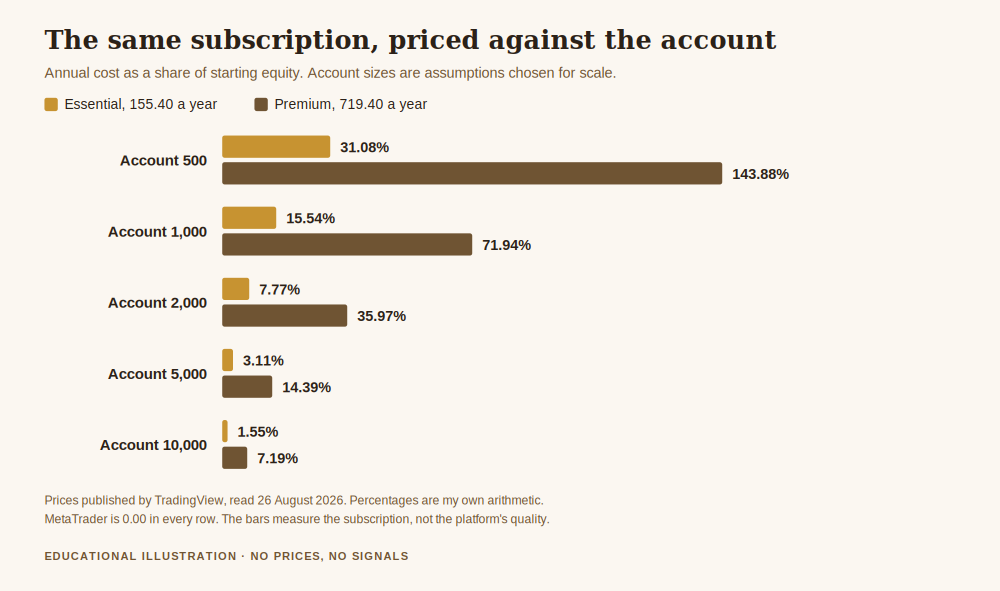
A fixed annual cost is a hurdle. Before your account has made a single unit of profit, it has to earn back the subscription just to stand still. Divide the annual cost by the account and you get that hurdle as a percentage. The account sizes below are assumptions I chose to show the shape, not recommendations about what anyone should fund.
- On a 500 account: Essential is a 31.08% hurdle, Premium is 143.88%.
- On a 1,000 account: Essential is 15.54%, Premium is 71.94%.
- On a 2,000 account: Essential is 7.77%, Premium is 35.97%.
- On a 5,000 account: Essential is 3.11%, Premium is 14.39%.
- On a 10,000 account: Essential is 1.55%, Premium is 7.19%.
- On a 25,000 account: Essential is 0.62%, Premium is 2.88%.
Read the Premium row twice. On a 1,000 account it asks for 71.94% of the account back before anything else happens. On a 25,000 account the identical product asks for 2.88%, which is a completely ordinary software line item for a small business. The tool did not change between those two rows. The account did.
Turn it around and each tier quietly names the account it was priced for. If you decide a tool should cost at most 2% of equity a year, which is a threshold I picked rather than a rule handed down from anywhere, then Essential fits an account of about 7,770, Plus about 17,970, Premium about 35,970, and Ultimate about 119,970. Nobody at TradingView is hiding this. It simply is not their question. It is yours.
Reading the indicator allowance backwards
The upgrade ladder is sold mostly in indicator slots, so it is worth pricing them. Going from Essential to Plus buys 5 more indicators per chart for 204.00 a year, which is 40.80 per slot per year. Plus to Premium buys 15 more for 360.00, which is 24.00 a slot. Premium to Ultimate buys 25 more for 1,680.00, which is 67.20 a slot.
The arithmetic is fine. The premise is what deserves a second look. An upgrade sold in indicator slots only pays for itself if the missing indicators were the reason for the losses, and on an account that is bleeding they essentially never are. I have never once reviewed a blown account and found that the problem was a fifth indicator the person could not afford. The problem was size, or it was a stop that was moved, or it was a trade taken out of boredom. None of those have a price on any pricing page. The same money spent on nothing at all, left sitting in the account, is a bigger and more honest upgrade. If you want the ranked version of what actually moves the needle, it is in risk management in gold trading and then how much to risk per trade.
So which one, then
Here is the honest answer, and it is duller than the comparison articles.
Use whatever your broker gives you, which is usually MetaTrader, and use TradingView’s free tier alongside it if you like the charts better, which many people do. Pay for a tier only when a specific limit is genuinely blocking work you are already doing well, and when the annual cost is a small share of your account rather than a meaningful share. If you cannot name the limit that is blocking you, the upgrade is not the thing you are buying, and the honest name for what you are buying is hope.
One more practical note, since it comes up every time. Charting in one place and executing in another means your chart and your fills come from two different data feeds, and they will not agree to the tick. That is normal and it is not a fault in either product, but it does mean your journal should record the broker’s numbers, not the chart’s. If you want your MetaTrader charts set up sensibly in the first place, we walked through it in how to add gold to MetaTrader 4, and the TradingView equivalent is in the best chart settings for TradingView.
Get the free Gold Empire survival sheet, a one-page guide to spending your money on the things that actually keep an account alive, starting with the ones that cost nothing. One email, no spam, unsubscribe anytime.
Frequently asked questions
In tradingview vs metatrader, can I trade directly from TradingView?
With some brokers, yes, through a connection you set up between the two. Whether it is available to you depends on your broker, not on your subscription tier, so check with them rather than with the pricing page. Note that this does not change who executes the order or on what terms. It changes which screen you clicked.
Is the free TradingView tier good enough?
For most people reading this, yes. It gives you one chart per tab and two indicators per chart, and if two indicators is genuinely the constraint on your trading then you are in a much better position than the average person who asks me this. Start there and let a real limitation, not a feeling, be what moves you up.
Does MetaTrader cost anything at all?
Not from MetaQuotes. The terminals are offered for download at no charge, and your broker supplies the account. What you pay in that arrangement is the spread, the commission and the swap on your trades, which is a real cost and is worth measuring from your own statement. It just is not a software cost.
Will better charts improve my results?
Better charts make you more comfortable, and comfort is worth something. But the things that decide whether an account survives are position size, the risk you take per trade, and whether you follow your own rules on a bad day. None of those live in the charting software. That is not a slogan, it is what the arithmetic above keeps pointing at.
Why do the two platforms show slightly different prices?
Because they are quoting different feeds, and on an over the counter market like spot gold there is no single official price that everyone must quote. Small differences are expected. If the differences are not small, that is a question for your broker and it belongs in the same conversation as how you evaluate a broker in the first place.
What Gold Empire actually does
Gold Empire is a free education channel for people trading gold, and the order in the name is deliberate: survive first, then grow. We publish the mechanics of this market, the ways accounts get destroyed, and the habits that keep people around long enough to get good at it. The free gold survival sheet is the one page version of that, and it costs nothing.
Everything here is free to read. There is an optional kit for people who want the material organised into a working system, and following along without ever buying it is a completely normal way to use this channel. We share our own results openly, and signals are part of what the channel offers, but we do not promise profits, because no honest channel can. If you want the next steps in order, start with risk management in gold trading, then how much to risk per trade.
About the author
Matthew writes the Gold Empire material. He spent his first two years upgrading things, the charts, the screens, the indicator packages, while the one number that was actually destroying the account went unexamined the entire time, and most of what he publishes now is the article he wishes somebody had handed him then. He reads every message in the group and answers the ones about risk first. You can read more about the Gold Empire approach here.
This article is educational content, not financial advice. The prices quoted are the vendors’ own published figures read on 26 August 2026 and can change without notice, and every percentage in it is my own arithmetic on stated assumptions about account sizes and cost thresholds, not a quote, a recommendation or a claim about anyone’s results. Gold Empire has no commercial relationship with TradingView or MetaQuotes. This article does not account for your personal circumstances, your tax position or your risk tolerance, and nothing in it is a recommendation to buy or sell any instrument or to open an account anywhere. Trading leveraged products carries a high risk of losing money rapidly, and no entry, stop or target discussed should be treated as a signal. Consider speaking to a licensed professional in your jurisdiction before making decisions about your money.
One step first
Where should we send the Gold Survival Sheet?
Leave your email and we will send the free one page checklist, then take you straight to the Telegram channel.
No cost and no obligation. Educational only, not financial advice, and nothing here promises a return. Unsubscribe any time in one click.
Leave a Reply