GOLD EMPIRESurvive First, Then Grow

Category: Survival & Risk

  • How to Avoid Stop Loss Hunting Forex Traders Blame on Brokers

    How to Avoid Stop Loss Hunting Forex Traders Blame on Brokers

    Almost every trader who asks me how to avoid stop loss hunting forex style has just watched the same thing happen. Price dipped a little below the obvious low, took them out, then turned around and went exactly where they thought it would. It feels personal. It feels like somebody looked at their order and reached for it.

    I want to give you the honest version, because the popular explanation is wrong in a way that leads people to do the one thing that makes the problem worse. Your broker is almost certainly not hunting your individual stop. But your stop was very probably sitting in the same obvious place as thousands of other stops, and that cluster is a real thing that real money moves toward. Those two statements are not in conflict, and the difference between them decides what you should actually do about it.

    So this is a mechanism first, then arithmetic. To be clear from the start: no entry, stop or target discussed should be treated as a signal.

    What a stop order actually is

    Start with the definition, because most of the confusion lives here.

    The US Commodity Futures Trading Commission defines it plainly in its official glossary: a stop order “becomes a market order when a particular price level is reached”, and “a sell stop is placed below the market, a buy stop is placed above the market”.

    Read that once more, slowly. Your stop is not a polite request to exit at your price. It is an instruction that converts into a market order the instant a level trades. It takes whatever price is available at that moment.

    Now think about what happens when several thousand traders have all placed sell stops just below the same visible low. That level is not a line on a chart any more. It is a pile of dormant market sell orders, all of which will fire at once the moment price touches it.

    This is the whole mechanism, and there is nothing shadowy in it. Price reaches an obvious level, a cluster of stops converts to market orders simultaneously, that burst of selling pushes price further and faster than the original move justified, and then, with the stops cleared out, price is free to go back to whatever it was doing. What you experienced as being hunted was your order being part of a crowd that moved the market by exiting together.

    Why the conspiracy version leads you astray

    The reason I labour this is not pedantry. The two explanations point at opposite solutions.

    If you believe a broker is picking off your specific order, the natural response is to hide it: use a mental stop, or set it much tighter so there is less to take. Both of those are seriously bad ideas, and I will show you why with numbers in a moment.

    If instead you understand that the problem is where your stop sits relative to everyone else’s, the response is completely different and much more useful. You stop placing stops in the obvious place, and you accept that the obvious place is obvious to everyone precisely because it is easy to see.

    There is a further point worth making for fairness. Genuine misconduct by regulated brokers does exist and regulators pursue it. But the everyday experience of “my stop got hit then price reversed” is almost always the crowd mechanism above, and treating ordinary market structure as a personal attack tends to produce angry trading rather than better trading.

    How to avoid stop loss hunting forex traders fall into: the arithmetic of stop width

    Here is the part that settles the argument, and it needs no view on gold and no assumption that anyone has an edge.

    Model the market as a driftless random walk. That is deliberately the fairest possible assumption: nobody is predicting anything, there is no trend, no manipulation, no skill on either side. For a position with a stop distance S and a target distance T, the probability that price touches the stop before the target is simply T divided by (S plus T).

    Fix the target at 10 dollars per ounce and vary the stop:
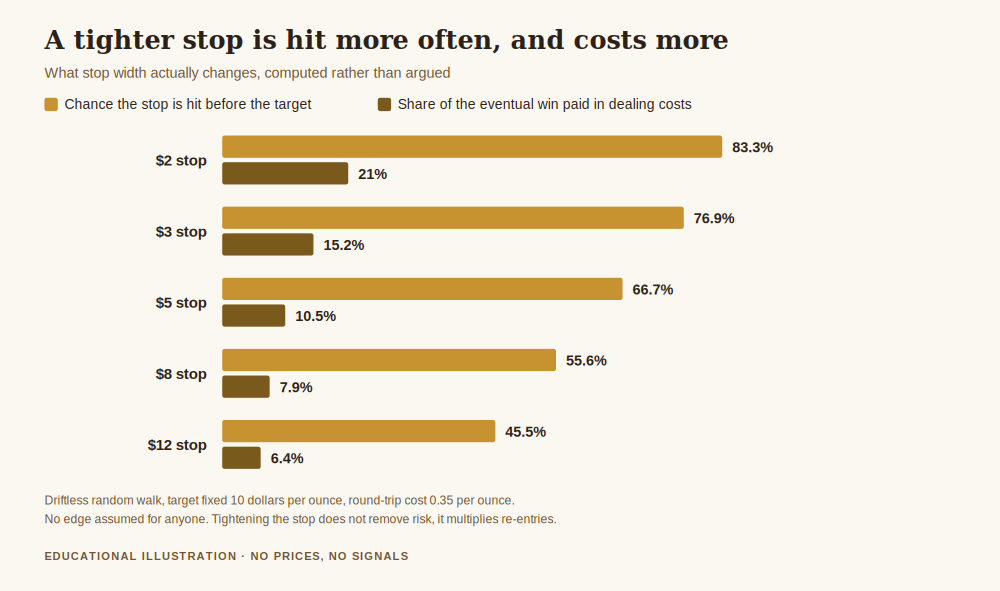
    Chart showing how to avoid stop loss hunting forex by stop width, a tighter stop is hit first far more often and pays more in dealing costs
    The arithmetic behind how to avoid stop loss hunting forex style: a 2 dollar stop is hit first 83.3 percent of the time, before anyone manipulates anything.
    • A $2 stop is hit first 83.3 percent of the time.
    • A $3 stop, 76.9 percent.
    • A $5 stop, 66.7 percent.
    • An $8 stop, 55.6 percent.
    • A $12 stop, 45.5 percent.

    Look at the top line again. Four times out of five, a tight stop is taken out before the target is reached, in a market where by construction nobody is hunting anyone. If your response to feeling hunted is to tighten up, you have just volunteered for that number.

    And it gets worse once dealing costs enter, because being stopped out means going again. At a round-trip cost of 35 cents per ounce, the number of entries needed before one target is reached, and the share of that eventual win consumed by costs, run like this:

    • $2 stop: 6.00 entries per win, costing 21.0 percent of the win.
    • $5 stop: 3.00 entries, costing 10.5 percent.
    • $8 stop: 2.25 entries, costing 7.9 percent.

    Tightening from an $8 stop to a $2 stop makes you enter 2.7 times as often for the same result. I computed all of this in Python from the assumptions stated above, and you can change the target, the cost or the model and watch the table move.

    The conclusion is uncomfortable but clean. In a fair market, no stop width is smarter than another in terms of expectancy before costs. What stop width genuinely changes is how frequently noise ends your trade, and therefore how much you pay in friction. Tight stops do not protect you from being hunted. They guarantee you are stopped more, and they hand more of your account to the spread.

    What actually reduces the problem

    Four things, in the order I would fix them.

    One: place the stop where your idea dies, not where your wallet is comfortable. A stop has one job, to tell you the reason for the trade is gone. If the level that would prove you wrong is 8 dollars away, then the trade risks 8 dollars, and the only remaining variable is how many ounces you buy. Deciding the stop from how much you want to lose is backwards, and it is the single most common cause of stops sitting in silly places. This is why position sizing is the lever, not stop distance.

    Two: stop using the most obvious level available. If you can see the swing low at a glance, so can everyone. Placing your stop a little beyond the level, rather than immediately against it, moves you out of the densest part of the cluster. It costs you a slightly wider stop, which the arithmetic above says is a good trade, and it means the burst of market orders can clear without taking you with it.

    Three: understand the level before you trade near it. The sweep you keep getting caught in has a name and a shape, and I have written about the mechanism separately in what a liquidity sweep in gold trading is and in why price moves toward where the crowd is losing. Neither of those will let you predict the sweep. Both will stop you being surprised by it.

    Four: never remove the stop. The mental stop is the worst answer to this problem. It replaces a defined, automatic loss with a decision you have to make while losing money, which is the moment you are least able to make it well. An account can survive being stopped out badly for years. It rarely survives one position held without a stop through a genuine move. The rules on where to place a stop loss on XAUUSD are worth settling while calm, in writing.

    One thing a stop cannot do for you

    Since we started with the CFTC definition, it is worth closing the loop on it.

    Because a stop becomes a market order, it does not guarantee your price. In a fast market, or across a weekend gap, the next available price can be well beyond your level, and you will be filled there. That is not your broker cheating. It is what a market order does when there is nothing to trade against at your price.

    The practical consequence is that your real worst case is wider than the number on your ticket. Any risk plan that treats the stop as a hard floor is slightly optimistic, which is another argument for sizing so that being wrong, and being wrong by more than expected, are both survivable. That is the entire logic of the risk management approach underneath everything else on this site.

    Free gold survival sheet

    Get the free Gold Empire survival sheet, a one-page guide to protecting your account through the kind of market this article describes. One email, no spam, unsubscribe anytime.

    Get the free survival sheet →

    Frequently asked questions

    Do brokers really hunt stop losses?

    Regulated brokers are not generally sitting there picking off individual retail orders, and the everyday version of this experience is explained by order clustering rather than misconduct. Stops gather at visible levels, they all convert to market orders at the same instant, and that burst moves price further than the original flow justified. Genuine misconduct exists and regulators pursue it, but it is a poor explanation for the ordinary case.

    Will a tighter stop protect me from stop hunting?

    It does the opposite. On a driftless random walk with a fixed 10 dollar target, a 2 dollar stop is hit first 83.3 percent of the time against 55.6 percent for an 8 dollar stop, and it requires 2.7 times as many entries per eventual win, paying 21 percent of that win in dealing costs rather than 7.9 percent.

    Should I use a mental stop instead so nobody can see it?

    No. A stop resting at the broker is not visible to the wider market in any useful sense, and replacing it with a decision you must make under pressure removes the one protection that works when you are least rational. The failure mode of a mental stop is the position you never closed.

    Where should I put my stop so it does not get swept?

    There is no placement that cannot be reached, and anybody promising one is selling something. What helps is choosing the level from where your reasoning is proven wrong rather than from your comfort, then sitting a little beyond the most obvious price rather than right against it, and adjusting the number of ounces so the wider stop still risks the percentage you intended.

    Does a stop loss guarantee I lose only that amount?

    No. A stop becomes a market order when the level trades, so in fast conditions or across a gap you can be filled materially worse than your level. Treat the stop as your intended loss rather than your maximum one, and size with that gap in mind.

    Where did these numbers come from?

    I calculated them in Python from a driftless random walk, where the probability of touching the stop before the target is the target distance divided by the sum of both distances. The assumptions are a 10 dollar target and a 35 cent round-trip cost per ounce, both stated so you can change them. The stop order definition is quoted from the CFTC glossary, linked above.

    Where this leaves you, and what we do about it

    The honest summary is that stop hunting is mostly a description of crowding, not of villainy, and the fix is to stop standing where the crowd stands. That is a placement and sizing decision made calmly before the trade, not a grievance to be processed after it. Once the arithmetic of stop width is in front of you, the instinct to tighten up after a bad exit stops looking like discipline and starts looking like what it is, which is paying more to be stopped more.

    Gold Empire is a free Telegram channel where we work through market context in public, including the days the read does not work out. There is no promise of profit, because there honestly cannot be one. What there is, is a group of people trying to stay in the game long enough for competence to start paying.

    If this was useful, the free Gold Survival Sheet is the natural next step. It is a one page checklist that puts the size, the cost and the ceiling in front of you before you enter, and it is free to download with nothing to join.

    About the author. Matthew writes the Gold Empire market notes. He spends most of his time on the unglamorous half of trading, position size, dealing costs and the arithmetic of recovery, on the view that surviving the first two years is what makes the rest of it possible.

    Disclaimer: This article is general educational content about how leveraged markets work. It is not financial advice and it is not a recommendation to buy or sell anything. Trading leveraged products carries a high risk of losing money rapidly. No entry, stop or target discussed should be treated as a signal. Figures attributed to external sources are linked so you can check them, and figures I have calculated are shown with the assumptions they rest on so you can change them.


  • How to Trade Gold With Small Account Balances: The Floor Nobody Mentions

    How to Trade Gold With Small Account Balances: The Floor Nobody Mentions

    Most of the questions I get about how to trade gold with small account balances assume the problem is strategy. People believe that a $200 account needs a sharper method than a $20,000 account, some tighter, cleverer way of reading the chart that makes up for the missing money. It does not. The percentages behave identically at every account size. What actually changes on a small balance is something far more boring and far more binding, and almost nobody mentions it, because it is arithmetic rather than analysis.

    The constraint is this: your broker will not let you trade a position small enough to obey your own risk rule. Below a certain balance, the smallest trade you are permitted to place already risks more of your account than you intended to risk. No amount of discipline fixes that, because the discipline is not the thing failing. The platform’s minimum order size is.

    This article works through that floor with numbers you can recalculate, then covers what leverage does and does not do for you, and finishes with the four honest options available when the floor binds. To be clear from the start: no entry, stop or target discussed should be treated as a signal.

    What a small balance actually changes

    Start by clearing away the thing that does not change.

    Percentage risk is scale free. Risking 1 percent of $500 and 1 percent of $50,000 are the same decision expressed in different currency amounts. A ten trade losing streak hurts an account by the same percentage either way. The recovery arithmetic is identical. In that sense a small account is not more dangerous, and anybody telling you that small accounts are inherently doomed is skipping a step.

    What does change is granularity. Gold is quoted per troy ounce, a convention you can see in the LBMA precious metal price data, and the standard contract most brokers build on is 100 troy ounces. The common minimum most retail platforms allow is one hundredth of that, usually written as 0.01 lots, which is one troy ounce. At one ounce, a one dollar move in the gold price is one dollar of profit or loss. That is the smallest unit of exposure the platform will sell you.

    So your risk per trade is not a dial you can turn continuously. It comes in steps, and on a small account the first step is already large relative to the balance.

    How to trade gold with small account balances starts with the minimum lot

    Here is the calculation that decides everything else, and it needs no forecast and no view on gold.

    Your risk on a trade is the size of your position multiplied by the distance to your stop. At the minimum size of one ounce, your position multiplier is fixed at one. So your risk in dollars simply equals your stop distance in dollars per ounce. A $5 stop risks $5. An $8 stop risks $8. There is no way to risk less, because there is no smaller position to take.

    Now express that as a percentage of different account balances.

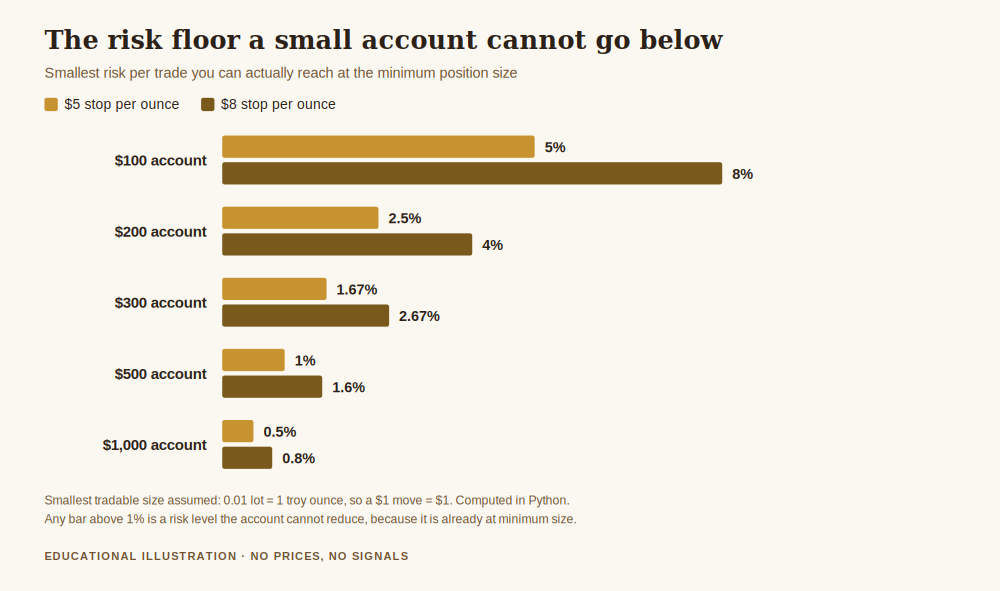
    Chart showing how to trade gold with small account balances, the minimum risk per trade a small account can reach at the smallest tradable position size
    The floor under how to trade gold with small account balances: at minimum position size, a $100 account risks 5 percent on a $5 stop and cannot go lower.

    A $100 account taking a $5 stop is risking 5 percent of everything it has, on the smallest trade the platform allows. Widen the stop to $8, which is not an unusual distance on gold, and that becomes 8 percent. A $200 account is at 2.5 percent and 4 percent respectively. Only at $500 does the $5 stop finally land on 1 percent.

    The general rule falls straight out of it. To keep risk at or under 1 percent per trade at minimum size, you need an account of at least one hundred times your stop distance in dollars per ounce:

    • A $3 stop needs about $300.
    • A $5 stop needs about $500.
    • An $8 stop needs about $800.
    • A $12 stop needs about $1,200.

    I calculated these in Python and the assumptions are all on the table: minimum size of 0.01 lots equals one troy ounce, one dollar of price movement equals one dollar per ounce, and no commission included. Change the minimum size your broker offers and the whole table shifts. That is the point. These are not laws of nature, they are the consequences of a contract specification, and you can look yours up in ten minutes.

    Notice what this does to the usual advice. “Risk one percent” is excellent guidance that quietly assumes you are able to. Under roughly $500, with a normal gold stop, you are not able to. The advice does not become wrong, it becomes unreachable, and the gap between the two is where a lot of small accounts quietly die while their owners believe they are following the rules.

    Leverage is not the lever you think it is

    The instinctive response to a small balance is to reach for more leverage, and this is worth being precise about, because the reasoning behind it is usually backwards.

    Leverage determines how much margin the broker sets aside to hold your position. It does not determine how much you lose when price moves against you. Your loss is decided by position size and stop distance, both of which you chose before leverage entered the conversation. Two traders with identical positions and identical stops lose identical amounts whether one is at 20:1 and the other at 500:1. The higher leverage account simply had more of its balance left free while the trade was open. I have written about this at more length in what leverage in gold trading actually is, because it is the single most misunderstood number on the platform.

    What leverage genuinely changes is how much rope you have to hang yourself with. It raises the ceiling on the size you are permitted to take, and on a small account the temptation to use that ceiling is strongest, because it is the only apparent route to a meaningful return.

    Regulators reached the same conclusion from the other direction. When the European Securities and Markets Authority reviewed retail trading in leveraged products, it capped retail leverage on gold at 20:1 and paired it with two structural protections: a margin close out rule that forces positions shut when account equity falls to 50 percent of the minimum required margin, and negative balance protection so a retail client cannot end up owing the broker money.

    Read that margin close out rule carefully if you hold a small account, because it is the mechanism that will actually end you. You do not get to ride a position all the way to zero and hope. The system intervenes at a threshold, and on a small balance with a large position, the distance to that threshold is short. The protection is real and I am glad it exists, but its existence tells you what regulators expected to happen often enough to legislate for.

    The survival arithmetic under a forced risk level

    Once you know the risk percentage the floor forces on you, you can work out how much room for error you have bought. I ran the same simple loop for three balances, all at a $5 stop and minimum size, counting how many consecutive full stop losses it takes to cut the account in half:

    • A $200 account is forced to 2.5 percent per trade, and loses half its balance after 20 straight losses.
    • A $500 account reaches 1 percent, and needs 50 straight losses.
    • A $1,000 account reaches 0.5 percent, and needs 100.

    Twenty consecutive losses sounds impossible until you remember that a beginner changing method every week is effectively taking random trades, and that a run of twenty is not remotely rare across a few hundred attempts. The $500 account is not twice as safe as the $200 one. In terms of how many mistakes it can absorb while you are still learning, it is two and a half times as safe, and that ratio compounds with every extra dollar of funding until the minimum lot stops binding at all.

    This is also why I keep pointing people at position sizing for gold before anything else, and why risk management sits underneath every other article on this site. Size is the only input in the whole chain that you control completely and that the market cannot argue with.

    The four honest options when the floor binds

    If the arithmetic above says your balance cannot support a sane risk level, you have four real choices. I am going to be blunt about the trade-offs in each, because the usual answer is to pretend the problem does not exist.

    One: fund the account to where the rule becomes reachable. Multiply your realistic stop distance by 100 and that is your target balance. This is the cleanest fix and often the least popular, because it means waiting. If the difference is a few hundred dollars, waiting two months is a genuinely better trade than any setup you will take this week. It is worth reading how much money you actually need to start trading gold alongside this, since the two questions are the same question asked from opposite ends.

    Two: find a broker that offers a smaller minimum. Some platforms allow 0.001 lots, a tenth of an ounce, which drops the floor by a factor of ten and makes a $100 account workable on paper. Check this before you deposit rather than after, and check it against the same broker’s other terms, because a tiny minimum size attached to a wide spread or an unregulated entity is not a bargain. The process for vetting that is in how to open a gold trading account.

    Three: trade a shorter stop distance, with your eyes open. Halving your stop halves your dollar risk at fixed size, which does move the floor. But a stop is not a free parameter. It should sit where your idea is proven wrong, and moving it closer to entry for accounting reasons means you will be stopped out of trades that were working. You are trading one problem for another, and the second one is harder to see because it shows up as a series of small losses rather than one large one.

    Four: accept a higher risk percentage deliberately, and cap the damage elsewhere. If you decide a $200 account will risk 2.5 percent per trade because that is the floor, then the compensating control has to be frequency and a hard stop on the month. Deciding in advance that four losses in a row ends your week is a real constraint, and it is the only one available once size is maxed out at the minimum. What makes this option survivable is that you set it while calm, in writing, before the first trade.

    What I would not do is the fifth option nobody lists, which is to take the forced 5 percent risk and simply not think about it. That is how a small account becomes a story about how trading does not work.

    The costs that do hit a small account harder

    One correction to a common belief, since I want this to be accurate rather than just reassuring.

    Dealing costs scale with position size, so the spread you pay is the same percentage of your account whether you trade one ounce or one hundred. Frequency multiplies it identically at every balance. On that dimension, small accounts are not penalised.

    Fixed fees are the exception, and they are brutal on small balances precisely because they do not scale. An inactivity fee, a withdrawal charge, or a fixed minimum commission per ticket is a rounding error on $20,000 and a serious tax on $200. A $10 monthly inactivity fee is 5 percent of a $200 account per month, which is more than most traders make in a good month. Read the fee schedule, and look specifically for the charges quoted in currency rather than percentages. Those are the ones aimed at you.

    Free gold survival sheet

    Get the free Gold Empire survival sheet, a one-page guide to protecting your account through the kind of market this article describes. One email, no spam, unsubscribe anytime.

    Get the free survival sheet →

    Frequently asked questions

    What is the minimum realistic balance for trading gold?

    It depends entirely on your stop distance and your broker’s minimum position size, not on a round number somebody quotes. With a standard 0.01 lot minimum and a $5 stop, roughly $500 is where a 1 percent risk rule becomes reachable. With a broker offering 0.001 lots the same rule works from about $50. Work out your own figure by multiplying your typical stop distance in dollars by 100.

    Can I just use higher leverage to trade gold with a small account?

    Higher leverage does not reduce your loss on a losing trade, it only frees up margin while the position is open. Your loss is position size multiplied by stop distance, and leverage appears nowhere in that calculation. What higher leverage does is permit larger positions, which on a small account is the fastest available route to a serious loss.

    Does a small account need a different strategy?

    No. The percentage arithmetic is identical at every balance. What a small account needs is an honest check that its risk rule is actually achievable at the minimum position size, and a deliberate decision about what to do if it is not.

    Is it better to demo trade until I can fund properly?

    Demo is genuinely useful for learning the platform mechanics, order types and your own process, and it costs nothing. What it cannot teach is how you behave when the money is real, which is a substantial part of the skill. A reasonable compromise is to demo the mechanics while funding the account properly, then start live at the size the arithmetic supports.

    What happens if my small account runs out of margin?

    Under the European rules, positions are closed automatically once account equity reaches 50 percent of the minimum required margin, and negative balance protection means a retail client cannot be left owing the broker. Rules differ by jurisdiction, so check what applies to the entity you actually signed with rather than assuming.

    Do these numbers change if gold is expensive or cheap?

    The risk arithmetic in this article does not depend on the gold price at all, because it works from the stop distance in dollars per ounce rather than from a price level. What the gold price does affect is the margin required to hold a position, since margin is a percentage of notional value. That changes how many positions you can hold at once, not how much you lose on any one of them.

    Where this leaves you, and what we do about it

    The honest summary is that a small account is not a strategy problem, it is a resolution problem. Your risk rule is continuous and your position sizes are not, and below a certain balance those two facts collide in a way no amount of chart reading resolves. Once you can see the floor, the decision in front of you is a funding and broker decision made while calm, not a trading decision made at the screen.

    Gold Empire is a free Telegram channel where we work through market context in public, including the days the read does not work out. There is no promise of profit, because there honestly cannot be one. What there is, is a group of people trying to stay in the game long enough for competence to start paying.

    If this was useful, the free Gold Survival Sheet is the natural next step. It is a one page checklist that puts the size, the cost and the ceiling in front of you before you enter, and it is free to download with nothing to join.

    About the author. Matthew writes the Gold Empire market notes. He spends most of his time on the unglamorous half of trading, position size, dealing costs and the arithmetic of recovery, on the view that surviving the first two years is what makes the rest of it possible.

    Disclaimer: This article is general educational content about how leveraged markets work. It is not financial advice and it is not a recommendation to buy or sell anything. Trading leveraged products carries a high risk of losing money rapidly. No entry, stop or target discussed should be treated as a signal. Figures attributed to external sources are linked so you can check them, and figures I have calculated are shown with the assumptions they rest on so you can change them.


  • How to Avoid Losing Money in Forex Trading: The Arithmetic Nobody Shows You

    How to Avoid Losing Money in Forex Trading: The Arithmetic Nobody Shows You

    Almost everyone who asks me how to avoid losing money in forex trading is really asking a different question. They want to know which setup wins, which session is safest, which indicator finally makes the chart make sense. I understand the instinct. But the traders I have watched survive their first two years did not get there by finding a better signal. They got there by fixing a handful of things that can be measured with a calculator, before the market ever entered the picture.

    So this article is not a strategy. It is arithmetic. I want to show you where retail money actually goes, why a loss costs more than it appears to, and which of the leaks are inside your control. Some of it is uncomfortable. All of it is checkable, and I have shown my working throughout so you can rerun the numbers yourself and disagree with my assumptions.

    To be clear from the start: no entry, stop or target discussed should be treated as a signal.

    The base rate almost nobody quotes you

    Start with the number that frames everything else.

    When European regulators reviewed retail trading in leveraged products, they did not rely on anecdote. National regulators across the member states analysed real client accounts, and the European Securities and Markets Authority published what they found: 74 to 89 percent of retail accounts typically lose money, with average losses per client ranging from 1,600 to 29,000 euros.

    Read that range again, because the width of it matters more than the headline. It is not a single figure from a single broker. It is a band drawn across different countries, different firms and different market conditions, and the floor of that band is 74 percent. Even in the friendliest jurisdiction studied, roughly three accounts in four ended up down.

    I do not quote this to frighten anyone away. I quote it because it changes what a sensible goal looks like. If the base rate is that harsh, then the first job is not to make money faster than everyone else. The first job is to not be in the losing group, and those are genuinely different objectives that pull you toward different behaviour.

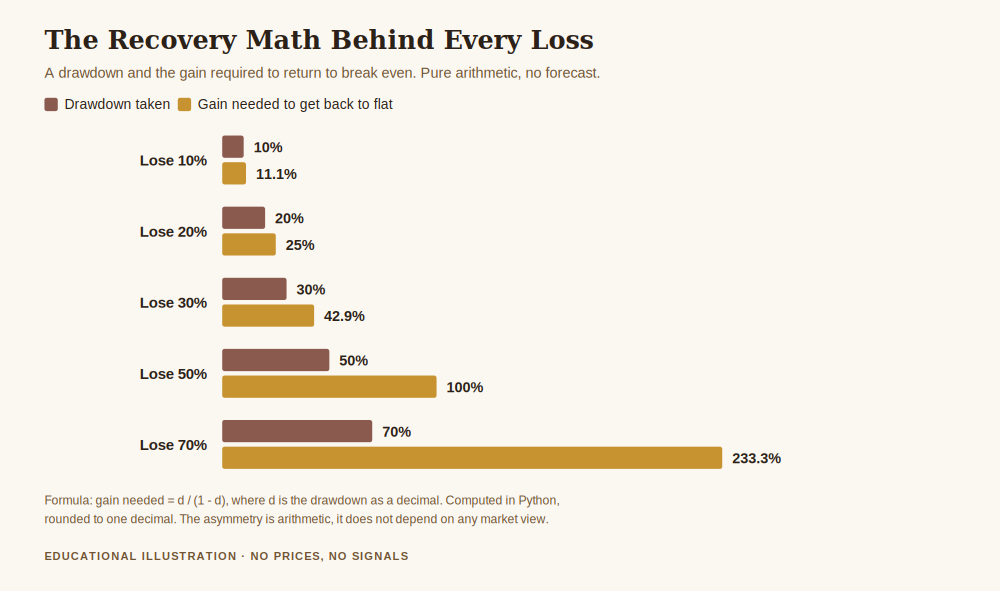
    How to avoid losing money in forex trading, the recovery math showing a 30 percent loss needs a 42.9 percent gain
    The recovery arithmetic behind how to avoid losing money in forex trading: every drawdown demands a larger gain to undo it.

    How to avoid losing money in forex trading starts with the recovery math

    Here is the piece of arithmetic I wish someone had put in front of me on day one.

    A loss and the gain that reverses it are not the same size. If you lose 20 percent of an account, you do not need 20 percent to get back to where you started, because you are now earning that percentage on a smaller balance. You need 25 percent. The formula is simple: the gain required equals d divided by (1 minus d), where d is the drawdown expressed as a decimal.

    Run it across the range and the curve gets ugly quickly:

    • Lose 10 percent, you need 11.1 percent to get back to flat.
    • Lose 20 percent, you need 25 percent.
    • Lose 30 percent, you need 42.9 percent.
    • Lose 50 percent, you need 100 percent. You have to double what is left.
    • Lose 70 percent, you need 233.3 percent.

    I computed these in Python and rounded to one decimal place. There is no forecast in them and no assumption about gold, the dollar or anything else. It is the same arithmetic whether you trade metals, currencies or nothing at all.

    What this tells you is that damage is not linear, so caution should not be linear either. The cost of a bad month is not the money, it is the months of competent trading you now have to spend undoing it. A trader down 50 percent is not halfway to recovery. They are facing a task most people never complete, which is why the account that reaches 50 percent down so rarely comes back.

    The practical consequence is that the whole game is played in the shallow end of that table. Keeping your worst stretch inside 10 or 15 percent is not timidity. It is the thing that keeps recovery a routine matter rather than a heroic one. That is the reasoning behind the risk management guide that sits underneath everything else on this site, and it is why how much to risk per trade is the first number worth settling.

    The leak you can measure before you place a trade

    The second thing that quietly drains accounts is not a bad call. It is the cost of doing business, multiplied by how often you do it.

    Every trade crosses the spread, which means you begin every position slightly behind. That is not a scandal, it is how dealing works, and I explain the mechanism in more detail in what the spread in gold trading actually costs you. What surprises people is the size of it once you multiply by frequency.

    Let me do it with numbers you can change. Assume an account of 5,000 dollars, risking 1 percent per trade, which is 50 dollars. Assume a stop distance of 5 dollars in gold, which puts the position at 10 ounces. Assume a dealing spread of 30 cents. Those are my assumptions, not measurements, and your broker and your stop distance will move them.

    On those numbers, the spread costs 3 dollars per round trip. That is 6 percent of the money you put at risk, gone before the market has done anything at all. Now multiply by frequency across a year:

    • 1 trade a week, 52 a year: 156 dollars, or 3.1 percent of the account.
    • 2 trades a week: 312 dollars, or 6.2 percent.
    • 4 trades a week: 624 dollars, or 12.5 percent.
    • 10 trades a week: 1,560 dollars, or 31.2 percent.
    • 20 trades a week: 3,120 dollars, or 62.4 percent.

    The trader taking twenty trades a week has to be right enough to overcome a headwind of more than 60 percent of their capital per year, purely in dealing costs. They usually describe their problem as a strategy problem. It is an arithmetic problem, and no strategy fixes it, because the cost is charged on activity rather than on accuracy.

    This is the most encouraging finding in the whole article, because frequency is entirely yours to set. You do not need a better forecast to cut that number. You need fewer, more deliberate trades, and the saving is guaranteed rather than hoped for. It is also why who you trade through is a decision worth taking seriously rather than settling in five minutes.

    The loss that is not a market loss at all

    There is a category of losing money that has nothing to do with trading, and it is larger than most people imagine.

    The FBI’s Internet Crime Complaint Center publishes an annual report of what the American public actually reports losing. In its 2024 Internet Crime Report, total reported losses came to 16.6 billion dollars across 859,532 complaints. The single largest crime type by loss was not ransomware, not romance fraud, not tech support scams. It was investment fraud, at 6,570,639,864 dollars.

    Investment fraud alone accounted for close to 40 percent of every dollar reported lost to internet crime that year. And the shape of it is familiar to anyone who has spent time in trading communities: a mentor with screenshots, a managed account promising a monthly return, a signal group where the wins are posted and the losses are not, a platform where deposits work smoothly and withdrawals develop problems.

    I raise it because someone asking how to avoid losing money in forex trading is often, statistically, one bad decision away from a loss that no amount of risk management touches. Position sizing does not protect you from handing your capital to someone who has no intention of giving it back. Two habits do most of the work: never send money to an individual, and treat any promised return as disqualifying rather than attractive. A real market cannot promise a number, so anyone who does is telling you they are not operating in one.

    What actually moves the odds

    Put the three sections together and you get a short list that does not require you to predict anything.

    Keep the worst stretch shallow, because the recovery curve is unforgiving and the cost of a deep drawdown is measured in months rather than money. Trade less often than feels natural, because the cost of activity compounds against you whether you are right or wrong. Refuse anything that promises a return, because the largest single category of reported loss is not the market at all.

    None of that is a strategy, and that is the point. It is the floor a strategy stands on. Traders who skip the floor spend their first years discovering these numbers the expensive way, one account at a time, usually concluding that they need a better system when what they needed was a smaller size and a slower week. I have written elsewhere about the loop that keeps repeating when the floor is missing, and it is remarkably consistent from trader to trader.

    The uncomfortable part is that none of this is fast. The arithmetic rewards patience and punishes urgency, and urgency is exactly what most people bring to a new account. If you are opening one, how to open a gold trading account walks through the practical setup, but the numbers above matter more than any of those choices.

    A quick word before the questions

    If this is the kind of explanation you find useful, the Gold Empire Telegram channel is where I post market context through the week, in plain language and without pretending anyone knows what happens next. The free Gold Survival Sheet is a one page checklist built around exactly these numbers, so the arithmetic is in front of you before you size a position rather than after.

    Free gold survival sheet

    Get the free Gold Empire survival sheet, a one-page guide to protecting your account through the kind of market this article describes. One email, no spam, unsubscribe anytime.

    Get the free survival sheet →

    Frequently asked questions

    Is it actually possible to avoid losing money in forex trading?

    Not entirely, and anyone telling you otherwise is selling something. Losses are a normal operating cost of the activity. What is realistic is avoiding the losses that are structural rather than market driven: oversized positions, excessive frequency, and outright fraud. Those three are where most of the damage lives, and all three are inside your control.

    Why do most retail traders lose money?

    Regulators looking at real accounts found 74 to 89 percent of retail accounts losing. The common threads are leverage used to take size the account cannot absorb, trading frequency that multiplies dealing costs, and a recovery curve that turns a moderate drawdown into a problem that outlasts the trader’s patience.

    Does trading more often improve my chances?

    It reliably increases your costs and it does not reliably increase your edge. On the assumptions above, moving from one trade a week to ten multiplies the annual spread bill from about 3 percent of the account to more than 31 percent. That is a headwind you have to beat before you profit at all.

    How big a drawdown is too big?

    There is no universal figure, but the arithmetic gets punishing fast beyond 20 percent, where you already need 25 percent to recover. Past 50 percent you need to double what is left. Most traders find that setting a ceiling in advance, while calm, is the only version of this decision they can actually keep.

    How can I tell if a signal service or mentor is a scam?

    The clearest tell is a promised return, because no honest participant in a market can promise one. After that: pressure to deposit quickly, payments to an individual rather than a regulated firm, withdrawals that develop friction, and a public record that shows wins but not losses. Investment fraud was the largest single category of reported internet crime loss in 2024, so the base rate justifies the suspicion.

    Do I need a bigger account to be safe?

    A bigger account does not change the percentages, it only changes the currency amounts. What a bigger account does buy is the ability to take a sensible percentage risk while still trading a position size the platform supports. The percentages in this article behave identically at any account size.

    Where this leaves you, and what we do about it

    The honest summary is that avoiding losses is mostly a bookkeeping discipline dressed up as a market skill. The recovery curve, the cost of frequency and the base rate of fraud are all knowable in advance, and none of them require an opinion about where gold goes next. Getting them right will not make you money on its own. Getting them wrong will reliably take money from you regardless of how good your analysis is.

    Gold Empire is a free Telegram channel where we work through market context together, in public, including the days the read does not work out. There is no promise of profit here, because there cannot honestly be one. What there is, is a group of people trying to stay in the game long enough for competence to matter.

    If this was useful, the free Gold Survival Sheet is the natural next step. It is a one page checklist covering the size, the cost and the ceiling before you enter, and it is free to download with nothing to join.

    About the author. Matthew writes the Gold Empire market notes. He spends most of his time on the unglamorous half of trading, position size, dealing costs and the arithmetic of recovery, on the view that surviving the first two years is what makes the rest of it possible.

    Disclaimer: This article is general educational content about how leveraged markets work. It is not financial advice and it is not a recommendation to buy or sell anything. Trading leveraged products carries a high risk of losing money rapidly. No entry, stop or target discussed should be treated as a signal. Figures attributed to external sources are linked so you can check them, and figures I have calculated are shown with the assumptions they rest on so you can change them.


  • What a Break-Even Stop Really Protects, and What It Costs

    What a Break-Even Stop Really Protects, and What It Costs

    When a trade moves your way, there is a moment where the sensible thing seems obvious: pull the stop up to your entry price so the trade can no longer lose. That move has a name. It is a break-even stop, and you will see it announced in every trading room on earth, usually with a phrase like “capital is now protected”.

    We say something close to that ourselves when a position earns it. I want to spend this article being precise about what that phrase means, because it is roughly true, it is not exactly true, and the difference between roughly and exactly is where people quietly lose expectancy for years without noticing.

    This is not an argument against moving your stop. It is an argument against believing the move is free.

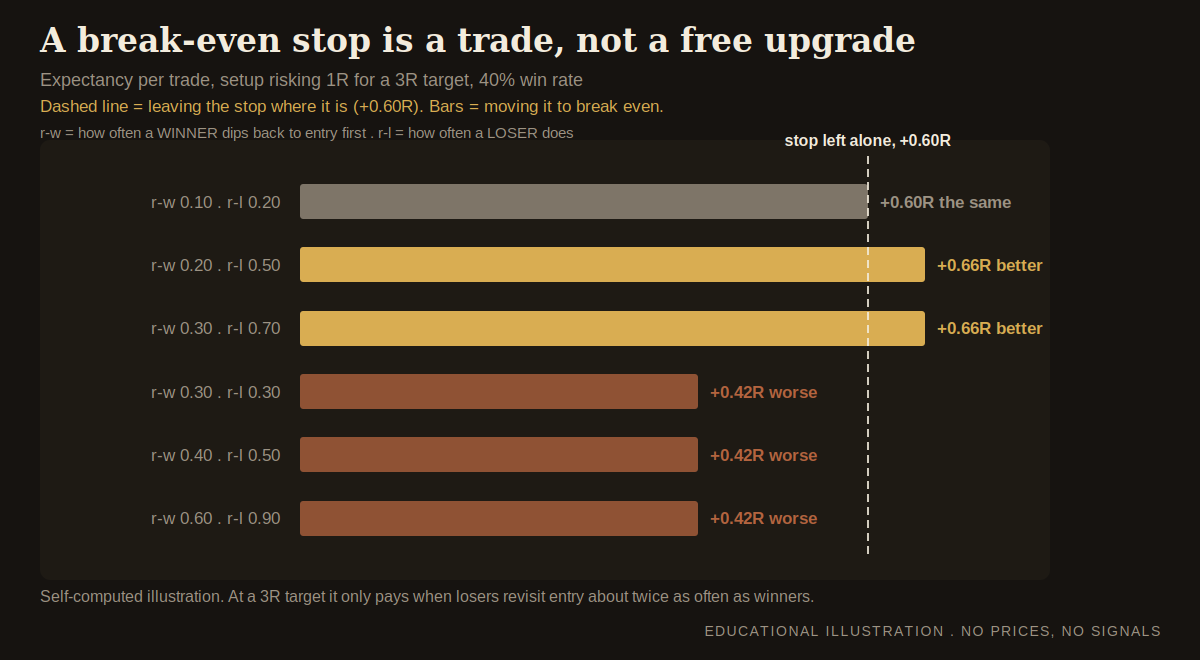
    Chart showing when a break-even stop improves expectancy and when it reduces it
    A break-even stop changes your expectancy in both directions. Which way depends on your setup.

    What a break-even stop actually is

    You enter a trade with a stop below your entry, risking some fixed amount. Price moves in your favour. You then move the stop up to the price you entered at. From that point, if price comes back to where you started, you exit with nothing gained and nothing lost, minus costs.

    The appeal is emotional and immediate. The trade can no longer hurt you. You stop watching it with your stomach. For a lot of people this is the single most calming action available in trading, and I am not going to pretend that has no value, because managing your own state is part of the job.

    But notice what has actually happened. You have not removed risk from the trade. You have exchanged one risk for another. The risk of losing 1R has been swapped for the risk of being taken out of a trade that was going to work.

    Why “zero risk” is not quite right

    Two things stop a break-even stop from being the guarantee it sounds like.

    The first is mechanical. A stop is an instruction to leave at the market once your price is touched. It is not a promise about the price you will get. In a thin or fast market, price can pass through your level and fill you somewhere worse. That is not a rare edge case, it is normal behaviour around scheduled news and at the edges of the trading day.

    The second is the weekend and the gap. If the market closes and reopens somewhere else entirely, your stop was not sitting there defending anything, because there was no market for it to act in. I went through this in detail in the piece on weekend gaps in gold trading, and it is the cleanest proof that a stop level is an instruction rather than a shield.

    Regulators have effectively conceded this point. When European authorities intervened in leveraged retail products in 2018, one of the measures they introduced was to ensure that investors cannot lose more money than they put in. That protection had to be legislated. If stop orders reliably capped losses at the level people set them, there would have been nothing to legislate.

    So “capital is now protected” is a fair shorthand for “most of the downside on this position has been removed”. It is not the same as “zero downside risk”, and the honest version is worth saying out loud.

    The part almost nobody calculates

    Now the more interesting question, and the reason I wanted to write this. Set aside slippage and gaps entirely. Assume the break-even stop works perfectly and takes you out at exactly your entry. Is it still a good idea?

    The answer is that it depends, and it depends on something you can measure rather than something you can feel. Here is the arithmetic, with every assumption stated so you can disagree with it.

    Take a setup that risks 1R and targets 3R, and assume it reaches that target 40 percent of the time. Left alone, the expectancy is 0.40 times 3, minus 0.60 times 1, which is plus 0.60R per trade.

    Now introduce the break-even stop. Two numbers decide everything:

    • How often a trade that would have won dips back to your entry first, and gets scratched at zero. Call it the winner pull-back rate.
    • How often a trade that would have lost comes back to your entry before hitting its original stop, and gets scratched at zero instead of costing you 1R. Call it the loser pull-back rate.

    The first number costs you 3R every time it happens. The second saves you 1R every time it happens. That asymmetry is the whole story, and it is why the answer is not obvious.

    Run the numbers and a clean condition falls out. On this setup, a break-even stop only improves your expectancy if your losers come back to entry at least twice as often as your winners do. If losers revisit entry 50 percent of the time and winners only 20 percent, expectancy improves from 0.60R to 0.66R. If both revisit entry 30 percent of the time, expectancy falls from 0.60R to 0.42R, a drop of about a third, for a change that felt like pure prudence.

    The general form is worth keeping. The ratio you need is your reward multiple times your win rate, divided by your loss multiple times your loss rate. The bigger your target, the more the break-even stop has to earn its place, because every winner it scratches costs you more.

    What that means in practice

    The useful conclusion is not “never move your stop” and it is not “always move it”. It is that the right answer is a property of your setup, not a rule you can borrow.

    Nobody can tell you from the outside whether your losers revisit entry more often than your winners. It depends on how you choose entries, how much room you give them, and what kind of market you trade in. It is knowable, but only from your own records.

    Which means the honest instruction is boring: go and look. If you keep a journal, you already have the raw material. For your last several dozen trades, mark whether price came back to your entry after moving in your favour, and whether that trade eventually worked or not. Two columns. If losers come back far more often than winners, the break-even stop is earning its keep. If both come back at similar rates, you are paying for comfort.

    This is the same principle behind everything in the risk management guide. Rules that sound universal are usually rules somebody derived from their own data and then presented as law.

    The reason people move to break even anyway

    I want to be fair to the practice, because there is a real argument for it even when the arithmetic is unfavourable.

    A trader who moves to break even and then sits calmly is a different trader from one who watches an open position with real money at stake and interferes with it. If the break-even stop costs you 0.18R of expectancy but prevents one panicked exit a month, it may still be the better choice for you as an operator. Expectancy on paper assumes you execute perfectly. You do not, and neither do I.

    That is a legitimate reason. Notice it is a completely different reason from “this removes risk”. One is an honest trade of expectancy for consistency. The other is a misunderstanding. Make the trade knowingly, and you are managing yourself well. Make it because you think it is free, and you are slowly paying for something you were never told the price of.

    There is also a middle path a lot of experienced traders end up on: move the stop to reduce risk rather than eliminate it, so a pull-back costs you a fraction of the original amount instead of scratching you at exactly zero. It keeps some of the protection without sitting your stop at the single most likely place for price to touch on its way up. I am describing what people do, not telling you to do it.

    Where this sits with the rest of trade management

    Moving a stop is one decision inside the larger job of running a position after you are in it, which I covered more broadly in how to manage a gold trade after you enter. And where you put the stop in the first place, before any of this comes up, matters more than any adjustment you make later. That is the subject of where to place a stop loss on XAUUSD.

    If your original stop is in a bad place, moving it to break even does not fix that. It just gives you a different way to be taken out.

    A quick word before the questions

    If this is the kind of thinking you find useful, the Gold Empire Telegram channel is where I post market context through the week, free, with no upsell. And the free Gold Survival Sheet is a one page checklist covering sizing and stop placement, which is the layer underneath everything in this article.

    Free gold survival sheet

    Get the free Gold Empire survival sheet, a one-page guide to protecting your account through the kind of market this article describes. One email, no spam, unsubscribe anytime.

    Get the free survival sheet →

    Frequently asked questions

    When should I move my stop to break even?

    There is no honest universal answer, and that is the point of this article. It depends on whether your losing trades return to your entry more often than your winning ones do, which is measurable in your own journal and different for every method. Anyone who gives you a confident number for this without seeing your records is guessing.

    Does a break-even stop really mean zero risk?

    No. It removes most of the downside on that position, which is worth having, but a stop is an instruction to exit at the market rather than a guaranteed price, and a closed market can reopen past your level. “Most of the risk is gone” is accurate. “No risk” is not.

    Why would moving to break even ever hurt me?

    Because your entry price is a level price often revisits on its way to your target. Every time it does, you are taken out of a trade that would have paid. If your target is three times your risk, each of those costs three times what a saved loser gains you.

    Is it better to move the stop partway instead?

    Some traders do exactly that, reducing risk without sitting at the most crowded price. It keeps part of the protection and scratches fewer good trades. Whether it suits you depends on your setup and on how you behave with an open position, so treat it as an option to test rather than an upgrade to adopt.

    Does this apply to trailing stops as well?

    The same logic applies with more force. A trail is a repeated version of the same decision, so it exits more winners early in exchange for locking in more of the moves that keep running. Whether that is a good exchange depends on how your particular market moves, which again comes back to your own records.

    What about the emotional benefit, does that count?

    Yes, genuinely. If moving to break even stops you interfering with trades, that is worth real expectancy, because a plan you actually follow beats a better plan you abandon. Just be clear with yourself that you are buying calm with expectancy, rather than getting something for nothing.

    Where this leaves you, and what we do about it

    The break-even stop is a good example of how trading advice goes wrong. Nobody is lying when they say capital is protected. It is a reasonable shorthand, said in good faith, and mostly accurate. But it hardens into a belief that the move is free, and once something feels free, nobody measures it.

    Almost everything that costs traders money over a career looks like this. Not a dramatic mistake, just a small unexamined assumption applied several hundred times.

    Gold Empire is a free Telegram channel where we work through market mechanics in public. There is no promise of profit here and there never will be, because nobody can honestly make one. What we can do is take the phrases everyone repeats and check whether they survive arithmetic.

    If this was useful, the free Gold Survival Sheet is the natural next step. It is a one page checklist covering position size, stop placement and the questions worth asking before you touch a live position. It costs nothing and it does not require you to trade anything.

    About the author. Matthew writes the Gold Empire market notes and has spent his time in this market mostly learning what not to do. He is not a licensed adviser and does not want to be one. His interest is in the part of trading nobody posts screenshots of: staying in the game long enough for a method to matter.

    Disclaimer: This article is general educational content about trade management mechanics. It is not financial advice, not a recommendation, and not a solicitation to trade. The expectancy figures are illustrations computed from stated assumptions, not measurements of any real strategy or account. Trading leveraged products carries a high risk of losing money rapidly. No entry, stop or target discussed should be treated as a signal. Past market behaviour does not predict future behaviour. Consider your own circumstances and seek independent regulated advice if you need it.


  • How to Manage a Gold Trade After You Enter

    How to Manage a Gold Trade After You Enter

    Ask most new traders what makes or breaks a trade and they will point to one thing: the entry. Where you get in. They hunt for the perfect signal, the magic level, the exact moment to click buy or sell, as if everything is decided in that single instant. Then they get a good entry, watch it move nicely into profit, and give it all back anyway, because nobody ever taught them the harder half of the job: what you do after you are in.

    Here is a truth it took me a long time to accept. Your entry is one decision. Managing the trade is a hundred small ones, and they matter more. A mediocre entry managed well often ends better than a brilliant entry managed badly. So let me walk you through how to think about a gold trade once it is live, the plain, unglamorous mechanics that decide whether a good start turns into a kept result.

    One thing before we start, and I mean it. Everything below is educational, a way of thinking, not a set of instructions and never a signal. There are no prices, no entries, no targets here for a reason. How you manage a trade must come from your own written plan and your own risk rules, not from me.

    The entry is the start, not the jobWhat you do after you are in decides the resultENTRY (already done)One decision, taken by plan1 · PROTECTMove the stoptoward breakevenas it moves your way2 · BANK SOMETake partial profitat a point youplanned in advance3 · LET IT WORKHold the rest toyour planned target,no fiddling4 · EXIT BY RULEClose by your plan,not by fearor greed→→→A good entry managed badly still loses. Manage first, protect first.Decide these steps before you enter, so emotion has nothing to doEDUCATIONAL ILLUSTRATION, NO PRICES, NO SIGNALS
    How to manage a gold trade after you enter: protect, bank some, let it work, exit by rule, all decided in advance.

    Why the Entry Gets All the Attention (and Why That’s a Trap)

    The entry is seductive because it feels like the moment of skill. It is a single, clean click, and the whole internet sells it to you, “the perfect setup,” “the exact entry.” But think about what actually happens to your money. At the instant you enter, your profit is zero. Everything you will make or lose happens after that, in the minutes and hours you hold the position. That is the part almost nobody trains for.

    I have watched countless traders, and been one of them, nail a lovely entry, feel like a genius for twenty minutes, and then hand the whole thing back because they had no plan for the middle of the trade. They moved their stop the wrong way to avoid being stopped out. They took profit far too early out of fear, or held a winner until it turned into a loser out of greed. The entry was never the problem. The management was.

    A perfect entry with no management plan is just a lucky start waiting to be wasted. The trade is won or lost after you are in.

    Step One: Protect Before You Do Anything Else

    The first job after entering is not to grab profit. It is to reduce your risk. Once a trade has moved meaningfully in your favour, many traders will consider moving their stop loss closer to their entry point, toward breakeven, so that a trade which was working can no longer turn into a full loss. The idea is simple: you defend the account first, and let the profit question come second.

    This is entirely a risk decision, and it is the same discipline I talk about in where to place your stop loss. The exact “when” and “how far” is not something anyone can hand you, and beware anyone who tries. It depends on your strategy, your timeframe, and the structure of that specific trade. The principle, though, is universal: your open risk should shrink as the trade proves itself, never grow. If you only take one idea from this article, take that.

    Step Two: Bank Some, Decided in Advance

    The second common tool is taking partial profit, closing a portion of the position at a point you decided before you entered, and letting the rest run. There is a real psychological benefit here. Once you have banked something, the fear of the trade turning around loses its grip, because you have already locked in part of the result. A calmer trader manages the rest of the position far better than a frightened one.

    The key words are “decided in advance.” The damage happens when people improvise, grabbing profit early in a panic on one trade, then holding too long out of hope on the next, with no consistency. The whole point of planning your management before you enter is to take the trembling, in-the-moment version of you out of the driver’s seat. This is a plan, not a reaction.

    Management runs on rules, not nerves

    The traders who keep their gains are the ones who wrote the plan before they clicked. Grab our free one page Survival Sheet, the risk and management checklist I run before every session.

    Download the free Survival Sheet ›  or  join the Gold Empire channel on Telegram ›

    Step Three: Let the Rest Work Without Fiddling

    Once you have protected the trade and banked part of it, the hardest skill of all begins: leaving the remainder alone to reach your planned target. This sounds easy and it is brutally hard, because a live trade is a constant temptation to interfere. Every wobble tempts you to close early; every small pullback feels like the end of the world.

    But a trade needs room to breathe to reach its goal. If you tighten everything and hover over every candle, you will get shaken out of good positions again and again. Managing well often means deciding, in advance, to do nothing until price hits a level that matters. Doing nothing, on purpose, by plan, is an advanced skill, and it is a close cousin of what I describe in risk management: most of the discipline is in what you refuse to do.

    Step Four: Exit by Rule, Not by Emotion

    Finally, the trade ends, and how it ends should be a rule, not a mood. Your exit, whether it is a target you set, your protective stop being hit, or a condition in your plan being met, was ideally decided before you ever entered. When the exit is pre-planned, closing the trade is a calm, mechanical act. When it is not, the exit becomes a panic or a fantasy: slamming out at the first scare, or refusing to close a loser because “it might come back.”

    Notice the thread running through all four steps: the real work of management is done before the trade, in the calm, and merely executed during it. The version of you staring at a live, moving position is the worst possible person to be making fresh decisions. Your job in the moment is to follow the plan the calm version of you already wrote.

    How Management and Position Size Work Together

    None of this replaces the decision you make before any of it: how much to risk in the first place. Management protects and shapes a trade, but it cannot rescue a position that was far too big to begin with. If you oversize, then the first adverse wobble creates so much fear that clean management becomes impossible, you cannot think straight when too much is on the line. Sensible position sizing and a sane amount risked per trade are what make calm management even possible. Small enough to think clearly, planned enough to act mechanically, that is the whole game.

    Free gold survival sheet

    Get the free Gold Empire survival sheet, a one-page guide to protecting your account through the kind of market this article describes. One email, no spam, unsubscribe anytime.

    Get the free survival sheet →

    Frequently Asked Questions

    What does it mean to manage a trade after you enter? It means everything you do with a position once it is live: protecting it by adjusting your stop as it moves in your favour, taking partial profit at planned points, holding the remainder to a planned target, and exiting by a rule rather than emotion. The entry opens the trade; management determines what the trade actually becomes.

    Is the entry or the management more important? Management, for most traders. A great entry handed to someone with no management plan is routinely given straight back, while a modest entry managed with discipline often ends well. Your profit is zero at the moment you enter; everything is decided by how you handle the position afterwards. That is where the skill and the discipline live.

    Should I move my stop loss to breakeven? Moving a stop toward breakeven once a trade has moved in your favour is a common way to reduce open risk, but exactly when and whether to do it depends entirely on your strategy, timeframe and the trade’s structure, and it is a decision only your own plan can make. This is education about the concept, not a recommendation to do it on any trade. It should never be improvised in the heat of the moment.

    When should I take partial profit? The honest answer is: at a point you decided before you entered, if at all, and according to your own written plan, not because a live trade made you nervous. Partial profit is a tool some traders use to reduce fear and manage the rest of a position more calmly. Whether it suits you, and where, is personal and strategy-dependent, and nothing here is a signal to act.

    Why do I keep giving back my profits? Almost always because the trade had no management plan, so the emotional, in-the-moment version of you made the decisions: cutting winners early out of fear, moving stops the wrong way, or holding losers out of hope. The fix is to decide your protect, bank and exit rules before you enter, and then simply execute them. Calm, pre-planned management is what stops the leak.

    The Bottom Line

    Stop obsessing over the perfect entry. It is the smallest part of the job. The traders who keep their money are not the ones with the sharpest entries, they are the ones who protect first, bank by plan, leave good trades room to work, and exit by rule instead of emotion, all decided in the calm before they ever click. Learn to manage the trade you are in, size it so you can think clearly, and you will keep far more of what the market gives you. That mindset is the whole of the risk management guide, and it is what this community is built around.

    About the Author

    Matthew, founder of Gold Empire. I run a XAU/USD community of around 12,900 traders, where I share daily gold analysis and the reasoning behind it, not tips to blindly copy. My focus is the unfashionable half of trading that actually keeps people in the game: protect your capital first, manage what you are in with rules instead of nerves, size sensibly, and let patience do the rest. I would rather you learn to run a trade calmly than chase a perfect entry you cannot hold. The channel is free to follow, there is no promise of profit, and I will always take the boring, durable path over the exciting, expensive one.

    Risk disclaimer: This article is for educational purposes only and is not financial advice. Trading gold, CFDs and other leveraged instruments carries a substantial risk of loss, and most retail traders lose money. The trade-management concepts described here are illustrative ways of thinking, not instructions, and must come from your own written plan and risk rules. No entry, stop or target discussed should be treated as a signal. Past performance does not guarantee future results. Only trade with capital you can afford to lose.


  • Where to Actually Place Your Stop-Loss on XAU/USD (How to Set a Stop Loss on Gold)

    Where to Actually Place Your Stop-Loss on XAU/USD (How to Set a Stop Loss on Gold)

    The Stop That Cost Me a Winner

    It’s 2 a.m. I’m long XAU/USD. The chart is clean. The low that would prove me wrong sits at $4,038. Then I do the dumbest smart-looking thing a trader can do. $4,038 feels too close, so I drag my stop down to $4,040, a rounder number my chest can breathe under. I told myself I was giving it “a little room.” I wasn’t. I was making the loss comfortable.

    Twenty minutes later gold flushes. It wicks to $4,037.40, one long lower shadow that dips under my stop, fills it, and reverses. I’m out at the worst possible tick. Then gold runs straight to the target I’d marked hours earlier. Without me. My read wasn’t wrong, my level wasn’t wrong. My stop was in the wrong place, parked at a number I could stomach instead of the number that decided whether the trade lived or died.

    That’s the lie almost every trader lives inside. We place our stops where the loss stops hurting, not where the trade stops being valid. The honest question isn’t “how much am I okay losing on this line?” It’s “at what price is my idea proven wrong?” On gold the two numbers usually don’t line up. Wide candles, a spread that yawns open the second liquidity thins. Trade the first number and you’ve built a machine for getting stopped out of trades you’d have won. It bleeds you out of good setups until you decide the market is rigged. It isn’t.

    So here’s the frame that makes this different from every “set a tight stop” post.

    Your stop location is an input. Your position size is the output.

    You read the stop off the chart, and your size falls out of that distance so the stop only costs what you’d already decided to risk. Distance first, size second. Most people run it backwards, picking a size they like and shoving the stop wherever keeps it comfortable. This post won’t teach the size math (Position Sizing for Gold) or how much to risk per trade (How Much Should You Risk Per Trade). One job here: on gold, where does the stop go?

    Every price and distance below is an educational example to show the method, not a prediction, not a signal to trade. No stop placement wins every time. Done right, you’ll still take losses. The point isn’t to avoid losing. It’s to lose on purpose, small, in the right spot.

    Place the Stop Where the Idea Is Wrong, Not Where It Feels Bearable

    You’re long XAU/USD on an $8,000 account. Your reason is clean: price tested a swing low at $4,036, held it, turned back up. Stay above $4,036 and the idea is alive. Close below and the buyers who defended that level are gone, and so is your reason for being long. So the stop belongs below $4,036, a level the market gave you, where real orders showed up. A round number like $4,040 is one you gave yourself. Put your stop there and you haven’t reduced your risk, you’ve moved your exit inside the noise. Gold wicks to $4,039, taps you out, then turns right back up off $4,036. You placed your stop in front of the buyers instead of behind them.

    So here’s the discipline. Before you touch the stop field, answer one question. What single price, if gold traded there, would mean the structure I entered on is gone? That’s your invalidation level, and your stop goes just beyond it. Let the number be ugly. $4,035.40, whatever the structure says. Structure is a fact about where other people acted. A round number is arbitrary, and the market owes it nothing. Where the idea breaks is a fact about the market, not your account. Get the location right, and the size follows.

    Give Gold Room: Volatility and Spread Will Stop You Out

    You find the invalidation and drop your stop right on it, $4,038, on the line. And gold tags $4,037.60, takes you out, then goes exactly where you said. You weren’t wrong about the level. You were wrong about how gold moves around one. Its candles are wide, its wicks long. Those wicks aren’t “the trade being wrong,” they’re the market breathing, poking below a level to grab the stops sitting right on it before it continues, because that’s where the orders are. A stop on the line doesn’t need your idea to be wrong to get taken out. The market just has to breathe past you.

    So the second mechanic. Place your stop a buffer beyond the invalidation, not on it. A fixed distance decided before you enter, not a level you slide when the trade feels uncomfortable. Two things set the buffer. The wick: if gold routinely stabs $1.50 to $2.00 past a swing before turning, a stop $0.30 beyond the line gets picked off, so give it more room than the recent wicks (some traders size this precisely with a volatility read like Average True Range Average True Range (ATR)). The spread: your stop on a long triggers off the sell-side quote, so the market only has to reach your stop plus the spread, which widens to a dollar or more around news. Ignore it and your stop is tighter than you think.

    A stop on the structure line stands on the train tracks, clipped by every retest. A buffered stop stands back on the platform, reached only when the structure genuinely breaks. It never removes the chance of a loss. Sometimes price runs past your buffer and the idea really was wrong. But it stops routine chop from taking you out. And a wider stop means, at the same risk, a smaller size. Input setting output.

    Leave Extra Room Around News, or Stand Aside

    Your invalidation is a swing low at $4,038, price at $4,051. Normally a $13 stop. But there’s a red-folder event in forty minutes: NFP, CPI, the Fed. On gold, those aren’t normal conditions.

    I’ve watched XAU/USD print a $10 candle in a single second on an NFP release, and gotten filled far below my stop because there was no price in between. Stop at $4,060, filled at $4,044. That gap isn’t your broker cheating you. A stop-loss exits at the next available price, not a guaranteed price, and around news those two drift far apart, because gold can slip past your level before there’s a price to fill you. A $13 stop that’s safe at 11 a.m. is a coin flip at 8:30 on jobs day. A wider stop doesn’t mean more risk. It means a smaller position, so the dollar risk stays where you decided.

    A bigger event forces a wider stop. A wider stop forces a smaller position. Never the other way around.

    So you have two honest choices. One: widen the stop to a true invalidation and size down. If the real level sits $25 away once you account for the violence, then $25 is your distance. Two: don’t be in the trade. Flatten before the release, let the first insane candle burn out, look again when there’s a chart to read. Missing a move costs you a feeling. Getting gapped through a stop on a $10 candle costs you real money. Flat has never blown an account.

    What you don’t get is the option everyone secretly wants: full size, tight stop, through the news, hoping. For the neutral mechanics of how these orders behave, Investopedia lays it out straight stop-loss order. Around news the risk of loss is simply larger and less predictable. Educational example, not a promise.

    One Worked XAU/USD Example, Start to Finish

    The numbers are made up so the logic is clear, not a trade to take.

    Gold’s in a pullback inside an uptrend. Price carves out a low at 4,038.00, where buyers stepped in, holds above it, breaks up, and I enter on the retest at 4,045.00 long. If gold closes below 4,038.00, the idea is dead. That’s the invalidation. But I don’t drop my stop right at 4,038, on the exact level everyone can see. It goes beyond it, a few dollars under, at 4,035.00.

    • Entry: 4,045.00
    • Invalidation (swing low): 4,038.00
    • Stop: 4,035.00 (3.00 buffer below)
    • Stop distance: 10.00

    Notice the order. I read the invalidation first, added room, and the 10-dollar distance is simply what came out. Structure set it, volatility and spread widened it, my comfort had no vote. That distance is the number you carry into the sizing math at Position Sizing for Gold. Distance in, size out. Treat these figures as an illustration of the method, not digits to copy. On a live fill the spread widens and gold gaps, so the real numbers move. Educational example only.

    The 5-Question Stop-Placement Check

    A fast gate before your finger hits the button. Five questions, each yes or no. A “maybe” is a “no.”

    1. Do I know the exact price that proves this idea wrong? If you can’t say it out loud, you have a hope, not a trade.

    2. Is my stop at that invalidation, not a round number that feels safe? Where the trade is wrong, or where the loss stops hurting?

    3. Did I add a buffer for gold’s noise and the spread? A candle can spear five or six dollars past a level and come back. A Tuesday, not a signal.

    4. Is there news before my target? If so: leave real room and size down, or stand aside.

    5. Am I carrying this stop distance into the size math? Location is the input, size is the output. Dragging the stop closer to keep the size big is the old story in a new mask.

    If every answer is yes, place it and let it be. If even one is “no,” the move is never to squeeze the stop tighter until the “no” goes quiet. That’s the reflex that costs winners. Go back to the chart, or skip the trade.

    Survive First, Then Grow: The Stop Is a Fact, Not a Feeling

    Your stop is a fact you read off the chart, built from three things and only three. Where the idea is proven wrong. Enough buffer so gold’s noise doesn’t clip you. Extra room around news, or no trade at all. If your honest answer to “why is your stop there?” is “$4,040 felt like a round number I could live with,” you don’t have a stop. You have a wish with a price tag.

    None of this stops you losing. Put the stop in the right place and gold will still take it sometimes, because no line is right every time. Survive first, then grow. A stop in the right place is what lets you be wrong, stopped out, done, and still be here next week with an account to trade. Not to be right tonight. To still be here Monday.

    Watch Real Stops Taken Small in Public (+ Grab the Survival Sheet)

    It’s easy to nod along at your kitchen table. It’s a different animal at 2 a.m. with the candle coming at your level. So here’s the awkward part. I place my XAU/USD stops in public, on the Gold Empire channel, at the level where the idea breaks, given air for spread and noise, sized small. You see the entry, the invalidation, the distance, and what happens next. Sometimes the stop holds. Plenty of times price wicks in, takes me out, and runs the other way. I post both, on the record, no quiet delete, because a stop at invalidation means you will get tagged sometimes, and that’s the system working. Watching that on a real account does more for your nerves than any post can.

    If you want the short version to keep by your screen, grab the free Gold Trader’s Survival Sheet. One page walking the same stop-first, size-second order, to glance at before the click. No countdown, no upsell. I’m not selling you a shortcut. I’m just leaving the light on.

    FAQ: Setting Stop-Losses on Gold

    How far should a stop-loss be on XAU/USD? As far as the invalidation level plus a small buffer for noise and spread. No magic pip count. If that distance comes out wide, you don’t tighten the stop, you size down (that math is in Position Sizing for Gold).

    Should I use a fixed-dollar or fixed-pip stop on gold? No. “I always risk 20 pips” decides the distance before you’ve looked at the trade. Force it onto a setup that needs more room and you park your stop in noise. Let the chart set the distance.

    Does a stop-loss guarantee I won’t lose more than I planned? No. It’s an order to exit at a level, not a promise about the price you get. Gold gaps, over weekends, around news, in thin liquidity, and when price jumps past your stop you’re filled at the next available price, which can be worse. A stop makes your risk defined most of the time, not guaranteed.

    A note on risk: Everything above is educational, not financial advice, and not a promise about any trade. Trading XAU/USD carries real risk of loss, including more than you planned when the market gaps, and including on trades where you followed your rules. No stop, method, or rule wins every time. Only risk money you can afford to lose.

    Free gold survival sheet

    Get the free Gold Empire survival sheet, a one-page guide to protecting your account through the kind of market this article describes. One email, no spam, unsubscribe anytime.

    Get the free survival sheet →

    About the Author

    I’m Matthew. I trade XAU/USD in public on Telegram and post the tape as it happens: entries, invalidation levels, stops taken small in front of everyone, wins next to stop-outs.

    I didn’t earn the right to write about stops by being good at this. I earned it by being bad at it first. I blew accounts, more than one, because I put my stops where the loss stopped hurting instead of where the trade stopped being valid, then sized up to win it back tonight. So I don’t lead with certificates or a win rate. What I have is the tape, not to prove I’m right, but to prove I’m still here.

    Survive first, then grow. There’s no other order that works.


    Disclaimer: This is educational content, not financial advice or a personalized recommendation. Every price and figure here, including the worked XAU/USD example, is an educational example, not a promise or prediction. Trading gold carries real risk, including losing your entire account. No method or rule here wins every time. Even a well-placed stop gets hit. Only risk money you can genuinely afford to lose, and for your own situation speak with a licensed professional.

    ๐ŸŽ“ Lesson 7 of 14 ยท The Survival School

    You reached the end. Nice work. ๐Ÿ‘

    Read the lesson through, then claim your 100 XP and climb a rank in the Survival School. Progress saves on this device, no sign-up, no email.

    ๐ŸŽ‰ Lesson 7 of 14 complete, progress saved to your Survival School.
    Read the lesson to unlock this.


    Related from Gold Empire

  • Position Sizing for Gold: The Math That Keeps You in the Game (Not the Trade That Blows You Up)

    Position Sizing for Gold: The Math That Keeps You in the Game (Not the Trade That Blows You Up)

    The Number That Blows Up Accounts Isn’t on the Chart

    It’s 3 a.m. and I’m staring at a XAU/USD trade that’s already two hundred bucks underwater. The setup was fine. The chart was fine. What wasn’t fine was the number in the size box.

    I’ve blown accounts this exact way. Not with a bad read. With a big size on a night I felt sure.

    Here’s the thing nobody tells you when you’re learning gold. You spend months hunting the perfect entry, better indicators, cleaner structure, a signal you can finally trust. And the whole time, the number that actually decides whether you survive isn’t on the chart at all. It’s in the size box, the one you type in two seconds and never think about again. Most gold traders don’t die from bad signals. They die from position size. Your entries might already be good enough; the reason one bad night can undo a good month is that the loss was too big relative to your account. And that size, you chose, usually in a hurry, usually while feeling something.

    So here’s what you’ll walk away with: one fixed rule for how much you’re allowed to lose on any single trade, tied to your account size, not to how confident you feel. And a short ritual you run before every click, so the number gets decided by math and your stop, never by your gut at 3 a.m. Not a better signal. A number that lets you be wrong and still be here next week. (Nothing here is financial advice, and no dollar figure I use is a promise. They’re educational examples.)

    Survive first. Then grow. Let’s start with the number in the box.

    Why Gold Punishes Oversized Positions Harder

    When you move from a slow pair over to gold, the math of a loss changes. Same rules, same stop, but gold hits back harder. I once put the same size on XAU/USD I’d used on a calm major, because the number looked the same on the screen. It wasn’t. Gold ran forty dollars against me in the time my old pair took to move four. My stop was in the right place. My size was not.

    Gold moves in bigger candles, faster, and it can gap past your exit around news or the weekend open, so bad weeks come faster. A five-percent position on a calm pair might drift a while before it hurts; on XAU/USD it can be underwater by lunch. The volatility doesn’t make you wrong more often. It makes being wrong cost more, sooner. Oversizing on a calm pair is a slow leak. On gold, it’s a puncture.

    The 1% Rule, Done Honestly

    Here’s the number I wish someone had put in front of me before I burned through my first three accounts: one percent. Not as a slogan, but as a hard dollar cap on what any single trade is allowed to take from you. On a $5,000 account, that’s $50. On a $10,000 account, $100. Not the position size, not the lot size. The actual amount you lose if the trade hits your stop.

    When I first heard this, my gut reaction was the one you’re probably having: fifty bucks is nothing. A dinner. Less than a tank of gas. That’s the trap. The flip side of “$50 is too small to win” is “$500 is worth the risk,” and once you’re risking $500 a trade on a $5,000 account, you’re one bad night from being done. That voice doesn’t want you to survive. It wants you to feel big.

    Gold can hand you a losing streak that has nothing to do with your skill. A run of chop, a news spike, three clean-looking setups that just didn’t work. So run the math on a real streak: on the $5,000 account at $50 a trade, eight losses in a row is $400, about eight percent. It stings, and your ninth trade is still $50. “Swing for it” at $500 a trade instead and those same eight losses are $4,000, eighty percent gone. And you’d never take those eight cleanly. Somewhere around loss four or five, down two grand, you’d stop respecting your stop, widen it, add to it. The oversized number doesn’t just lose faster. It makes you trade worse while it does. Fear and revenge feed on big positions; they starve on small ones.

    (Again, educational example, not a promise. Real fills, spread, and slippage on gold move the exact figures.)

    That’s the point of fixed-fractional risk. You decide the percentage once, when you’re calm, and let it size every trade for you when you’re not. This is what traders mean by position sizing, letting the risk decide the size, not the other way around. It’s just boring enough that most people won’t do it, because boring doesn’t feel like control when you’re underwater at 3 a.m.

    Be straight with yourself, though. The 1% rule doesn’t make you win. It won’t fix a weak read, and it won’t save you if you move your stop after you set it. So before the next trade, ask one honest question: if this hits its stop, is the number I lose one I can shrug off, or one I’ll feel the need to win back tonight? If it’s the second, the size is too big. Cut it until the answer is the first.

    Set the Stop First, Then Let It Decide Your Size

    Here’s the mistake I made for years, and the one I watch traders make every week. They open the size box first, type in a number of lots that “feels right,” then go find a spot for the stop that fits it. If the honest stop is too far away and the loss looks scary, they drag it closer. That’s backward. The stop is not a slider you push around to make a number feel comfortable. It’s a fact about the chart, the price where your idea is wrong. So flip the order, every time.

    Find the invalidation level. Where does price have to go for this trade to be wrong? Below the swing low, above the range high, the actual line where your reason for being in the trade stops being true.

    Measure the distance in dollars. On XAU/USD you’re pricing per ounce. Buy gold at $4,050, and if the level that kills the idea sits at $4,038, that’s a $12 move against you, pulled off the chart, not off your hopes.

    Work backward from the money. On a $5,000 account at 1%, that’s $50 you’re willing to lose (educational example, not a promise). Now it’s division: $50 รท $12 is a little over four ounces. That’s your size, because it’s what keeps a full stop-out at $50, not a dollar more. I never asked “how many lots do I want?” I asked where the exit is if I’m wrong and how much I’m willing to lose. The size fell out of the answers. It wasn’t a decision. It was arithmetic.

    Do it the other way, size first, and here’s the trap. You want a bigger position because tonight feels certain, but at that size the honest $12 stop loses more than your account can take. So you don’t shrink the size, you shrink the stop, jam it to $4 away, and now it sits on top of gold’s normal noise. Gold runs $4 against you and back before breakfast without your idea ever being wrong, and you’re knocked out of a good trade by a bad stop, all so a big number could live in the box. I’ve done it. The setup was right and I still lost.

    And that distance isn’t fixed. Around news, when price is throwing $10 candles, the honest stop has to sit farther out, and when it’s wider the correct move is a smaller position, not a tighter stop. The chart sets the distance, your risk sets the dollars, and the size is whatever’s left.

    There’s an emotional half to this too, why I’d size up on the very nights I should’ve sized down, and I wrote about that separately: How I Stopped Revenge Trading After Every Loss. Size off a fixed stop instead of a feeling and the revenge loop loses its fuel.

    Your 60-Second Pre-Trade Sizing Ritual

    Everything above is theory until your finger is on the button at 2 a.m. So here’s the part you actually run, before every click. I do it out loud, because saying the numbers is harder to fake than thinking them. Copy this, put it on a sticky note, tape it to your monitor.

    PRE-TRADE SIZING GATE, answer all five, out loud, before I click.
    
    1. Account balance right now: $__________
     (The real number today. Not what I hope it'll be.)
    
    2. My 1% dollar risk: $__________
     ($5,000 -> $50. $10,000 -> $100. Balance / 100.)
    
    3. Where my stop goes, in price: __________
     (Set from the chart FIRST, structure, not hope.)
    
    4. Stop distance in dollars per unit: $__________
     (Entry price minus stop price. What one unit costs me if I'm wrong.)
    
    5. Position size = line 2 / line 4: __________
     (Not a rounder number that feels right.)
    
    THE GATE: If I can't fill in all five, I don't click. Not smaller. Not just this once.
    

    That last line is the whole ritual. Everything above it is arithmetic; the gate is the discipline. The night I blew my worst account, I couldn’t have answered line 3. I had no stop, just a direction and a feeling. This gate would have made me walk.

    Here’s what the gate does to the version of you that wants to revenge-size. When your chest is tight and you want it back tonight, line 1 forces you to look at the real, smaller balance, and line 2 shrinks your risk right along with it. The ritual can’t be argued with. That’s the feature. It reduces the damage, though; it doesn’t remove it. Run all five lines perfectly, click, and you can still lose. What it buys you isn’t a winning trade. It’s a next trade. Do the sixty seconds. Every time. Especially when you’re sure.

    Survive First, Then Grow

    I spent years thinking survival was a training-wheels phase you’d graduate out of once your reads got sharp enough. That belief cost me more accounts than any bad chart ever did. I’ve had the read right and still blown up, because I put too much on it and the market took its normal walk against me before it turned.

    Size isn’t a profit decision. It’s a survival one. It asks how many more trades you get to take if this one goes wrong, not how confident you are. You decide it before the emotion arrives, or the emotion decides it for you, because at 3 a.m., chest tight, you are not a rational person, and neither am I. The market can stay against you longer than an oversized position can stay alive. Survive first. Then grow. You can’t grow an account you’ve already blown.

    Get the Survival Sheet and Watch the Real Trades

    If any of this landed, here’s the small next step. I put together a one-page cheat sheet, The Gold Trader’s Survival Sheet: the stop-first order of operations, the 1%-to-lot-size math on one line, and the pre-trade gate, no login. It’s the stuff I wish someone had taped to my monitor back when I was sizing up at 3 a.m. to win back two hundred bucks. Grab it here: The Gold Trader’s Survival Sheet. It won’t trade for you or turn a losing week into a winning one. It just makes the small number the easy one to reach for when your hands want the big one.

    And if you want to see whether I actually live by this, I post my real XAU/USD calls on Telegram, the Gold Empire channel, the green ones and the red ones, in public, as they happen. I don’t clean up the losers before you see them, because they’re half the point: some weeks you watch me take a stop-out on a trade I was sure about, eat it, and size the next one exactly the same anyway. That’s what surviving looks like when it’s boring. I’m not going to chase you or tell you the market’s about to run without you. I’m just leaving the light on, in case it saves you the 3 a.m. I already paid for. Whenever you’re ready.

    Free gold survival sheet

    Get the free Gold Empire survival sheet, a one-page guide to protecting your account through the kind of market this article describes. One email, no spam, unsubscribe anytime.

    Get the free survival sheet →

    Frequently Asked Questions

    What’s the right lot size for a $5,000 gold account? There’s no magic number, and anyone who gives you one without asking about your stop is guessing. Cap your risk at 1% ($50), set your stop where the trade is actually wrong, and pick the size that keeps your worst case at or under that $50 (educational example, not a promise). On XAU/USD, that often lands smaller than your gut wants.

    Should I risk more than 1% on high-conviction gold trades? The market has never once read your conviction, and my most confident trades were often my worst, because certainty made me size up. Conviction doesn’t change my size. If a setup is genuinely better, it earns a tighter stop, not a fatter position.

    How do I size XAU/USD when the stop has to be wide? You size down, you don’t move the stop. The chart tells you where the stop belongs, your fixed 1% tells you how much you can lose, and whatever size comes back from dividing one by the other is the size, even if it’s tiny. If the trade only works with a size you can’t afford at a proper stop, it’s not your trade tonight.

    Does position sizing guarantee I won’t blow my account? No. Nothing does. Sizing right doesn’t make you win, and you will take losing trades following every rule perfectly. What it does is keep a single loss, or a rough streak, from taking you out of the game, so you’re still here next month.

    About the Author

    I’m Matthew. I trade XAU/USD, and I do it in public.

    There’s no origin story where I found a secret system and rode it to a beach. Mine is the ugly one. In my first couple of years I blew through more than one account, almost never because I couldn’t read the chart, but because I couldn’t survive being wrong. After a loss I’d size up to win it back, same night, and sometimes it worked, which was the worst thing that could happen, because it taught me to do it again. That habit followed me into real debt, the kind that sits in your chest at 3 a.m. while everyone else is asleep.

    What changed wasn’t a better indicator. It was the size box. Small numbers, fixed risk, stops set before the click, not moved after. Boring. It saved me. So now I trade gold out loud, winning weeks and losing weeks side by side. No certificates, no cropped green screenshots, no win rate to sell you, just the scars and the willingness to show you the tape.

    Survive first. Then grow.

    A note before you go. This is educational content, not financial advice, and nothing here is a personal recommendation to buy, sell, or hold anything. Every number I mention is an educational example, not a promise. Trading gold carries a real risk of loss, up to your entire capital, and no rule, mine included, wins every time. Only risk money you can afford to lose, and for advice on your own situation, talk to a licensed professional.

    ๐ŸŽ“ Lesson 6 of 14 ยท The Survival School

    You reached the end. Nice work. ๐Ÿ‘

    Read the lesson through, then claim your 100 XP and climb a rank in the Survival School. Progress saves on this device, no sign-up, no email.

    ๐ŸŽ‰ Lesson 6 of 14 complete, progress saved to your Survival School.
    Read the lesson to unlock this.


    Related from Gold Empire


  • Risk Management for Gold Trading: The One Rule That Keeps You in the Game

    Risk Management for Gold Trading: The One Rule That Keeps You in the Game

    The Green Account That Was Already Dead

    One night I watched my account balance climb, and I felt nothing.

    Not calm. Empty. The number was green, up almost eleven percent on the month, and it was only the fourteenth. Three winners in a row on XAU/USD, all pyramided into the same run because the run kept paying. My finger had stopped hovering over the exit. Why cut a trade that keeps giving? Underneath the good feeling was a colder one I kept pretending not to notice. There was no rule protecting that account. Not one.

    I wasn’t sizing to a plan. I was sizing to a mood. Stops moving when I got nervous, lot size creeping up on the trades I “felt sure” about. That green number wasn’t a method. It was gold being polite to me for nine days straight, and gold is not polite for long. The trade that ends an account like that isn’t some exotic disaster. It’s an ordinary Tuesday going the other way, the whole green pile back in the market by afternoon. The account had been dead for days. It just hadn’t gotten the news yet.

    That’s what nobody tells you when you’re up. A green account with no rules isn’t a winning account. It’s a losing account that hasn’t lost yet. The rule isn’t what slows the winners down. It’s the only reason you’re still at the table next week. It’s not the brake. It’s the floor.

    So here’s the one rule: decide the loss you can survive before you click. Then how to size around that loss instead of the profit you’re dreaming about, the four quiet places gold traders leak risk, and one thing to do tonight. I’m writing this for the trader who already reads a chart fine, but has had months where the technicals were right and still gave it back, because after a loss you sized up to get even. I was that trader.

    A note, and I mean it. Everything here is educational, not financial advice. Trading gold carries a real risk of loss. You can lose part or all of your capital, and no rule here changes that.

    Decide the Loss You Can Survive Before You Click

    Your risk isn’t decided the moment you lose. It’s decided long before. Either by you, on purpose, when your head is clear, or by fear, in the middle of the trade, when your head is anything but. There is no third option.

    I lived the fear version. I’d open a trade with no real number in my head. “I’ll cut it if it goes wrong,” but “wrong” was a feeling, not a level. So price moves against me and I’m negotiating. Maybe it comes back, maybe I give it more room, maybe I pull the stop just this once because the setup was good. Fear can’t do math and it doesn’t care about your account. Don’t set the number first and you haven’t skipped the decision. You’ve handed it to the worst version of you, at the worst time. Deciding first is a wall you build while you’re calm, so the scared version can’t tear it down later.

    And you pick the number not from how much you want to make, but from how much you can lose and still be here next week. Say your account is $5,000. A common ceiling is 1% per trade, which is $50; on $10,000, that’s $100. What matters is that the number exists before the trade and is small enough that hitting it doesn’t change how you feel about tomorrow. At $50 a trade, gold can go against you ten times in a row and you’re still standing. And sit with this: if losing $50 would make you want to win it back tonight, it’s still too big for your nerves, even if the math says it’s fine.

    One honest caveat. That $50 is a ceiling you build on purpose, not a guarantee you’ll only ever lose that much. On a fast, gappy move a stop can slip past it, and the 1% is a common reference point, not a magic number. The point isn’t perfection. It’s that you drew a line while you still could, so a single bad trade is a bruise instead of a burial. For why capping loss per position is standard discipline and not something I invented, risk management is worth a read.

    Size Backward From the Loss, Not Forward From the Win

    For years I sized the wrong way. I’d see a clean break and decide the size before I’d measured anything. Two lots, because I could taste what two lots pays. That’s forward sizing: you start from the reward, and the cleaner the chart looked, the bigger my number got. Conviction is a liar at the moments it feels loudest, so the trades I was surest about were the ones I sized heaviest, and the days I was most wrong cost me the most.

    Backward sizing starts with the loss you already decided you can survive: $50. Then you ask where the stop goes. Not where it feels safe, but where the idea is proven wrong, which on XAU/USD might be a dollar away or four. Only now does size get a say, and it gets a calculation, not a vote. Your fixed loss, divided by the distance to that stop, hands you the lot. The quiet part that changes everything: when the stop is wider, the size gets smaller, never riskier. You shrink the lot, not stretch the dollars.

    Size forward and you load up, then tuck the stop in tight to make the big position “work.” Right under the entry, where gold’s normal 2 a.m. wobble taps you out on noise, not on being wrong, and because the position is fat that wobble takes a real bite. Size backward off the same $50 line and your stop sits where the idea actually dies, wide enough that gold’s breathing can’t reach it, and the math just gives you a smaller size. You might still lose the trade. Backward sizing doesn’t make you win. It makes the loss the size you already agreed to. Because the version of you at 2 a.m. with a red number won’t be doing arithmetic. He’ll be reaching for two lots off the win. The only way that guy sizes right is if this one, the calm one reading now, decides it first.

    (Educational example only. The $5,000, $50, and 1% figures illustrate the method, not a recommendation. Only risk money you can afford to lose.)

    The Four Places Gold Traders Quietly Leak Risk

    Gold doesn’t let you hold a rule loosely. XAU/USD moves like weather with a temper: a slow drift, then a spike through your level in the time it takes to reach for your coffee. So the rule doesn’t break in one loud moment. It leaks, in four specific places, while you tell yourself you’re still following it. I’ve sprung all four.

    One: no fixed stop before you enter. You click first and figure out the damage later. This leak swallows the other three, because a rule you didn’t set can’t protect you. You tell yourself you’re risking $100, but there’s no line, so $100 becomes $180 becomes “I’ll just watch the next candle.” The candle chose that loss, not you. Set the stop before the click, a hard number the broker holds, or you don’t have a trade. You have a hope with money on it.

    Two: moving the stop to “give it room.” Price comes for your stop, a reasonable voice says the setup’s still valid, so you drag it down. You didn’t give the trade room. You gave the loss room, and $50 becomes $130, then $210. The trap: sometimes it bounces and your brain writes down “good thing I moved it,” so you do it again, bigger, until the once it doesn’t. A stop moves one direction only, toward locking in. Drag it the other way and it isn’t a stop. It’s a wish you fund one drag at a time.

    Three: adding to a loser to average down. The trade’s red, so you buy more at the better price to “lower your average.” On paper it’s clever. In practice you doubled your bet on the thing already beating you, while losing, which is when your judgment is worst. On XAU/USD a move can run a level for hours before it looks back, and the doubled loss comes due all at once. Take the small loss and you’re still here.

    Four: stacking correlated gold positions so “three trades” is really one. The sneakiest, because it hides behind the feeling of diversification. A XAU/USD long, then a gold setup on another timeframe, then a third “different” gold instrument. Three tickets, three little $50 risks, feels spread out. It isn’t. They all move on the same thing, and when a data print hits they go the same direction at the same second: one $150 hit at once. Count real exposure, not tickets. If everything on your screen is gold pointing the same way, that’s one position. Size it as one.

    Not one of these is an analysis problem. Your read on gold can be perfect and every one will still drain you, because they live in the mechanics, not the chart. Run them backward before your next entry: stop in, not about to move it, not adding to a loser, not stacking the same trade three ways. Plug these four and you haven’t found a better strategy. You’ve stopped handing back what your strategy earns.

    Do This Tonight

    Do it before you close the laptop, while nothing hurts, not tomorrow at the open. Open a note where your eyes will land at 2 a.m., and write one sentence:

    “I never risk more than $__ per trade. My stop is set before I enter. I do not average down.”

    Fill the blank with a number you’d be genuinely fine losing on your worst night. Not the one that sounds brave, the one that lets you sleep. If it makes your stomach drop, it’s too big. Some traders cap near 1%: on $5,000 that’s $50, on $10,000, $100. At 2 a.m. you’ll read one line, not a chapter.

    Then before every entry, run four questions. One honest “no” kills the trade, not a smaller version of it.

    1. Do I know my exact dollar risk, and does it match my rule? If I’m guessing, I’ve already broken it.
    2. Is my stop in, before entry, at the price that proves me wrong? Not the price that just hurts to hold. No stop, no trade.
    3. Am I averaging down to make the math feel better? If this trade only exists to rescue a bleeding one, close the laptop instead.
    4. Would I take this exact trade tomorrow morning, coffee in hand, nothing to prove? If the honest answer is no, I just want the last loss back, it’s revenge wearing a clean chart. Catch it at the door.

    The check takes twenty seconds. The loss it stops can take months to earn back. It won’t make your trades win. What it does is decide, in advance, how much a bad night can cost you.

    Survive First, Then Grow

    The loss comes from the market. The survival comes from you. One loss inside your rule is just Tuesday. The danger is the loss big enough to make you want it back, the one that turns a trader into a gambler in a single click. Keep every loss small and you take that click off the table before it’s ever offered. You cannot compound an edge you’re not around to use. The traders who make it aren’t the ones who never lose. They’re the ones still in the chair a year later.

    Survive first. Then grow. There’s no other order that works.

    Get the Survival Sheet + Watch Real Trades

    You already know the rule isn’t the hard part. Doing it at 2 a.m., alone, after a loss: that’s the hard part.

    So I built the thing I wish I’d had. The Gold Trader’s Survival Sheet. One page. Free. It’s the pre-trade checklist from this article, laid out to look at before you click: the loss you decided you can survive, whether your size matches it, whether your stop is where the chart says or where your hope says. If any answer’s wrong, the trade waits. Grab it here: https://goldempirefx.com/survival-sheet/. A rule you can see beats one you’re trying to remember with your chest tight.

    The other thing I’ll leave you is my Telegram. I post my real XAU/USD trades there, green weeks and red ones, in the open while they’re happening, not screenshotted after I know how they ended. A wall of wins with the losses quietly deleted is the most dishonest thing in this business. Watch here: t.me/GoldEmpire. Come see how a rule survives contact with a losing streak.

    No countdown. No “spots closing.” Nothing to buy. Grab the sheet if it helps, watch the channel if you’re not sure, close the tab if tonight’s not the night. I’m just leaving the light on.

    FAQ

    How much should I risk per trade on gold? Less than you think. Whatever feels “safe” when you’re calm, cut it, because you won’t be calm when it matters. A common starting point is 1% per trade: on $5,000, $50; on $10,000, $100. The point isn’t the figure. It’s that you decide it before you click, and it stays fixed whether you’re up for the week or clawing back a bad day.

    What is a safe stop-loss for XAU/USD? No stop is guaranteed, and anyone who hands you one is selling something. Gold gaps, spreads widen around news, and a stop can fill worse than the price you set. That’s slippage, real at 2 a.m. when liquidity is thin. So I place my stop where the idea is actually wrong, then size backward from it. If the stop needs to be far, you trade smaller. You don’t move it closer to squeeze in a bigger position.

    Is risk management more important than strategy? Yes, and it’s not close. A mediocre strategy with disciplined risk survives long enough to improve. A brilliant strategy with no risk rule dies on the one trade it’s wrong about, and every strategy is wrong sometimes. If you’re still fighting the urge to size up after a red day, that’s a separate wound: How to Stop Revenge Trading Before It Blows Your Gold Account.

    Free gold survival sheet

    Get the free Gold Empire survival sheet, a one-page guide to protecting your account through the kind of market this article describes. One email, no spam, unsubscribe anytime.

    Get the free survival sheet →

    About the Author

    I’m Matthew. I trade gold, XAU/USD, and I’ve paid for the lessons the expensive way. I didn’t learn risk management from a course. I learned it from watching my own accounts die and opening the next one to do it again. I paid the tuition and kept the scar.

    What changed wasn’t a better indicator. It was one boring decision made in advance: I stopped asking how much I could win and started deciding how much I could lose before I clicked. That’s the whole shift, and it’s the only reason I’m still here. I’m not your guru. I’m a guy who blew up more than once, figured out the one thing that mattered too late, and decided to leave the light on for the next person standing at 2 a.m. with a finger over the button.

    Survive first, then grow. There’s no other order that works.


    A necessary word before you go. This article is educational and reflects my own experience. It is not financial advice and not a personalized recommendation. No rule wins every time, and trading gold (XAU/USD) carries a real, ongoing risk of losing money, including more than you might expect. Only ever risk capital you can afford to lose, and before you do, consult a licensed financial professional who knows your full circumstances. I can show you how I try to survive. I can’t decide what’s right for you.

    ๐ŸŽ“ Lesson 4 of 14 ยท The Survival School

    You reached the end. Nice work. ๐Ÿ‘

    Read the lesson through, then claim your 100 XP and climb a rank in the Survival School. Progress saves on this device, no sign-up, no email.

    ๐ŸŽ‰ Lesson 4 of 14 complete, progress saved to your Survival School.
    Read the lesson to unlock this.


    Related from Gold Empire

  • How Much Should You Risk Per Trade? An Honest Answer

    How Much Should You Risk Per Trade? An Honest Answer

    The Question Everyone Asks Wrong

    It’s Sunday afternoon. Markets are closed, and you’re doing the one thing that decides whether you’re still trading gold next year. You’re picking a number. Not a chart, not an entry. A percent, how much of your account you’ll lose on one trade.

    Here’s where almost everyone gets it wrong, me for longer than I want to admit. They treat it like a fact to look up. They type how much should I risk per trade into Google, read the same “1% or 2%” on ten sites, and still don’t believe it, because it sounds too plain.

    So let me say it straight. There is no magic number I can hand you. Anyone who gives you one without knowing your account, the rent you have to make, and how you behave at 2 a.m. when you’re underwater is guessing about your money. The percent isn’t a fact you find. It’s a decision you make, and the trick is when. You decide it now, with a clear head, so that later, at 2 a.m. with the red number glowing and your finger over the size button, it’s already made.

    Most traders set risk by feel. Big conviction, size up. Down for the week, size up to catch it back. That’s not a rule. That’s a mood, and moods are what blew my accounts. I won’t re-teach stop placement or how to turn a percent into a lot size here, that’s covered in Where to Place Your Stop-Loss on XAU/USD and Position Sizing for Gold. You can read a chart. This is about the number itself.

    One thing up front: every dollar figure here is an educational example, not a promise. Nothing here is financial advice, and no percent makes losses disappear. Trade by any rule and you’ll still lose trades. The goal isn’t to stop losing. It’s to survive the losing.

    Why “What Can I Survive?” Beats “What’s Optimal?”

    You want one clean figure you can lock in and forget. I did too. For years I chased the “real” percent the pros used. A guy in a Discord swore by “2% max.” I ran it on an account that couldn’t survive his losing streak, and it went to zero anyway.

    That’s what the fantasy hides. Risk per trade depends on two things that are yours alone: how big your account is, and how long a losing streak you can sit through without blowing up or losing your nerve. A trader with $10,000 and a steady salary survives a very different run of red than one with $5,000 who checks the balance at every red candle.

    So the honest question was never “what’s optimal?” Optimal assumes you’ll be right and around to compound it. The real question, the one still true at trade number forty when you’re tired and down, is quieter. What can I survive?

    What 1% and 0.5% Actually Look Like on $5,000 and $10,000

    A percent is easy to nod at and hard to feel. So let me put real dollars on the table.

    • $5,000 account, 1% is $50, 0.5% is $25
    • $10,000 account, 1% is $100, 0.5% is $50

    (Educational examples only, not promises. They show what a single loss is capped at when you set the number this small. Gold trading carries real risk of loss.)

    Read those again, because your gut is going to argue. A whole night of watching gold, reading the chart right, and the most it costs you when you’re wrong is fifty dollars? That feels like nothing, and that feeling is the enemy.

    The tempting number never shows up as a percent. It’s a whisper when you’re up a little. “This setup is clean. Why am I only risking $50? Put $250 on this and that’s a real day.” On that same $5,000, $250 is 5%. What matters isn’t the math, it’s what each number does to the next trade. Lose $50 and you shrug. Lose $500 and your chest tightens, and now you’re reading your balance instead of the chart, wanting it back tonight. Fifty dollars protects your capital, but more than that it keeps you calm enough to keep deciding.

    One caution. We’re deciding the size of the number here, the dollar you’ll lose on one trade, not how many lots that becomes on gold. Mixing those up is how people risk $50 in their head and $400 on the platform. Turning the number into a lot size is its own step, Position Sizing for Gold.

    Pick a Number Small Enough to Bore You

    The right number should feel almost too small to matter. You’ll look at it and think, that’s it? Good. That flat feeling is the number doing its job. I used to feel the opposite. If I wasn’t a little nervous placing the trade, I figured I wasn’t trading big enough to change my life, so I’d size up until my chest went tight. That tightness felt like conviction. It was the fuse. A number big enough to scare you is big enough to make you do something stupid when it goes against you.

    Walk it out on $5,000. At 1%, eight losses in a row is $400, down about 8%. It stings, but your hands are steady. At $500 a trade that same run is $4,000 gone, and you never even reach loss number eight, because around the third or fourth the disciplined version of you leaves the building. Same losses, same trader, only the size changed.

    A number small enough to bore you starves the two things that eat traders alive. Fear can’t grip a $50 loss the way it grips a $500 one, and revenge can’t feed on money that barely left. When that urge does show up, there’s a whole piece on it, The Revenge Trade: Rules for the 2 a.m. Click. But the cleanest defense is upstream. Don’t ask how much you want to make. Ask how many losses in a row this can take before you trade scared. A shrug survives a streak, a wound doesn’t.

    Decide It While You’re Calm, Not While You’re Chasing

    A risk percent doesn’t fail because it’s wrong. It fails because you change it, and the reason isn’t math. The person who sets the rule and the one who has to obey it are not the same person.

    The Sunday version of you looks at $50 on a $5,000 account and thinks, fine, I can lose that a bunch of times and still be here. The 2 a.m. version, down three trades with his own money bleeding in real time, hates $50. He’s not doing math, he’s doing pain management, and pain always argues for bigger. He’ll build a beautiful case for why this one is the exception. I wrote that case a hundred times, right before I clicked, and it always sounded like wisdom. It was the account talking me into killing it.

    That’s why you decide today. Not because Sunday-you is smarter, but because he’s safer to leave in charge. A rule is a decision your calm self hands your desperate self, so at 2 a.m. there’s nothing left to negotiate.

    And be straight about what this does and doesn’t do. The right percent does not make you win. You’ll still have red weeks with a perfect 1% on. What it buys isn’t victory. It’s another trade tomorrow.

    Your Number, Decided in Five Minutes (Do This Now)

    Get a pen and something you can’t easily delete, a sticky note or an index card. Not your phone. Your phone is where you place trades, and your risk number shouldn’t sit next to the button that betrays you.

    One. Write your account balance. The real one, what’s in there today, not what you’ll fund next month.

    Two. Pick a percent you could lose eight to ten times in a row and still sit down calm the next morning. Say it out loud: “I lose this ten trades straight, am I still calm, still funded, still here?” If your chest tightens, it’s too big. For most people with a $5kโ€“$10k account and a day job, that lands around 1% or below.

    Three. Turn the percent into a dollar figure and stare at it. On $5,000, 1% is $50 and 0.5% is $25. On $10,000, 1% is $100 and 0.5% is $50. If $50 feels too small to bother with, good. That’s your ceiling, not your target, and good setups don’t get to raise it.

    Four. Write the sentence that holds you. In your own hand: “My max loss per trade is $____, and I do not change this number while a trade is open.” That last clause is the whole fight, louder than the voice telling you to make this one bigger.

    Five. Put the card where your eyes go, not where they hide. Taped to the edge of the monitor, where your gaze lands before your finger does. Mine lived on the bottom of my screen for two years, corner curling, coffee-stained. I stopped needing to read it. I just needed to see it was there.

    One caveat: the percent is only half a trade. It doesn’t become a live position until it meets a stop, the price that gets you out for exactly that dollar amount. When you’re ready, Where to Place Your Stop-Loss on XAU/USD turns this number into something the market can hold you to. Do this part first.

    Survive First, Then Grow

    Stripped to what fits in your head at 2 a.m.: the number that keeps you alive beats the number that feels big. So pick small, so a run of losses is survivable. Pick boring, because a percent that makes your pulse jump is too big. And pick it calm, because the you that decides while chasing always chooses wrong.

    For the wider frame, how this sits inside stop placement, sizing, and drawdown as one system, that’s the pillar: Risk Management for Gold Trading. For a plain-English grounding in what risk management even means, Investopedia lays it out: risk management.

    Survive first. Then grow. There’s no other order that works. I’ve tried the other one, and it’s how I ran out of accounts. The number you picked today is how you buy yourself the “then.”

    Get the Survival Sheet + Watch the Real Trades

    No countdown timer, no “last chance” line. Two things sit on the table.

    The first is a free one-pager, The Gold Trader’s Survival Sheet. The boring stuff from this article on a single page: the fixed percent, the plain math for turning it into a dollar figure, and the one check you run before you click. Tape it next to your screen so that at 2 a.m., when your finger’s already hovering, the number is decided and you don’t have to think. Pick it up here: The Gold Trader’s Survival Sheet.

    The second is my Telegram channel, where I post real XAU/USD trades, live, on my own account. Not screenshots cropped after the fact. The winners and the losers, in public, as they happen. When a week goes red, you’ll see it go red. The channel’s here: @Goldempire_TM.

    I’m not selling you a shortcut, because there isn’t one. I’m just leaving the light on. Either way, pick your number while you’re calm.

    FAQ: How Much to Risk Per Trade

    Is 1% per trade too conservative?

    No. I know it feels that way when 1% looks like lunch money. But the question isn’t whether it’s too small to make you rich fast. It’s whether it’s small enough to keep you in the chair after a bad run. Losses come in clusters. String five or six at 1% and you’re down a chunk but still trading. String them at 5% and a third of your account is gone and your judgment is shot.

    Should I risk more on a high-conviction gold trade?

    This one’s cost me the most. “High conviction” is a feeling, and feelings at the chart are the least reliable thing you own. The trades I was surest about are the exact ones where I sized up and got taken apart. Keep your percent flat, and let the setup decide whether you take it, not how much is on it.

    What percent should a beginner risk?

    You’re probably not a beginner. You know your way around a chart, you’ve just been burned by your own hands. But the answer is the same either way: small, fixed, decided while calm. Many disciplined traders sit in the 0.5% to 1% range and never move it. On $10,000, that’s $50 to $100 a trade (educational example, not a promise; your numbers depend on your account and stop, and trading gold can and does lose money). If anything, a newer trader should risk less. For turning a percent into lots, see Position Sizing for Gold.

    Does a small risk percent guarantee I won’t blow up?

    No. Nothing does, and anyone who says otherwise is selling something. A small percent buys room to survive a losing streak. It doesn’t erase it. You can still blow up at 1% if you abandon the number the second you’re underwater, widen your stop after entry, or fire off ten revenge trades in a night. The percent is a seatbelt. It works when you keep it on.

    Free gold survival sheet

    Get the free Gold Empire survival sheet, a one-page guide to protecting your account through the kind of market this article describes. One email, no spam, unsubscribe anytime.

    Get the free survival sheet →

    About the Author

    I’m Matthew (@Matthew_TraderGold). I run the Gold Empire channel on Telegram, where I post my real XAU/USD trades in public, the green months and the red ones, no highlight reel.

    I’ve traded gold for years. Early on I blew accounts, several of them. Not because I couldn’t read a chart, but because I sized up after every loss to win it back, right then, that night. The read was never the problem. The number was. What changed me was shrinking that number until no loss and no streak could dig a hole I couldn’t climb out of. My credibility, if I have any, comes from the scars and from putting my trades where you can watch them go wrong in real time. Not certificates, not screenshots of one green day. Be suspicious of anyone who leads with those.

    Survive first. Then grow. There’s no other order that works.


    Disclaimer. This article is for educational purposes only and is not financial, investment, or trading advice. It is not a recommendation to buy, sell, or hold any instrument, and it is not personalized to your situation. Every figure here, including the 1% and 0.5% examples on $5,000 and $10,000 accounts, is an illustrative example, not a promise of any outcome. Trading gold and other leveraged instruments carries a real risk of losing money, including your entire account. No method, percent, or rule wins every time; even a disciplined approach loses on some trades. Only risk money you can genuinely afford to lose, and consider speaking to a licensed professional before making any trading decision.

    ๐ŸŽ“ Lesson 5 of 14 ยท The Survival School

    You reached the end. Nice work. ๐Ÿ‘

    Read the lesson through, then claim your 100 XP and climb a rank in the Survival School. Progress saves on this device, no sign-up, no email.

    ๐ŸŽ‰ Lesson 5 of 14 complete, progress saved to your Survival School.
    Read the lesson to unlock this.


    Related from Gold Empire