
Learning how to set price alerts on mt5 takes about ninety seconds. Learning why it matters takes rather longer, because the feature looks like a convenience and is actually a piece of risk control. An alert is the difference between a trader who checks the market when something has happened, and a trader who sits in front of a chart for six hours so that nothing can happen without being watched. The second one is not more diligent. He is just more tired, and tired accounts make expensive decisions.
This article covers the mechanics, which are simple, and then the part almost nobody does, which is working out where the alert should actually sit. That second question has a measurable answer, so rather than guess, we will use the published London gold benchmark and count.
How to Set Price Alerts on MT5, the Ninety Second Version
The alerts panel lives in the Toolbox at the bottom of the MetaTrader 5 window. If the Toolbox is hidden, View then Toolbox brings it back, or Ctrl+T does the same thing. Along the bottom of that panel is a row of tabs, and one of them is Alerts.
Right click anywhere inside the Alerts tab and choose Create. A small dialog opens with the fields that matter:
- Action. What the platform does when the condition is met. Sound, file, mail or notification. Notification is the one that reaches your phone.
- Symbol. The instrument the alert watches. On most gold accounts this is XAUUSD, though brokers name it differently, so take the name from Market Watch rather than typing what you expect it to be.
- Condition. Bid above, Bid below, Ask above, Ask below, or Time equals. Gold spreads can be wide, so it is worth being deliberate about whether you are watching Bid or Ask.
- Value. The level. This is the field this article is really about.
- Expiration. When the alert stops being valid. Leave this at the default and you will collect dead alerts for levels that stopped being interesting weeks ago.
- Maximum iterations and timeout. How many times it may fire and how long it waits between firings. One iteration is usually right. Five is how you teach yourself to ignore your own alerts.
For the alert to reach your phone, the desktop platform needs your MetaQuotes ID, which appears in the Messages tab of the mobile app under settings, and gets pasted into Tools, Options, Notifications on the desktop. MetaQuotes documents the whole notification path on its own trade alerts page, including the point that the platform will notify you by sound, email or push so that you do not have to spend hours watching price movement on a monitor.
One caveat that costs people real money: desktop alerts are evaluated by the desktop terminal. If the machine is asleep, the terminal is closed, or the connection has dropped, the alert does not fire and nothing tells you it did not. If an alert genuinely has to fire while you are away from the computer, it needs to live somewhere that stays awake, which in practice means a phone app alert, a broker side alert, or a hosted terminal.
Where to Put the Alert, Measured Rather Than Guessed
Here is where most guidance stops and mine starts. An alert is only useful if it fires rarely enough to mean something and often enough to be worth setting. That is an empirical question, and gold has a public record that answers it.
The London Bullion Market Association runs the auction that sets the world benchmark price for gold and publishes the entire history free. Taking the afternoon auction from 4 January 2000 to 18 September 2026 gives 6,698 consecutive sessions. For every one of them, I asked a simple question: if you had set an alert a given distance away from that day’s benchmark, in either direction, would it have fired within the next five sessions, meaning roughly one working week?
The answer, counted across 6,693 overlapping five session windows:
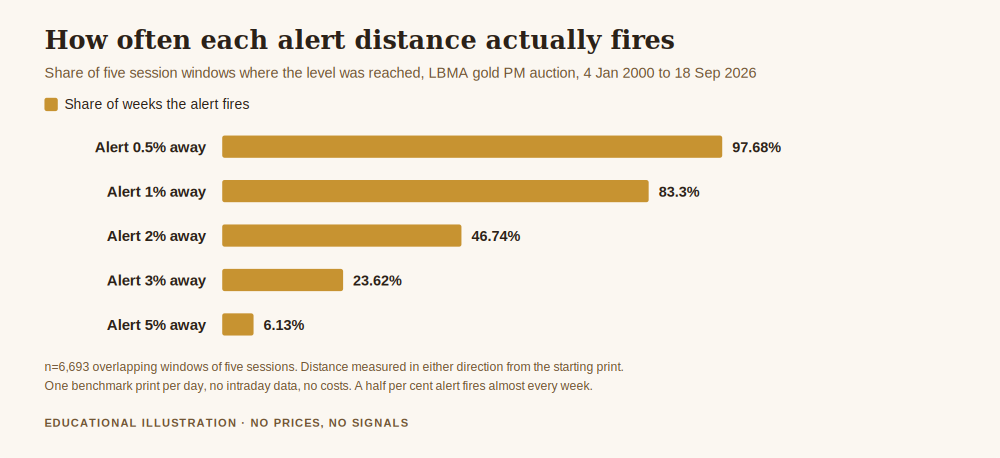
An alert placed half a percent away fired in 97.68 per cent of weeks. That is not an alert, that is a metronome. Gold moves through half a percent almost every week of its life, and a notification that arrives with that reliability trains you to swipe it away without reading it, which is worse than having no alert at all.
One per cent away fired in 83.30 per cent of weeks, and when it fired, the median wait was two sessions. Two per cent away fired in 46.74 per cent of weeks, so slightly less often than a coin. Three per cent fired in 23.62 per cent, roughly one week in four. Five per cent fired in 6.13 per cent of weeks, about three times a year.
For context on the scale, the typical single session moved 0.547 per cent from the previous benchmark, with a mean of 0.767 per cent, and there were 251 benchmark sessions in 2025. Method, so you can repeat it: one benchmark print per day, no intraday data, distance measured in either direction from the starting print, five forward sessions per window, overlapping windows, no costs, no spread, no absolute price quoted anywhere in this article.
What Those Percentages Actually Tell You to Do
Read the numbers as a budget for your own attention. If you set alerts at half a percent on a handful of instruments, you have signed up for several notifications a week that say nothing except that the market is open. Within a month you will stop looking at them. The alert has not failed. Your relationship with the alert has failed, and it took your trust in the whole system with it.
Set alerts at two or three per cent instead and each notification carries information, because something has happened that does not happen most weeks. The cost is that you will sometimes wait a fortnight for one. That waiting is the product, not a defect of it.
This is the same reasoning behind every rule in risk management for gold trading. You are deciding in advance which events deserve a reaction, and building a machine that ignores everything else on your behalf, because you will not reliably ignore it yourself at four in the afternoon on a slow Thursday.
Four Alerts Worth Having
These are categories rather than instructions. The levels are yours, and they should come from your own plan, not from a number in an article.
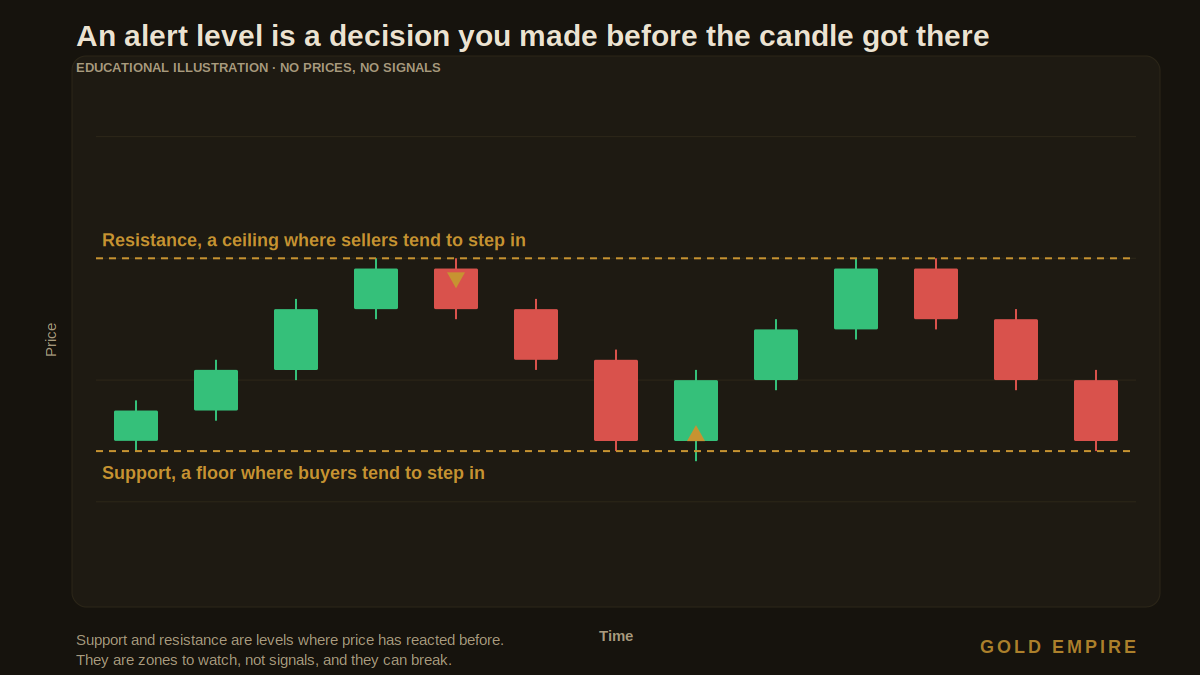
The level you already decided matters. If your analysis says a particular area is the one that would change your mind, that is an alert. Writing it into the platform converts an opinion into something the computer will remember after you have gone to bed and after you have talked yourself into a different story.
The level that says you were wrong. Traders set alerts for the price they are hoping for and almost never for the price that invalidates the idea. The second one is the one that protects capital. If you hold a position and the market reaching a certain area would mean the reason for the trade no longer exists, that deserves a notification at least as much as the happy case.
The time alert before a scheduled event. The Time equals condition is the least used field in the dialog. A notification fifteen minutes before a release you care about is a reminder to check your exposure while you still have a choice about it, rather than discovering it as the spread widens.
The alert on the instrument you are not in. The whole purpose of this feature is that you can be absent. If you want to be in gold only when a particular condition appears, an alert lets you close the platform and live your life until that condition appears. People who watch a market they are not trading end up trading it.
And one worth deleting: any alert you have snoozed twice. If you have dismissed it without acting, the level does not mean what you thought it meant when you set it. Remove it rather than leaving it to erode your attention.
The Real Problem an Alert Solves
I am going to be blunt about the mechanism, because it is not really a software feature at all.
The account damage caused by screen watching is not caused by watching. It is caused by what watching leads to. A trader who is present for every tick will eventually see a move that was not in his plan, feel the pull of it, and take a position that his written rules would never have authorised. He did not abandon his method. He was just in the room when the opportunity walked past, and being in the room is most of what it takes.
An alert removes you from the room. You are not fighting the impulse with willpower, you are arranging your day so the impulse never gets a chance to speak. That is the same design principle as a written risk limit, and it works for the same reason: rules that enforce themselves beat rules that need you to be disciplined at precisely the moment you are least able to be.
It is also why the two or three per cent alert beats the half per cent one on more than statistical grounds. A notification you receive twice a month is an event. A notification you receive daily is wallpaper.
What an Alert Cannot Do
An MT5 alert is a message. It is not an order, it does not size anything, it does not close anything, and it has no opinion about whether reacting is wise. If your plan requires an action to happen at a level whether or not you are awake, that is a pending order or a stop, and the alert is at best a courtesy copy.
It also cannot make a bad level into a good one. An alert on a number you invented while feeling impatient will fire exactly as reliably as an alert on a number you derived from your analysis, which is why the level deserves more thought than the dialog box does. If you are still building the analysis that produces those levels, reading a gold chart with a clear head is the prerequisite, and adding XAUUSD in MT5 covers the step before this one if gold is not yet in your Market Watch.
Finally, an alert will not fire on a market that is closed. Gold does not trade continuously, weekend closures exist, and a level reached while the market was shut is a level you meet on Monday at whatever the market thinks by then. That is a gap risk problem, not an alerts problem, and no notification setting solves it.
Get the free Gold Empire survival sheet, a one-page guide to protecting your account through the kind of market this article describes. One email, no spam, unsubscribe anytime.
Frequently asked questions
Do MT5 price alerts work when the platform is closed?
Desktop alerts do not. They are evaluated by the terminal on your computer, so if the machine is asleep or the platform is shut, the condition can be met without anything happening, and you will not be told afterwards. Alerts set inside the mobile app, or on a platform running on a hosted server, keep working while your computer does not.
How many price alerts should I have running at once?
Few enough that each one still makes you look. There is no technical limit worth worrying about, but there is an attention limit, and the measurement above shows how quickly you hit it: alerts set close to the current price fire in the great majority of weeks, and a notification stream that reliable stops being read.
Should the alert watch Bid or Ask?
Match it to what you would actually do. A level that matters for a buy is reached at the Ask, and a level that matters for a sell is reached at the Bid. On an instrument with a wide spread the two can be meaningfully far apart, so choosing by habit rather than by purpose will fire the alert slightly early or slightly late every time.
Is a price alert a substitute for a stop loss?
No, and treating it as one is a genuinely dangerous swap. A stop is an instruction sitting with the broker that executes without you. An alert is a message that requires you to be awake, holding your phone, and willing to act. Those are not the same protection.
Why does my alert fire and then fire again immediately?
Because maximum iterations is above one and the timeout is short. Price hovering around the level re-triggers the condition. Set iterations to one for a level you only need to hear about once, and use the timeout for the cases where you genuinely want a repeat.
Where Gold Empire Fits
Gold Empire is free to follow. Daily XAU/USD analysis on Telegram, with the reasoning stated before the trade rather than after it, losing days included. There is a free survival sheet for anyone who wants the capital protection material in one place, and an optional Kit for people who want the full method. Nothing here promises a profit and nothing here is a signal service.
The pillar this sits under is risk management for gold trading, the number the alert is supposed to protect is covered in how much to risk per trade, and the platform groundwork is in how to add XAUUSD in MT5. The benchmark data behind every percentage above is published by the London Bullion Market Association, and the raw file used is the published PM auction history. More about who writes this is on the about page.
About the author. Matthew writes Gold Empire and spends most of his attention on the boring mechanics that decide whether an account is still open in two years. He is suspicious of any setup that requires him to be at a desk, on the grounds that the desk has taken more money from him than the market ever has. Nothing in this article is a recommendation to trade, and no entry, stop or target discussed should be treated as a signal.
Disclaimer: This article is general educational content about platform features, notifications and attention management in retail trading. It is not financial advice, not investment advice and not a recommendation to buy, sell or hold any instrument, product or firm. Platform behaviour varies by broker and by version, so verify settings in your own terminal. Figures are calculations from the stated public data and stated assumptions, not predictions or performance claims. Trading leveraged products carries a substantial risk of loss and most retail accounts lose money.
One step first
Where should we send the Gold Survival Sheet?
Leave your email and we will send the free one page checklist, then take you straight to the Telegram channel.
No cost and no obligation. Educational only, not financial advice, and nothing here promises a return. Unsubscribe any time in one click.
Leave a Reply