
A member wrote to me in the spring with a question I get in some form most months. He had four thousand dollars, he wanted to trade gold, and a video had told him futures were the professional route while CFDs were for beginners. Was that true, and should he move? The honest answer took longer than he expected, because micro gold futures vs XAUUSD is not a question about which instrument is more respectable. It is a question about contract size, and contract size is the thing that decides whether a four thousand dollar account survives its first bad week.
So let me do this the way I would do it on paper. What each instrument actually is, what one move is worth in each, and what account each one quietly requires before the arithmetic stops working against you.
Every calculation below is mine, from assumptions I state as I go. The contract sizes and the market figures come from the regulator’s own report, linked where I use them. There are no gold price levels anywhere in this article, and nothing here is a recommendation to trade.
Micro gold futures vs XAUUSD, stated plainly
Gold futures are exchange traded contracts. The full size gold contract on COMEX covers 100 troy ounces. There is also a micro version covering 10 troy ounces, exactly one tenth. Those two sizes are not marketing copy, they are in the Commitments of Traders report published by the CFTC, which prints “contracts of 100 troy ounces” for gold and “contracts of 10 troy ounces” for micro gold next to the open interest for each.
XAUUSD is something different. It is a contract for difference, an agreement with your broker that settles the change in the gold price. Nothing is delivered and no exchange stands in the middle. The common retail convention is that one standard lot is also 100 ounces, with a minimum size of one hundredth of a lot, which works out at one ounce. I want to be careful here: that convention is set by each broker rather than by an exchange, so it is an assumption in what follows and it is the one thing on this page you should check against your own account before relying on it.
That is the whole structural difference. One is an exchange contract in fixed sizes, the other is a private agreement that can be cut much finer.
The number that decides everything: what one dollar of gold is worth to you
Forget the branding and price a single move. If gold moves one dollar an ounce, the full size futures contract moves one hundred dollars, because it holds a hundred ounces. The micro contract moves ten dollars. One hundredth of a CFD lot, under the convention above, moves one dollar.
Those three numbers are the entire argument. They are not opinions about which venue is more serious, they are multiplication.
Now attach a stop to them. Suppose you decide a trade is wrong if gold moves ten dollars an ounce against you. That is a stop distance, not a prediction, and I am choosing a round number to make the arithmetic legible. At that distance the full size contract puts a thousand dollars at risk, the micro contract a hundred dollars, and the one ounce CFD position ten dollars.
Here is where it stops being abstract. The rule I keep coming back to, and the one behind nearly everything on this site, is that no single trade should cost more than about one per cent of the account. Run that backwards and each instrument tells you the account it expects:
- Full size gold futures, one thousand dollars at risk, implies an account of about one hundred thousand dollars.
- Micro gold futures, one hundred dollars at risk, implies an account of about ten thousand dollars.
- One ounce on a CFD account, ten dollars at risk, implies an account of about one thousand dollars.
That is the answer to my member’s question, and it has nothing to do with which instrument is professional. With four thousand dollars, the smallest available position in full size futures would have been a twenty five per cent risk on a single trade. The micro contract would have been two and a half per cent, still more than I would want. The CFD route was the only one where his smallest possible position was smaller than his risk budget.
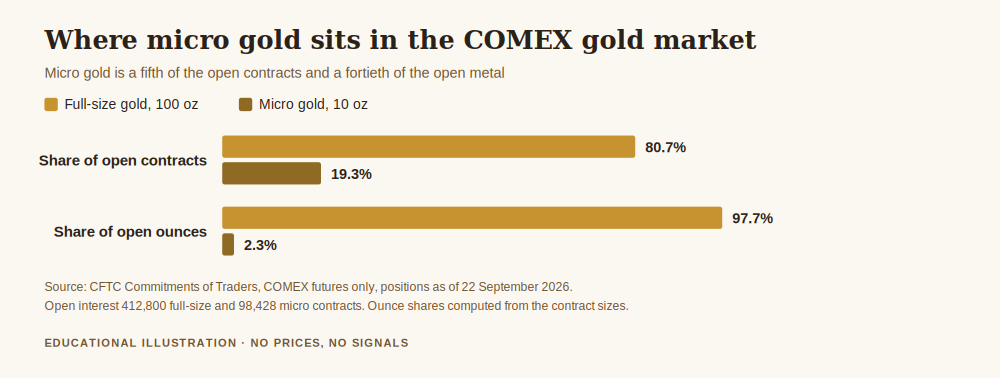
The chart is worth a moment because it shows the same point from the market’s side. In the CFTC report for positions as of 22 September 2026, there were 412,800 full size gold contracts open and 98,428 micro contracts. So micro gold is 19.3 per cent of the open contracts, nearly a fifth, which sounds substantial. Convert those contracts into metal and the picture changes: 412,800 contracts of 100 ounces is 41.28 million ounces, while 98,428 contracts of 10 ounces is 984,280 ounces. The micro contract holds 2.3 per cent of the open gold.
A lot of participants, very little metal. That is the signature of a contract built for small accounts, and it is the clearest evidence I know that trading gold in small size is ordinary rather than second class.
What the CFD side gives you, and what it charges for it
If finer sizing were the only consideration, CFDs would win for every small account and the article would end here. It is not, and the differences are worth stating without taking sides.
The first is who your counterparty is. With futures, you face a clearing house through a broker, and the contract specification is set by the exchange and reported to a regulator. With a CFD, you face your broker. That is not automatically sinister, but it means the terms are the broker’s terms, and it means the quality of the firm matters more than it does on an exchange. I have written separately about what happens if your forex broker goes bust, which is the question this leads to.
The second is leverage, and here the regulation is explicit. Under the product intervention measures agreed by ESMA, the European Securities and Markets Authority, retail CFD leverage on gold is capped at 20 to 1, which is the same as saying you must post 5 per cent of the position’s value as margin. The same measures set a margin close out at 50 per cent of required margin and require negative balance protection on a per account basis. Those rules apply to retail clients of EU regulated firms, so whether they cover you depends on where your broker is authorised.
That same ESMA announcement contains the number I would put on the wall of anyone starting out. The national regulators found that between 74 and 89 per cent of retail accounts typically lose money on CFDs, with average losses per client ranging from 1,600 to 29,000 euros. Three quarters to nine tenths. The instrument you pick moves that figure far less than the size you trade and the risk you take per trade.
The third difference is the running cost. A futures position has no overnight financing charge in the way a CFD does, because the cost of carry is already inside the futures price. A leveraged CFD held overnight is financed, and that financing tracks short term dollar interest rates. In the Federal Reserve’s H.15 release dated 1 October 2026 the effective federal funds rate was 3.88 per cent, so a position held for 30 days carries roughly 0.32 per cent of its notional value in financing before any broker markup. That is small for a day trade and material for a position you intend to hold for months.
Choosing without pretending the choice is bigger than it is
Put the three facts side by side and the decision mostly makes itself.
If your account is small enough that a micro futures contract would be more than one or two per cent of it on a sensible stop, you do not have a choice to agonise over. Trade the instrument that lets you size properly, which for most accounts under ten thousand dollars means a CFD account where you can deal in single ounces. The alternative is not “trading futures like a professional”, it is taking a position four or five times larger than your own rules allow, which ends the same way every time.
If your account has grown past the point where micro futures fit inside your risk budget, the futures route becomes genuinely attractive for the structural reasons: an exchange contract, a published specification, a clearing house, no financing charge layered on top. Many people make that move, and it is a reasonable one.
What I would not do is make the move early in order to feel more serious. The size of your position is the only variable in this article that has ever closed an account, and it is the one you control on either venue.
If you are at the stage of asking this question at all, how to trade gold with a small account and how much money to start trading gold are the two pieces that sit either side of it, and what leverage actually is in gold trading covers the mechanism that makes contract size matter so much in the first place.
Get the free Gold Empire survival sheet, a one-page guide to protecting your account through the kind of market this article describes, including how to work out the smallest position your instrument allows before you fund it. One email, no spam, unsubscribe anytime.
Frequently asked questions
Is XAUUSD the same as gold futures?
No. XAUUSD is a contract for difference with your broker that settles the change in the gold price. Gold futures are exchange traded contracts in fixed sizes, 100 troy ounces for the full size contract and 10 for the micro, with a clearing house as counterparty. They track the same metal and behave similarly day to day, but the counterparty, the sizing and the cost structure are different.
Which is cheaper to hold overnight?
Futures, usually, because the cost of carry is built into the contract price rather than charged as a nightly financing line. A leveraged CFD is financed at something close to short term dollar rates plus a markup, which was roughly 3.88 per cent a year as a base in the Fed’s H.15 release of 1 October 2026. For a position held a few hours the difference is negligible. For months it is not.
Can I trade micro gold futures with a small account?
You can open one, but opening one and sizing it sensibly are different questions. At a ten dollar an ounce stop the micro contract risks about a hundred dollars, so keeping that inside a one per cent risk budget implies an account near ten thousand dollars. Below that the smallest position available is larger than your rules allow, which is the situation worth avoiding.
Does the 20 to 1 leverage cap apply to me?
It applies to retail clients of firms authorised in the European Union under the ESMA measures linked above. Other jurisdictions set their own limits, some higher and some lower. Check what your broker is authorised under rather than assuming, because the cap also comes bundled with the margin close out rule and negative balance protection, and those matter more than the leverage number itself.
Why is micro gold a fifth of the contracts but only a fortieth of the metal?
Because a micro contract is one tenth the size. A lot of participants holding small contracts produce a high share of the contract count and a low share of the ounces. Both figures are computed from the CFTC report for positions as of 22 September 2026: 412,800 full size and 98,428 micro contracts open.
Which one should a beginner start with?
I will not answer that as a recommendation, because the right answer depends on your account size, your jurisdiction and your broker. What I will say is the test to apply: work out the smallest position the instrument permits, multiply it by the stop distance you would actually use, and check the result against one per cent of your account. If it does not fit, that instrument is not yet for you, whatever anybody calls it.
Where Gold Empire fits
Gold Empire is a free education channel about surviving in gold before trying to grow in it. Everything here is free to read and free to follow on Telegram. The one optional piece is the survival sheet above, a single page on protecting an account. We do not promise profits, we do not publish account results, and we do not believe anyone can tell you what your account will do. If you want the fuller version of the thinking in this article, risk management for gold trading is the piece everything else here hangs off.
About the author. Matthew writes Gold Empire. He traded full size contracts on an account that had no business holding them for most of a year, and the habit that saved him was not a better method but a spreadsheet that worked out the smallest position each venue allowed before he funded it. Nothing in this article is financial advice or a recommendation to trade, and no entry, stop or target discussed should be treated as a signal. Trading leveraged gold carries a substantial risk of loss and is not suitable for everyone.
One step first
Where should we send the Gold Survival Sheet?
Leave your email and we will send the free one page checklist, then take you straight to the Telegram channel.
No cost and no obligation. Educational only, not financial advice, and nothing here promises a return. Unsubscribe any time in one click.
Leave a Reply