
Trading vs investment is usually explained as a difference in time. An investor holds for years, a trader holds for minutes, and everything else follows from that. It is a tidy answer and it is wrong often enough to be dangerous, because plenty of people hold a losing position for months and call it investing. The real line is not how long you hold. It is who decides when the position ends. An investor who owns the metal outright decides that himself. A trader who put up a small deposit against a large notional has handed that decision to a margin rule, and the rule does not care what he believes about gold.
I get this question in a particular shape. About 70 messages in my inbox touch on gambling, luck and investing in the same breath. That is a keyword count across my own inbox, not a survey, so read it as a sign of how often the confusion comes up rather than a statistic about traders anywhere. One reader asked directly: “Do you have any material regarding mindset regarding gambling and investing?” Another had already worked it out the expensive way: “I always rely on luck, and this is very wrong. This was the main reason for the losses.” A third put the distinction better than most textbooks: “Without taking information and just taking trades on a setup will be like gambling, and it won’t be a great idea.”
Trading vs investment, the line that actually matters
Strip away the vocabulary and there are two different transactions hiding under the same word “buy”.
In the first, you hand over the full price and receive the thing. You own an asset. Nobody can take it from you because it fell in value. If it halves, you own exactly what you owned before, worth less. Your exit is a decision you make. That is investment, and the defining feature is not patience, it is that you paid for the whole position.
In the second, you post a fraction of the value and take on the price exposure of the whole. You do not own the thing. You own a position, and that position sits on top of a deposit that the other side is watching. If the price moves against you by roughly the size of your deposit, the other side is entitled to ask for more money or close you out. Your exit is now a decision that can be made for you. That is trading, and the defining feature is not speed, it is that somebody else holds a trigger.
This is why the time horizon answer misleads. You can hold a leveraged position for a year and it is still trading, because the trigger is still there every single day. You can buy a gold coin and sell it in a week and it was still an investment, because nobody could have forced you out of it. Duration is a habit. The trigger is a structure.
What the rulebook makes you post before you can trade
You do not have to take my word for the size of the deposit, because in the United States it is written down. Title 17 of the Code of Federal Regulations, section 5.9, covers security deposits for retail forex transactions. It says a dealer must collect a minimum security deposit for each transaction, and that the requirement “cannot be less than” 2 percent of the notional value for major currency pairs and 5 percent of notional for all other currency pairs.
Two things about that rule deserve more attention than they get.
The first is paragraph (c), which is the part nobody reads. It says the dealer “is required to collect additional security deposits from a retail forex customer, or liquidate the retail forex customer’s positions” if the deposits held are not sufficient. Not permitted. Required. The liquidation is not a punishment your broker chooses to apply when it is annoyed with you. It is an obligation written into the rule that lets the business exist at all. Once you understand that sentence, the phrase “my broker closed my trade” stops sounding like a betrayal and starts sounding like plumbing.
The second is that this specific rule is about currency pairs, and gold is not a currency pair. Gold is a commodity. So 5.9 is not the rule that sets the deposit on your XAU/USD position, and a venue outside the United States will set its own number, which may be far smaller. I am not quoting it as your deposit. I am quoting it because it is a published floor you can go and read yourself, and because the arithmetic it forces is the same arithmetic on any venue, at any percentage, in any jurisdiction. Change the number and the shape of the answer does not change.
The same two percent, two different endings
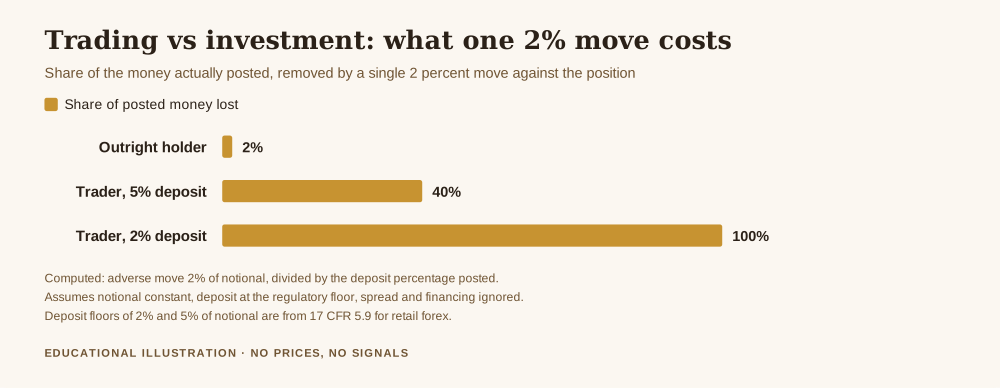
Here is the whole argument in arithmetic. Take one adverse move of 2 percent in the metal. Not a crash, not a gap, a move of the sort that happens on an unremarkable afternoon. Now ask what it costs three people who all believed the same thing about gold.
- The outright holder. Paid in full, owns the metal. A 2 percent fall costs 2 percent of his capital. He still holds everything he held yesterday. His position cannot be closed by anyone but him.
- The trader at a 5 percent deposit. 2 divided by 5 is 0.4, so the move consumes 40 percent of the money he put up. He is still open, but he is now one similar afternoon away from the end, and the obligation in paragraph (c) is awake.
- The trader at a 2 percent deposit. 2 divided by 2 is 1, so the move consumes 100 percent of the money he put up. The position is finished. He was right about nothing and wrong about nothing. He was simply sized so that an ordinary day was fatal.
Those figures are computed, not quoted, and the assumptions are worth stating so you can redo them with your own numbers: notional held constant, the move measured against the notional at entry, deposit sitting exactly at the floor, and financing costs and spread ignored, both of which make the leveraged cases slightly worse rather than better. The maximum leverage implied is just the reciprocal: 100 divided by 2 is 50 to 1, and 100 divided by 5 is 20 to 1.
The ratio is the part I want you to keep. The same 2 percent move costs the outright holder 2 percent of his money and the trader at the floor 100 percent of his. That is a factor of 50 between two people with identical opinions. Nothing in that gap is about analysis, conviction, discipline or market reading. It is all structure, decided before either of them had a view.
The sentence that turns a trade into an investment
There is a specific moment where these two things get confused, and it is always the same moment. A trade goes against someone, and they say: I will just hold it. It is a long term play now.
Listen to what has actually happened there. The position was opened as a trade, with a deposit, on a venue with a liquidation obligation. None of that changed. What changed is the story being told about it. The trader has adopted the investor’s time horizon without acquiring any of the investor’s protection. He now has an investor’s patience sitting on top of a trader’s trigger, which is the worst of both structures: he will not cut it, and he cannot keep it.
The honest version of that sentence is much shorter. It is: I do not want to take this loss yet. That is a human thing to feel and there is no shame in it. But calling it investing adds a layer of respectability to a position that is still on a timer, and respectability is exactly what stops people from checking the timer. One reader described where that ends with more clarity than I could manage: “I really was heartbroken when my money, like a gamble, was lost all inside.”
If you want a test, it fits in one question. Can anybody other than you close this position? If yes, you are trading, whatever you are calling it, and the holding period is not yours to decide.
What the metal does that the contract cannot
It is worth being fair to the investment side, because the case for it is not sentimental.
Gold has an unusual property among assets, which is that it does not really leave. The World Gold Council’s best estimate is that around 222,600 tonnes have been mined in all of human history, roughly two thirds of it since 1950, and because the metal is virtually indestructible almost all of that is still here in one form or another. Jewellery becomes bars, bars become jewellery, nothing is consumed. An ounce that existed in a Roman coin can be in a vault today.
That is a genuinely different thing from a position. A position has no existence apart from the contract that defines it, and the contract has a counterparty, a margin requirement and an end. The metal has none of those. It cannot default on you, it cannot be liquidated by a risk desk, and it does not require you to be solvent on any particular Tuesday.
What it also does not do is pay you anything, move when you want, or turn a small amount of money into a large one. Those are the things people come to trading for, and trading can deliver price exposure far beyond your cash, which is the entire attraction. Neither structure is better. They are answers to different questions. The damage happens when somebody is in one and believes he is in the other.
How to tell which one you are actually doing
None of this is a recommendation about what to hold. It is a set of questions that have factual answers, which is the most useful kind.
Did you pay the full value of what you are exposed to? If not, the difference is leverage, whatever the platform calls it. What percentage of the notional is your deposit? That single number tells you the adverse move that ends the position, because the move that consumes your deposit is the same percentage. Who else can close it, and at what point are they obliged to? That is in your account agreement and it is usually a short paragraph. Does your plan for this position involve waiting longer than your deposit can survive? If so, the plan and the structure disagree, and the structure will win.
Answer those four and the label stops mattering. You will know whether the exit is yours.
Get the free Gold Empire survival sheet, a one-page guide to protecting your account through the kind of market this article describes. One email, no spam, unsubscribe anytime.
Frequently asked questions
Is trading vs investment just about how long you hold?
No, and that is the most common error. A leveraged position held for a year is still a trade, because the deposit and the liquidation obligation are present on every one of those days. An outright purchase sold after a week was still an investment, because nobody could have forced the sale. The length of the hold is a preference. The ability of somebody else to end the position is a fact about the structure.
Which one is safer for a beginner?
That is a decision only you can make, and nothing here is advice on it. What can be said factually is that the two carry different kinds of exposure. Paying in full limits your loss to the fall in the asset and removes anyone else’s ability to close you. Posting a deposit gives you exposure larger than your cash and introduces a move, equal in size to your deposit percentage, that ends the position regardless of your view. Those are facts about mechanics, not a ranking.
Does buying a gold ETF count as investing or trading?
It depends on how you paid for it rather than on what it is. Bought outright in a cash account, it behaves like the first structure: you own a holding and you choose the exit. Bought on margin, it behaves like the second, because a deposit and a liquidation right have been introduced. The instrument does not settle the question. The funding does.
If I use a stop loss, am I protected from the liquidation rule?
A stop is your instruction and the liquidation obligation is the dealer’s. They are separate things, and a stop does not remove the second one. A stop also executes at the price available when it is triggered rather than the price you typed, so it limits exposure without guaranteeing an amount. It is a tool for managing a position, not a conversion of a trade into an investment.
Where can I check the deposit rule myself?
17 CFR 5.9 is linked below and is short enough to read in a couple of minutes. For your own account the number that matters is in your account agreement and your platform’s contract specifications, because gold is a commodity rather than a currency pair and the venue sets its own requirement. Read the figure, then divide it into any move you are worried about. That is the whole calculation.
Where this leaves you
Gold Empire is free to follow and stays free. The daily work writes out the reasoning rather than a number to copy, there is a free survival sheet for anyone who wants the capital protection material in one place, and there is an optional kit for people who want the longer version. Nothing here promises a return, because nobody can promise you one, and nothing here recommends any instrument, venue or product.
The foundation under this article is risk management in gold trading. Beside it, the mechanic that decides the size of your deposit is in what leverage in gold trading is, the arithmetic of how much of an account one position should be allowed to touch is in how to calculate lot size for gold, the question of whether the exchange traded route or the fund route suits you is in gold ETF vs gold fund, and the reason accounts end even when the analysis was fine is in why you keep blowing your trading account.
Outside sources used here: the minimum security deposit of 2 percent of notional for major currency pairs and 5 percent for all other currency pairs, and the dealer’s obligation to collect more or liquidate, are from 17 CFR 5.9 as published by Cornell Law School and checked against the official eCFR text. The estimate of around 222,600 tonnes of gold mined in history, about two thirds of it since 1950, is from the World Gold Council. Every percentage and ratio in the worked example is computed from the assumptions stated in the text, so you can reproduce it with your own figures.
About the author. Matthew writes Gold Empire and spends most of his time on the unglamorous half of this job, which is making sure an account is still there next year. He has read more account agreements than market forecasts, on the theory that the forecast is an opinion and the agreement is a contract. The deposit percentages here are quoted from the regulation linked above, the loss arithmetic is computed from the assumptions stated in the text so you can repeat it with your own numbers, the figures are illustrative of a mechanic rather than quotes from any particular venue, this article is educational and is not investment, legal or tax advice, nothing in it recommends or warns against any specific firm, instrument or product, and no entry, stop or target discussed should be treated as a signal.
One step first
Where should we send the Gold Survival Sheet?
Leave your email and we will send the free one page checklist, then take you straight to the Telegram channel.
No cost and no obligation. Educational only, not financial advice, and nothing here promises a return. Unsubscribe any time in one click.
Leave a Reply