

Most traders in Europe wake up, make coffee, open the chart, and find that gold has already been busy for eight hours without them. There is a small tidy cluster of candles sitting on the left of the screen, usually not doing very much, and then the day properly begins.
That quiet cluster has a name. It is the Asian range, and it is one of the most useful reference points on a gold chart, precisely because it is boring. Understanding it is what separates arriving at the European open with context from arriving with no idea what has already happened.
This piece is about what the Asian range actually is, what the European open tends to do to it, and the very common mistake of treating a break of that range as an instruction.
What the Asian range is
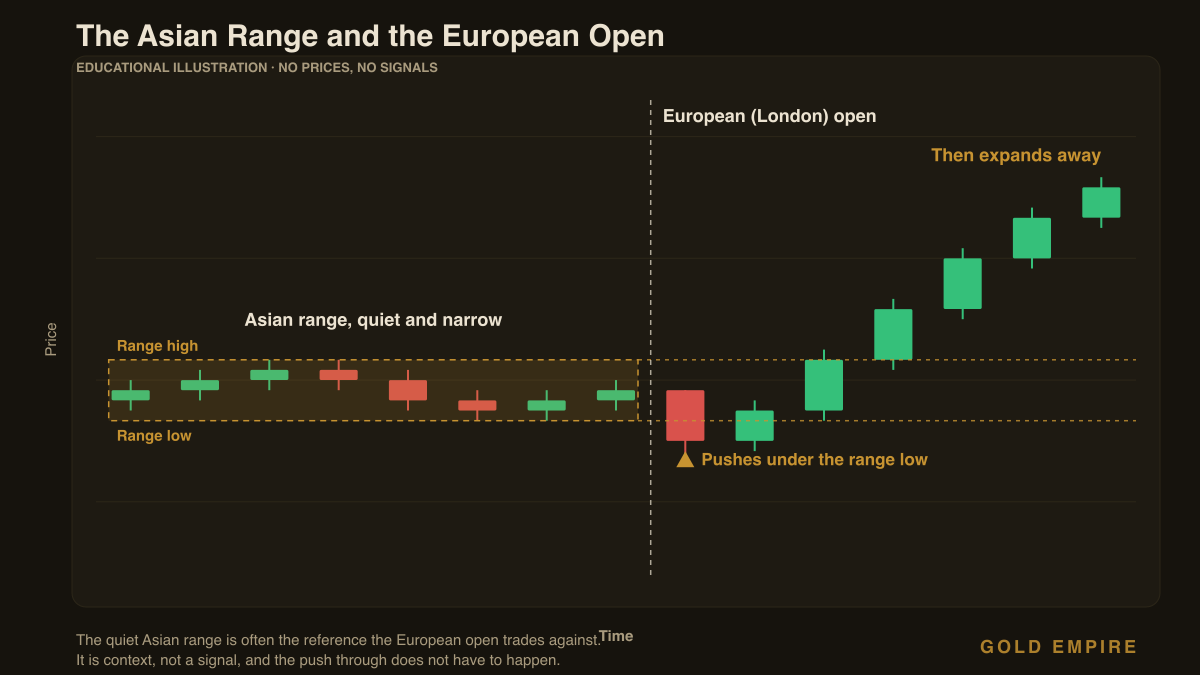
The Asian range is simply the high and the low that gold makes during the Asian trading hours, roughly midnight to 8am GMT, before European desks arrive.
That is the whole definition. It is not an indicator, there is nothing to install, and there is no setting to optimise. It is two horizontal levels: the highest price reached overnight and the lowest. Together they draw a box.
What makes the box interesting is not the levels themselves but a characteristic they usually share: the box tends to be narrow. Gold typically moves in a tighter range during Asian hours than it does later in the day. Understanding why explains most of what follows.
Why the Asian session is usually quiet
It comes down to who is awake and how much money is at the table.
Gold’s largest pools of participation sit in London and in the United States. Those are the centres where the biggest institutional volume trades, and where the news that moves gold is released. During Asian hours, both are largely asleep. There are real participants trading, but there are fewer of them and the orders are generally smaller.
Fewer participants means less disagreement, and price moves when people disagree about what something is worth. With most of the market absent, gold tends to drift rather than travel. It is the same instrument, running on a fraction of the fuel. I covered this pattern of the day more broadly in the best time to trade gold.
There is an important exception worth knowing. If something significant happens in Asian hours, major news out of China, a geopolitical shock, an unexpected central-bank comment, then the Asian range will not be narrow at all. The quiet is a tendency, not a rule.
Why traders pay attention to it
The Asian range matters for one reason: it is an obvious, agreed-upon reference that everyone can see.
Think about what a narrow overnight range means in practice. Thousands of traders open their charts in the morning and all of them see the same box, because it is not a matter of interpretation. The high is the high. The low is the low. Unlike a trendline you draw by eye or an indicator setting you chose yourself, this level is not subjective.
Levels everyone can see tend to attract orders. Traders holding overnight positions often place protective stops just beyond the range. Traders waiting for direction often place orders to enter if the range breaks. The result is that a cluster of resting orders builds up just outside a quiet box, on both sides.
Which brings us to what happens when the volume arrives.
What the European open does to the range
At the European open, participation increases sharply. Desks that were closed come online, and the amount of money willing to transact rises significantly within a short window.
What tends to happen next is straightforward once you see the mechanism. A market that has been compressed into a narrow box now has far more capacity to move, and the nearest points of interest are the edges of that box. So price frequently goes and tests one of them.
Here is where honesty matters, because this is where the topic is usually oversold. There are several things that can happen, not one:
- Price pushes through one edge and keeps going, and the day expands in that direction.
- Price pushes through one edge, then turns around and goes the other way. The break did not hold.
- Price tests an edge without breaking it, and the range holds.
- Nothing much happens at all, and gold spends the session inside or near the box.
All four are common. Nobody knows in advance which one is coming, and anyone who tells you they do is describing hindsight.
The second outcome deserves its own name because it catches so many people. Price breaks the range low, everyone watching concludes gold is heading down, and then it reverses hard and spends the rest of the day going up. The break was real, the follow-through was not. This is closely related to a liquidity sweep, and it is not a conspiracy against you. It is simply what happens when a market takes out the obvious orders sitting beyond a level and then finds there is nothing left to push it further.
A break of the Asian range tells you price left the box. It does not tell you price will keep going. Those are two entirely different claims.
The mistake: treating the range break as an entry
The most common error with this concept is turning it into a mechanical rule. Price breaks the Asian high, so buy. Price breaks the Asian low, so sell.
It sounds systematic, which is exactly why it appeals. Here is why it tends to disappoint.
The first move after the open is the least informed move of the session. Volume is arriving, but it has not finished arriving. What looks decisive in the first few minutes routinely gets undone once the rest of the session’s participants have their orders in.
Execution at the open is at its worst. Spreads can widen during the volatile transition into the session. Trading the fastest, thinnest moment of a session means paying more for a worse fill, at exactly the point where you have the least information.
A mechanical break rule has no context. A break of the Asian high means something quite different when the wider trend has been climbing for a week than it does when gold is grinding sideways in a bigger range. The box does not know what is around it, but you should.
The obvious level is obvious to everyone. If a rule is that simple and that visible, a great many people are watching the same line. That does not make it useless, but it does mean the easy version of the trade is unlikely to be the profitable one.
What the range genuinely tells you
Strip away the false promises and there are three real, useful things left. They are all context rather than triggers, which is less exciting and considerably more durable.
It gives you a sense of the day’s likely energy. An unusually tight Asian range means pressure has been building with nowhere to go, and sessions that follow a very compressed overnight range often expand more once volume arrives. Conversely, if gold has already travelled a long way overnight, some of the day’s movement may already be behind you. This is a rough read on conditions, not a forecast, but it helps you calibrate what to expect.
It marks the levels that matter to other people. Knowing where the obvious lines sit tells you where reactions are more likely to occur, and just as importantly, where a move might run out of fuel after clearing them.
It gives you a frame for the whole session. Whether gold is above the overnight range, below it, or still inside it is a genuinely useful one-second summary of where the day stands.
A calmer way to use it
What this looks like in practice is unglamorous.
Mark the box before the open, not after. Draw the overnight high and low while the session is still quiet. Doing it in advance means you are reading a level you identified calmly rather than one you drew to justify something you already want to do.
Do not act in the first rush. Let the open happen. Let spreads normalise. Watching the first move without needing to be part of it costs you nothing and removes the worst-value moment of the session from your day.
Wait for the session to show its hand. A break that holds and builds looks quite different from a poke through that immediately snaps back. The difference becomes visible with a little patience, and only with a little patience.
Keep the bigger picture in front of you. The Asian range is a small piece of context sitting inside larger context. It should inform your read of the day, not replace it, and it is worth far less than the risk rules you trade by.
None of this guarantees anything. The point of the Asian range is not to tell you what gold will do. It is to mean you arrive at the European open already knowing what has happened and where the obvious lines are, instead of trying to work it out while price is moving.
Want the boring foundations that actually keep beginners in the game? Our free Survival Sheet covers the risk rules that matter far more than any level on a chart, and we talk through market conditions daily with our community on Telegram. No hype, no promises.
Get the free Gold Empire survival sheet, a one-page guide to protecting your account through the kind of market this article describes. One email, no spam, unsubscribe anytime.
Frequently asked questions
What time is the Asian range for gold?
Roughly midnight to 8am GMT, ending as European desks come online. The exact hours are a convention rather than a fixed rule, and they shift with daylight saving. Many traders simply use the high and low made between the previous US close and the European open.
Why is the Asian session usually quieter for gold?
Because gold’s largest pools of volume sit in London and the United States, and both are mostly asleep during Asian hours. Fewer participants and smaller orders mean price tends to drift rather than travel. It is the same market running on much less fuel.
Does gold always break the Asian range at the European open?
No. Price often tests an edge without breaking it, and some sessions stay inside the range entirely. Even when a break happens, it may not hold. Treating a break as inevitable is one of the quickest ways to misuse the concept.
Should I trade the Asian range breakout?
That is a decision for your own tested plan, not something anyone should hand you. What is worth knowing is that the moment of the break is the fastest and least informed part of the session, spreads can be widest then, and a break without follow-through is common. Many experienced traders use the range as context rather than as a trigger.
Is a narrow Asian range a signal that a big move is coming?
It is a hint about conditions, not a signal. Compressed overnight ranges are often followed by larger daily ranges once volume arrives, but “often” is doing a lot of work in that sentence. It tells you to expect the possibility of expansion, not to predict its direction or size.
Can I use the Asian range on any timeframe?
The range itself is just two levels, so you can mark it on any chart. Reading it is usually easier on higher timeframes such as 1-hour, where the overnight period is a handful of candles rather than hundreds, and where the box’s shape is obvious at a glance.
About the author
Matthew runs the Gold Empire community, where the emphasis is on knowing what you are looking at before you risk anything on it. He has seen more traders damaged by mechanical rules applied without context than by any lack of clever techniques, which is why he would rather teach you what a level means than hand you a trigger to pull. Survive first, then grow.
Risk disclaimer
This article is educational content only and is not financial advice, investment advice, or a recommendation to trade. Trading gold and other leveraged instruments carries a high level of risk and can result in the loss of your entire capital. The session behaviour described here is a general tendency, not a prediction, and no entry, stop or target discussed should be treated as a signal. Past market behaviour does not indicate future results. Consider your own circumstances and seek independent advice from a licensed professional before trading.
One step first
Where should we send the Gold Survival Sheet?
Leave your email and we will send the free one page checklist, then take you straight to the Telegram channel.
No cost and no obligation. Educational only, not financial advice, and nothing here promises a return. Unsubscribe any time in one click.
Leave a Reply