

Open a cent account and the broker hands you a dropdown. The numbers in it run from something modest to something enormous, 1:500, 1:1000, sometimes further, and nothing on the page explains what the choice does. So the question arrives in my inbox almost every week in roughly the same words: what is the best leverage for a cent account. It is a fair question, and the honest answer is that the dropdown is not the control people think it is. It does not set your risk. It sets your ceiling, and almost everything that destroys small accounts happens because those two things get confused.
This article does not tell you which number to pick. It shows you what each number actually changes, using arithmetic you can repeat, so that the choice stops being a guess.
What a cent account is, before the leverage question
A cent account holds your balance in cents rather than in whole units. Deposit the equivalent of 100 and the platform shows 10,000, because it is counting the same money in smaller pieces. Position sizes shrink by the same factor, so the smallest trade you can place moves your balance by a hundredth of what it would move on a standard account.
That is the entire mechanism. Nothing is subsidised, nothing is simulated, and the money is real. It is a unit conversion, designed so that a beginner can trade genuinely small positions without the platform rounding them away to nothing. For that purpose it is a good tool, and I have no argument with it. More on how it differs from the standard version is in cent account versus standard account.
The complication is psychological rather than mechanical. A balance showing 10,000 does not feel like 100, and a dropdown offering 1:1000 does not feel like a warning. Both of those feelings point the same direction.
What is the best leverage for a cent account, and why the question has the wrong shape
Here is the thing the dropdown does not tell you. Leverage changes how much of your balance is frozen as margin while a position is open. It does not change how much you lose if the trade goes against you.
Take one position with a notional value of 10,000 units, and put the stop 1 per cent away from entry. Here is what the leverage setting does to that trade.
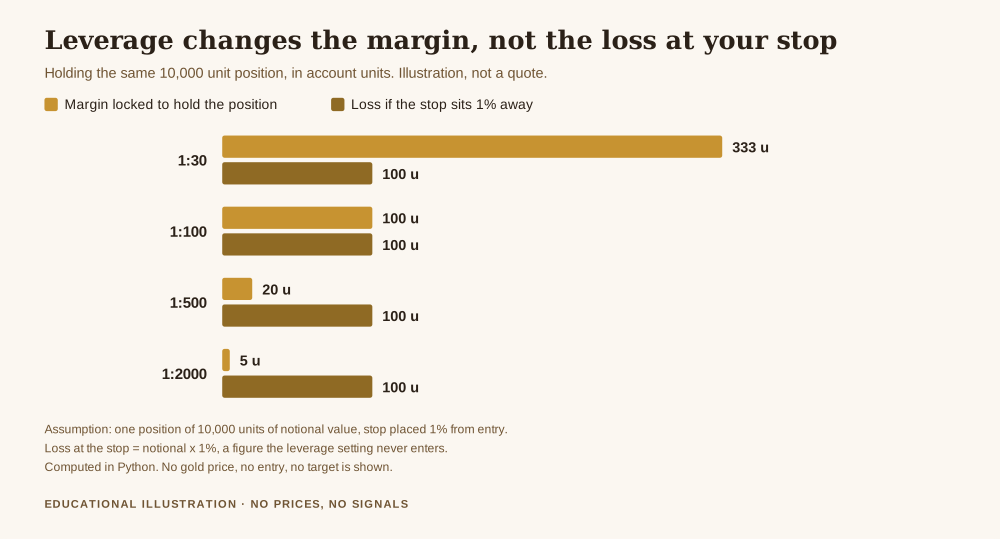
At 1:30 the position ties up 333 units of margin. At 1:100 it ties up 100. At 1:500, 20. At 1:2000, 5 units. The margin requirement falls by a factor of nearly 67 across that range.
And the loss if the stop is hit? 100 units. At every single setting. It does not move, because the loss is the notional value multiplied by the distance to your stop, and the leverage setting appears nowhere in that calculation.
This is the part worth re-reading. Two traders holding an identical position with an identical stop lose an identical amount, whether one chose 1:30 and the other chose 1:2000. The dropdown did not make one of them safer. It only changed how much of their balance sat idle as collateral while they waited.
What leverage does change, which is the dangerous part
If leverage does not change your loss, it is tempting to conclude that it does not matter. It matters enormously, just not where people look for it.
Leverage sets the maximum position you are permitted to open. On a balance of 1,000 units, 1:30 allows a maximum notional of 30,000. 1:100 allows 100,000. 1:500 allows 500,000. And 1:2000 allows 2,000,000 units of notional exposure against 1,000 units of actual money.
Now apply the same 1 per cent adverse move to each ceiling. At 1:30, that move costs 300, which is 30 per cent of the account. At 1:100 it costs the entire account. At 1:500 it costs five times the account. At 1:2000, twenty times.
Those last figures are not predictions of what you will lose, because a stop out will intervene long before the arithmetic completes and most retail accounts carry negative balance protection. They are a measure of how far outside your means the ceiling sits. A permission to take on twenty times more exposure than you own is not a safety feature that you simply decline to use. It is a door left open next to a person having a bad week.
Here is the same point from the other direction, at 1:500. If you use just 2 per cent of your available ceiling, it takes a 10 per cent adverse move to wipe the account. Use 5 per cent of the ceiling and it takes 4 per cent. Use 10 per cent and it takes a 2 per cent move. Use a quarter of what the broker allows, and a move of 0.8 per cent ends the account. Use all of it, and 0.2 per cent does.
Gold can travel 0.8 per cent in an ordinary session without anything newsworthy happening. That is the whole mechanism behind most of the blown accounts I see, and it never required a market crash.
Where a regulator landed when it had to choose a number
It is worth knowing what figure appears when someone is obliged to write one into law rather than into a marketing page.
Under 17 CFR 5.9, firms offering retail foreign exchange trading in the United States must collect a minimum security deposit of “2% of the notional value of the retail forex transaction for major currency pairs and 5% of the notional value of the retail forex transaction for all other currency pairs.”
Translate those into the language of the dropdown. A 2 per cent minimum deposit is a cap of 50:1. A 5 per cent minimum is a cap of 20:1.
Two honest caveats. That rule covers retail forex transactions and currency pairs specifically, so it is not a statement about gold, and it does not apply to every jurisdiction or every broker. I am not claiming it governs your account. The reason it is useful is narrower: when a rule writer had to pick a number for leveraged retail trading, with no incentive to make the product exciting, the number came out between 20:1 and 50:1. Hold that next to a dropdown offering 1:2000 and you can see what the dropdown is for. It is not there because 1:2000 is a sensible operating level. It is there because it is attractive.
So what should you actually set it to
Work backwards, because the order people do this in is the problem.
Decide first what fraction of the account a single losing trade is allowed to cost. That is a number you choose once and write down, and it is covered properly in how much to risk per trade. Then look at where your stop sits on the chart. Those two facts together determine your position size, completely, with no input from the leverage setting.
Only now does leverage enter, and it enters as a yes or no question: is the setting high enough to let me hold the position I already decided on? If yes, you are done. Anything above that point adds no capability you are using, and adds permission you did not ask for.
If the lowest setting your broker offers still lets you open fifty times more than your rules allow, then the dropdown has stopped being a meaningful control, and the thing protecting the account is your written position size rule. Which it always was.
The sharpest version of this I know: if changing your leverage setting would change the size of your next trade, then your position size is being set by the broker rather than by you. The whole argument of this article sits in that sentence. Background on the mechanism itself is in what leverage is in gold trading, and the forced closure that follows when margin runs out is in what stop out level means.
What people actually write in
Roughly 54 messages in my inbox mention leverage or margin directly. That is a keyword count across the messages I have rather than a survey, so read it as a sense of how often this comes up, not as a measurement.
The question usually arrives exactly as the title of this article. One reader wrote: “please I want to know what leverage is the best to set in forex trading.” Another, opening an account: “please when registering which leverage do you suggest I register with?” A third, already trading: “is the 500:1 my leverage? Also, is it okay that way?”
What strikes me about all three is that they are asked before anybody has mentioned a position size. The dropdown is being treated as the safety decision, which is why it gets so much attention and why the attention does not help.
Then there are the messages from further along. One reader: “a lot of the time I entered trades too early and most times I over leverage my account.” Another, shorter: “no. I keep margin call. need to study proper risk management for now.” Neither of those outcomes was caused by picking the wrong number in the dropdown. Both were caused by position size, which is the thing the dropdown quietly permits and never decides.
Get the free Gold Empire survival sheet, a one page guide to protecting your account through the kind of market this article describes, including the position size rule that makes the leverage dropdown irrelevant. One email, no spam, unsubscribe anytime.
What this article does not say
It does not say high leverage is a scam. It is a product feature, and for a trader with a written size rule it is close to irrelevant, which is precisely the point.
It does not say low leverage makes you safe. A trader on 1:30 who opens the largest position permitted is running 30 per cent of the account into a 1 per cent move. The setting did not save them.
And it does not tell you to trade gold, or anything else, at any size. It tells you which dial does what.
Frequently asked questions
What is the best leverage for a cent account, in one line?
The lowest setting that still allows the position size your written risk rule already produced. Anything higher changes nothing you are using and raises a ceiling you did not need.
Does higher leverage mean I lose more when a trade goes wrong?
No, not on a given position. Holding a 10,000 unit position with a stop 1 per cent away loses 100 units at 1:30 and 100 units at 1:2000. Leverage changes the margin locked up, which falls from 333 units to 5 across that range. It does not appear in the loss calculation at all.
Then why does leverage have a reputation for blowing up accounts?
Because it sets the maximum position you may open, and larger positions do lose more. On a 1,000 unit balance, 1:500 permits 500,000 of notional exposure, where a 1 per cent adverse move is five times the account. The damage comes from using the ceiling, not from the setting existing.
Is 1:2000 leverage on a cent account a warning sign?
Treat it as information about the product rather than about the broker. When a rule writer had to set a minimum for retail forex, the answer was 2 per cent of notional for major currency pairs and 5 per cent for others, which is 50:1 and 20:1. A number forty times higher is a marketing figure, and knowing that is enough.
If I use a cent account, do I still need a position size rule?
More than ever. The cent denomination makes each trade smaller, which is helpful, but it also makes a large position look modest on screen because the balance is displayed in hundredths. The rule is what keeps the two apart.
Where did the numbers in this article come from?
The 2 per cent and 5 per cent minimum security deposits are quoted directly from 17 CFR 5.9, linked above and checked on 28 October 2026. The margin figures, the ceilings, the 0.8 per cent and 0.2 per cent wipeout moves and the 50:1 and 20:1 conversions are my own arithmetic, assuming a 1,000 unit balance, a 10,000 unit position and a stop 1 per cent from entry. No gold price is used anywhere in this article, and none is needed.
What Gold Empire actually does
Gold Empire is free to follow. Daily gold analysis on Telegram with the level, the reasoning and the risk written down before the trade rather than explained afterwards, losing days included. There is a free survival sheet for anyone who wants the capital protection checks in one place, and an optional Kit for people who want the full method. Nobody here promises a profit, and nobody here will ever ask for your platform password or offer to trade the account for you. The foundation this article rests on is risk management in gold trading, and the small account version is in trading gold with a small account.
About the author. Matthew writes Gold Empire. He spends most of his time on the part of this business that happens before the entry, because an account that is still open next year is the only one that gets to compound anything. Nothing in this article is financial advice, and no entry, stop or target discussed should be treated as a signal.
One step first
Where should we send the Gold Survival Sheet?
Leave your email and we will send the free one page checklist, then take you straight to the Telegram channel.
No cost and no obligation. Educational only, not financial advice, and nothing here promises a return. Unsubscribe any time in one click.
Leave a Reply