
The difference between cent account and standard account is not a difference in the market, the spread you pay or the chart you look at. It is a difference in the size of the smallest mistake you are allowed to make. That sounds like a small thing. It is actually the whole thing, because on a small balance the smallest trade your broker will accept is often already larger than the risk your account can survive, and no amount of discipline fixes an arithmetic problem.
I want to do something more useful than list the features of two account types. I measured how far gold actually moves in a day, then worked out how big an account has to be before the minimum trade size on each account type fits inside a sane risk budget. The answer is a clean multiple of one hundred, and once you see it, the marketing language around cent accounts stops mattering.
What the Difference Between Cent Account and Standard Account Really Is
Both account types trade the same instrument through the same broker, usually with the same spread and the same execution. What changes is the unit your balance is counted in, and therefore the size of one lot.
On a standard gold account, one lot is one hundred troy ounces. A one dollar move in the price of an ounce is one hundred dollars to you. Most brokers let you go down to one hundredth of a lot, which is a single ounce, so the smallest trade you can place moves one dollar for every dollar the metal moves.
On a cent account, your deposit is displayed in cents rather than dollars, so a deposit of one hundred dollars shows as a balance of ten thousand. Everything else scales with it. One lot on that account is one hundredth of a standard lot, and the smallest trade you can place is one hundredth of an ounce. The numbers on the screen look bigger and the money at risk is one hundred times smaller.
That is the entire mechanical difference. A cent account is not a demo account, the money is real and the losses are real. It is not a different market, and it does not give you better fills. It is a smaller ruler.
The Only Question Worth Asking: What Does the Smallest Trade Cost You
An account type is not good or bad in the abstract. It is either compatible with your balance or it is not, and compatibility is measurable. To measure it I need two things: how far gold typically moves, and how much of your account you are willing to lose on one trade.
How far gold actually moves in a day
I took the published LBMA gold benchmark, the afternoon fix, and measured the average absolute change from one published session to the next. Over the most recent 250 sessions that average is 1.26 percent, with a median of 0.99 percent. Over the last 1,250 sessions, roughly five years, the average is 0.79 percent and the median 0.56 percent. Gold has been livelier lately than its own five year habit.
I am going to use one average daily move as the stop distance in everything below. Not because you should place your stop there, you should place it where your reasoning says the idea is wrong, but because it is a measured, neutral stand in for “a stop with enough room to breathe”. Using a tighter one would flatter the arithmetic, and I would rather the arithmetic be honest.
The account size the minimum trade demands
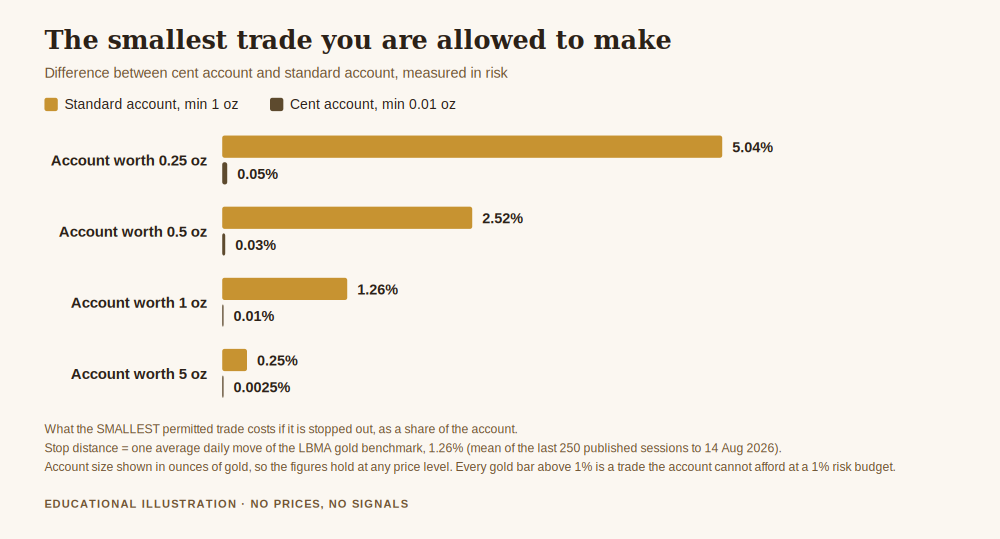
Set your risk budget at one percent of the account, which is the common convention and, in my experience, already generous for a beginner. Now ask the question backwards. If the smallest trade you can place is one ounce, and your stop is 1.26 percent of the value of that ounce, how big does your account have to be for that loss to equal one percent of it?
The answer is that your account must be worth about 1.26 ounces of gold. Below that, the smallest trade a standard account permits risks more than one percent, and you are no longer choosing your risk, the broker’s minimum is choosing it for you.
Here is the same calculation across several account sizes, with everything expressed in ounces so it holds regardless of where the gold price sits:
- Account worth 10 ounces: the minimum standard trade risks 0.13 percent. Comfortable.
- Account worth 5 ounces: 0.25 percent. Comfortable.
- Account worth 2 ounces: 0.63 percent. Workable.
- Account worth 1 ounce: 1.26 percent. Already above a one percent budget.
- Account worth half an ounce: 2.52 percent. Four losing trades in a row and you are down a tenth of the account.
- Account worth a quarter of an ounce: 5.04 percent. Twenty trades of that size is the whole account.
On a cent account the same calculation gives 0.0126 ounces, because the minimum trade is one hundredth of the size. That is the number that matters, and it is exactly one hundred times smaller. Everything else people argue about, the platform, the bonus, the leverage on offer, is decoration compared with this.
Leverage Does Not Solve a Small Account, It Postpones the Conversation
The usual objection at this point is that leverage makes the account size irrelevant. It does not, and the regulator’s own numbers show why.
Under the European product intervention rules, retail leverage on gold is capped at 20 to 1, which is the same bracket as non major currency pairs and major indices. Twenty to one means the margin you post is five percent of the position’s value. Now put the daily move next to it. One average day, 1.26 percent of the position, is 25.2 percent of the margin you posted. Not of your account, of the margin backing that one position.
Read that again, because it is the sentence I wish someone had put in front of me early. At the maximum leverage a European regulator considers acceptable for retail clients on gold, an ordinary day, not a shock, not a news event, an ordinary day, moves a quarter of your posted margin. Four ordinary days in the wrong direction, with no stop, is the position gone.
The same ESMA analysis found that 74 to 89 percent of retail accounts trading contracts for difference typically lose money, with average losses per client ranging from 1,600 to 29,000 euros. Those are supervisory figures collected across national regulators, not a survey and not marketing. Leverage is the mechanism by which a small account reaches the size of a large mistake, which is the opposite of what it is usually sold as.
What a Cent Account Is Genuinely Good For
I am not against cent accounts. I think they are the honest answer to a real problem, and the problem is that most people cannot start with an account worth several ounces of gold.
A cent account lets you take a real trade, with real money, at a risk fraction that is actually sane. You can hold a position through a session and feel what that does to you, which is information a demo account cannot give you because nothing is at stake. You can run twenty or fifty trades of a plan and see the shape of the results rather than the shape of one lucky week. You can find out whether you actually follow your own rules when the number on the screen is red, and you can find that out for a cost that will not end your participation.
That last point is the real argument. The purpose of the first year is not to make money. It is to still be here at the end of it with a record of what you did, and a cent account makes the tuition affordable.
What a Cent Account Cannot Teach You
Two things, and both of them catch people on the way up.
The first is emotional scale. Losing 30 cents when your rules say you should lose 30 cents is not the same experience as losing 30 dollars, or 300. The habit of following the plan is real and worth building, but the pressure that breaks the habit is not present at this size. Expect a step change when you move up, and plan for it by moving up slowly rather than in one jump.
The second is cost as a share of the position. Spread and commission do not shrink when the position shrinks, they are per ounce and they stay put. On very small positions the fixed cost of trading is a much larger share of the outcome, so a cent account will usually understate the quality of your edge, not overstate it. If your plan roughly breaks even on a cent account, it may be better than it looks. If it loses steadily there, it will lose faster with size, because the losses scale and the discipline does not automatically come with them.
How I Would Actually Choose
Work out what your account is worth in ounces, then read it off. If the account is worth less than about one and a quarter ounces at a one percent risk budget, a standard account cannot give you a position small enough, and the choice is a cent account or waiting until you have funded more. If it is worth several ounces, a standard account is fine and a cent account will mostly be an inconvenience, because the reporting is in a unit nothing else in your life uses.
Two things to check before you open either. Confirm the minimum lot size in writing, because “0.01” means one ounce on one account type and one hundredth of an ounce on the other, and the number alone tells you nothing. Confirm what happens when you want to move up, whether the same broker lets you transfer to a standard account without closing the relationship and starting again.
And then treat the choice as what it is, a decision about the size of your unit of learning, not a decision about how much you will make. The related pieces here go deeper on the two halves of that: how to calculate lot size for gold and forex for the arithmetic of the position itself, and how to trade gold with a small account for what to do once the size question is settled. The foundation under both is risk management in gold trading.
Get the free Gold Empire survival sheet, a one-page guide to sizing a position so that no single trade can end your account, whichever account type you are using. One email, no spam, unsubscribe anytime.
Frequently Asked Questions
Is a cent account real money or is it like a demo?
It is real money. The balance is shown in cents, so a hundred dollar deposit reads as ten thousand, but deposits, losses and withdrawals are all real. A demo account risks nothing, which is precisely why it teaches you less.
Which is better for a beginner, a cent account or a standard account?
Better depends on the size of your balance rather than your experience. If one minimum trade on a standard account would risk more than your intended percentage, the standard account is not offering you the choice you think it is. The measurements above put that threshold near an account worth one and a quarter ounces of gold at a one percent risk budget and a stop of one average daily move.
Do cent accounts have worse spreads?
Sometimes, and it is worth checking rather than assuming, because it is one of the few places where a broker can quietly charge for the convenience. The more reliable effect is arithmetic rather than pricing: the same spread is a larger share of a smaller position, so trading costs weigh more heavily on a cent account.
How long should I stay on a cent account?
I would not set that by time. I would set it by evidence, a stated plan and enough trades executed to that plan that you can see whether you actually followed it. Then increase size in steps small enough that no single step changes how you behave.
Can I use higher leverage instead of using a cent account?
You can, but it does the opposite of what people hope. Leverage does not make a position smaller, it makes the money backing it smaller. At the 20 to 1 retail cap for gold, one average daily move is 25.2 percent of the margin posted for that position, so higher leverage buys you a shorter distance between an ordinary day and a closed position.
Does the difference between cent account and standard account affect my strategy?
It should not affect what you consider a good trade. It affects how many of them you can survive being wrong about, and that is a bigger factor in the first year than the quality of any entry.
Where Gold Empire Fits
Gold Empire is a free Telegram channel where I post gold analysis with the reasoning stated before the move rather than after it, losing days included. Nothing needs to be bought to follow along, and there is an optional Kit later for people who want more structure. I publish no profit claims, and I do not rank brokers for payment.
The free survival sheet is the one page version of the sizing discipline in this article. If you want the neighbouring pieces, how much money to start trading gold approaches the same question from the funding side, and what is leverage in gold trading covers the mechanism that makes small accounts fragile.
About the author. Matthew writes Gold Empire. He is interested in the unglamorous half of this business, cost, size, frequency and the arithmetic of staying solvent, on the view that most accounts are lost to ordinary errors repeated patiently rather than to any single dramatic trade.
Disclaimer: This article is general educational content about how two account types differ in minimum position size. It is not financial advice, not a recommendation of any broker, account type or platform, and not a suggestion to open any particular position. Trading gold and leveraged products carries a high risk of losing money rapidly. No entry, stop or target discussed should be treated as a signal. The volatility figures above were computed by me from the published LBMA gold benchmark, afternoon fix, over the most recent 250 and 1,250 published sessions to 14 August 2026, and the account size figures follow from them by arithmetic under the stated assumptions of a one percent risk budget and a stop of one average daily move. The leverage cap and the client loss statistics are from ESMA and apply to retail clients in the European Union; your jurisdiction may differ. Contract sizes are broker specific and must be confirmed with your own broker. No gold price is quoted anywhere in this article and no trading results are represented. Past behaviour of a public benchmark is not a prediction.
One step first
Where should we send the Gold Survival Sheet?
Leave your email and we will send the free one page checklist, then take you straight to the Telegram channel.
No cost and no obligation. Educational only, not financial advice, and nothing here promises a return. Unsubscribe any time in one click.
Leave a Reply