
Open a gold futures vs XAUUSD chart side by side and the first thing you notice is that they look almost identical. The second thing, if you look for another minute, is that they are not. The shapes agree, the turning points agree, but the candles do not line up, the sessions start and stop in different places, and every so often one of them has a gap that the other does not. Traders usually assume one of the two is wrong. Neither is. They are two different instruments that happen to track the same metal.
This matters more than a chart curiosity, because the difference decides what you are actually holding, what it costs you to hold it, and who you are holding it with. I want to walk through the mechanics in the order they affect your account.
Two Markets, One Metal
The futures side lives on an exchange. COMEX lists a gold contract and that contract is a standardised, fixed lump of metal. You can see exactly how big it is in a source neither your broker nor I control: the US Commodity Futures Trading Commission publishes a weekly Commitments of Traders report, and the COMEX section of it labels each market with its contract size on the line above the data.
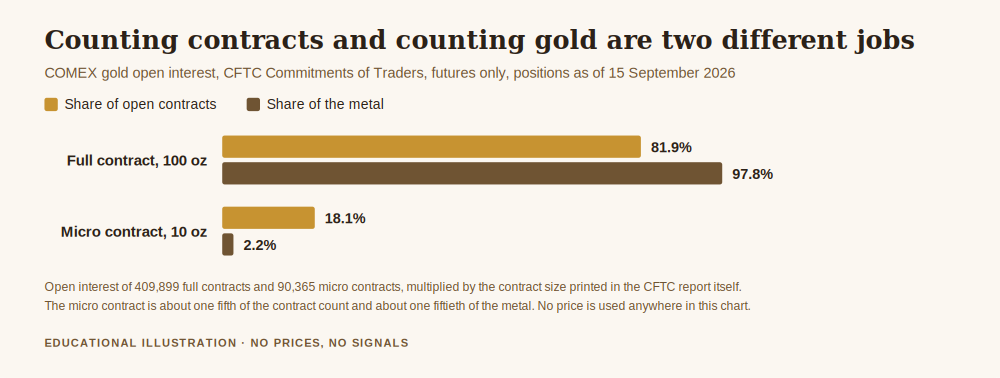
In the report covering positions as of 15 September 2026, the entry reads GOLD, COMMODITY EXCHANGE INC., contracts of 100 troy ounces, with open interest of 409,899 contracts. Directly beneath it sits MICRO GOLD, contracts of 10 troy ounces, with open interest of 90,365. You can read the COMEX Commitments of Traders report yourself, and it will have moved on by the time you do, which is rather the point of using it.
The spot side lives somewhere else entirely. XAUUSD as you see it in a retail terminal is not an exchange product. It is a contract for difference or a spot position quoted by your broker, priced off the over the counter loco London market, where gold has traded between banks for a very long time without any central exchange at all.
The Arithmetic That Makes the Two Comparable
Here is the part that makes the comparison concrete, and it needs no price at all.
One COMEX gold contract is 100 troy ounces. One standard lot of XAUUSD is also 100 troy ounces. So a single standard lot in your retail terminal carries the same quantity of metal as one full exchange contract. That is a fact worth sitting with if you have been treating a standard lot as a normal starting size.
Work down the scale. One standard lot equals ten micro gold contracts. A 0.01 lot, the smallest size many brokers allow, is one troy ounce, which is a tenth of a single micro contract. The retail market slices the metal far finer than the exchange does, and that is genuinely the main practical advantage of the spot side.
The open interest figures show how that plays out. Micro contracts are 18.1 per cent of all open COMEX gold contracts, which sounds like a substantial share of the market. Converted to metal, using the contract sizes printed in the same report, the full contracts account for 40,989,900 ounces and the micros for 903,650. The micro contract is therefore 2.2 per cent of the gold. Counting contracts and counting metal are two different jobs, and confusing them is how people talk themselves into believing a market is smaller or more retail than it is.
Why the Charts Do Not Line Up
Four mechanical differences produce almost every visible discrepancy between the two charts.
The futures chart is stitched together. A futures contract expires. The chart you are looking at, if it runs back further than a few months, is a continuous series assembled from a sequence of contracts, each handed over to the next at some roll date. Every handover can leave a step in the series that never happened to anyone holding a position. Spot XAUUSD has no expiry, so its chart has no rolls and no stitches.
The cost of time is expressed differently. Because a futures contract has a delivery date, the cost of holding metal over time is baked into the price of the contract itself. On the spot side the same economics arrive as a financing charge applied to your position, which is why an overnight XAUUSD position is debited or credited while the chart price carries no equivalent adjustment. We cover that mechanism in what is swap in gold trading.
Settlement is a different animal. Spot loco London settles two good UK business days after the trade, per ICE Benchmark Administration, which administers the LBMA Gold Price. A futures contract settles at its delivery date, potentially months away. Two instruments with different settlement horizons are not obliged to print the same price at the same moment.
The clocks are different. The exchange has a defined session with a defined daily break. The over the counter market has trading hours defined by banks in different time zones handing the book around. On top of that, the LBMA Gold Price runs auctions twice each business day, at 10:30 and 15:00 London time, with price formation in US dollars, as described by ICE Benchmark Administration and by the LBMA itself. That is ten benchmark auction moments in a normal working week which sit inside the over the counter market and have no equivalent on the futures chart.
Why Most Retail Accounts End Up on the Spot Side Anyway
Given that the exchange product is centrally cleared and transparently specified, it is fair to ask why almost every retail gold trader ends up on the spot side instead. There are three honest reasons and none of them is that one product is better.
The first is granularity, which we have already covered. The exchange sells metal in lumps of 100 ounces, or 10 for the micro. If your risk budget on a single idea is small, the smallest exchange lump may already be too large to be sized sensibly, whereas a 0.01 lot of one troy ounce almost certainly is not.
The second is access. A futures account is a different product from a retail spot account, with different paperwork, different minimums and a different relationship to margin. Plenty of traders never look at the futures side simply because the spot account was the one in front of them.
The third is the absence of expiry. A spot position can be held indefinitely, subject to financing, while a futures position has a date on it and must be closed or rolled. For somebody holding a view over weeks rather than hours, not having to manage a roll is a real convenience, even though the cost of time has not disappeared, it has only changed its address.
The flip side of those three conveniences is the counterparty point below, and it is a genuine trade, not a free lunch. Exchange clearing is something you give up in exchange for granularity and ease of access.
What Your Gold Futures vs XAUUSD Chart Comparison Should Change
Three practical consequences, in order of how much money they touch.
First, the counterparty question. A COMEX position is cleared through the exchange clearing house. A retail XAUUSD position is a contract with your broker, which means your broker’s solvency and conduct are part of your risk, not an afterthought. That is not an argument against the spot side. It is an argument for choosing the firm carefully, which is what choosing a broker for gold trading is about.
Second, the sizing question. If one standard lot is one full exchange contract, then the difference between 0.01 and 1.00 in the volume box is a factor of one hundred in metal. The fine granularity of the retail market is a genuine gift for risk control, and it is also the thing that lets somebody place an exchange sized position by accident in a terminal that makes it feel like a small number. The mechanics of translating that into an actual risk figure are in how to calculate lot size for gold forex.
Third, the data question. If you analyse on one chart and execute on the other, your levels are drawn from a series that your fills will not exactly respect. The gaps you see on a stitched futures chart are not gaps your spot position can trade through, and the session boundaries differ. Analyse on the instrument you trade, or at minimum know which of the two you are looking at.
Get the free Gold Empire survival sheet, a one page guide to protecting your account, including the contract size arithmetic that decides how big a standard lot really is. One email, no spam, unsubscribe anytime.
Frequently Asked Questions
Is XAUUSD the same as gold futures?
No. XAUUSD in a retail terminal is a spot or contract for difference position with your broker, priced off the over the counter loco London market. Gold futures are standardised exchange contracts with expiry dates, cleared centrally. They track the same metal closely, which is why the charts look alike, but the instrument, the counterparty, the expiry and the way the cost of time is charged are all different.
Which chart shows the real gold price?
Both show a real price for a real instrument, and neither is the single official price of gold. If you want a published benchmark rather than a live quote, the LBMA Gold Price is set by auction twice each business day at 10:30 and 15:00 London time and is published by ICE Benchmark Administration.
Why does my broker’s gold chart differ from the futures chart I see elsewhere?
Usually some combination of four things: the futures series is stitched across contract rolls, the two instruments have different settlement horizons, the cost of holding time sits inside the futures price but arrives as a financing charge on the spot side, and the trading sessions do not share the same boundaries. Quote source differences add a little more on top.
How much gold is in one standard lot?
One hundred troy ounces, the same quantity as one full COMEX gold contract as labelled in the CFTC report. One micro gold contract is ten troy ounces, and a 0.01 lot is one troy ounce.
Where did the numbers in this article come from?
The contract sizes and the open interest figures are taken directly from the CFTC Commitments of Traders report for COMEX, futures only, positions as of 15 September 2026, and that report is linked above. The percentage shares are simple multiplication of those two published figures, open interest multiplied by the contract size printed on the same line. The auction times and the settlement convention come from ICE Benchmark Administration. No price level is quoted anywhere in this article.
Where Gold Empire Fits
Gold Empire is free to follow. Daily XAU/USD analysis on Telegram, with the reasoning stated before the trade rather than after it, losing days included. There is a free survival sheet for anyone who wants the capital protection material in one place, and an optional Kit for people who want the full method. Nothing here promises a profit and nothing here is a signal service.
The pillar this sits under is risk management for gold trading, the definition work is in what is spot gold meaning, and the leverage that turns a hundred ounce position into a small looking number is covered in what is leverage in gold trading. More about who writes this is on the about page.
About the author. Matthew writes Gold Empire and spends most of his attention on the boring mechanics that decide whether an account is still open in two years. He has a long standing habit of reading contract specifications before charts, which makes him poor company at trading meetups and has saved him more money than any indicator. Nothing in this article is a recommendation to trade, and no entry, stop or target discussed should be treated as a signal.
Disclaimer: This article is general educational content about market structure, contract specifications and instrument differences in gold trading. It is not financial advice, not investment advice and not a recommendation to buy, sell or hold any instrument, product or firm. Contract specifications and broker terms change, so verify current details with the exchange and with your own broker before acting. Figures are taken from the stated public sources or are simple arithmetic on them, not predictions or performance claims. Trading leveraged products carries a substantial risk of loss and most retail accounts lose money.
One step first
Where should we send the Gold Survival Sheet?
Leave your email and we will send the free one page checklist, then take you straight to the Telegram channel.
No cost and no obligation. Educational only, not financial advice, and nothing here promises a return. Unsubscribe any time in one click.
Leave a Reply