

Nobody opens a trading account in order to look at a number. They open it because they want the number to turn into something: a repaired roof, a holiday, a year of school fees, a phone they have been eyeing since the summer. Yet the question of how to withdraw profits from forex account balances is one of the least discussed subjects in this industry, and I think that is not an accident. The withdrawal is the moment the abstraction ends, and a lot of people have quietly arranged their trading so that moment never arrives.
I want to treat this as two separate problems, because they get tangled. The first is mechanical: which buttons, how long, what the broker will ask for. The second is a policy problem, and it is the one that decides whether you ever hold any of this money. I will spend most of the article on the second, because the first is easy and the second is where accounts are lost.
How to Withdraw Profits From Forex Account Balances, the Mechanical Part
The rule that governs almost everything here is that the money goes back the way it came. Anti money laundering regulation pushes brokers to return funds to the original source, so a deposit by card is usually refunded to that card up to the amount deposited, and only the surplus goes out by bank transfer or to whatever e-wallet you used. This surprises people who expect to nominate any account they like, and it is the single most common reason a first withdrawal takes longer than expected.
Before the first withdrawal, the broker will want identity documents and proof of address, and possibly proof of the payment instrument. Do this on the day you open the account rather than on the day you want the money, because verification is the step that adds days. You will also want to check your own arithmetic on fees: some brokers absorb the transfer cost, some do not, and an intermediary bank can take a cut of an international transfer that neither you nor the broker controls. For the timing side of all this, I wrote about how long a forex withdrawal takes separately.
One thing worth doing on your very first withdrawal, whatever the size of the account: make it small. Send a token amount through the whole pipeline while nothing is at stake. You find out whether the name on your bank account matches the name on the trading account closely enough, whether your documents pass, and how long the chain really takes. Finding that out with a small sum is free. Finding it out when you urgently need the money is not.
What a Withdrawal Actually Buys, in Arithmetic
Here is the part I have never seen anyone write down, so let me put numbers on it. Take an account of 10,000 units and suppose, purely as an assumption to make the arithmetic readable, that it grows 2 per cent a month for twelve months. I want to be exact about the status of that number: it is an assumption chosen to make a comparison legible. It is not a forecast, not a target, and not a claim that anyone achieves it. Most retail accounts lose money, and there is a figure for that further down.
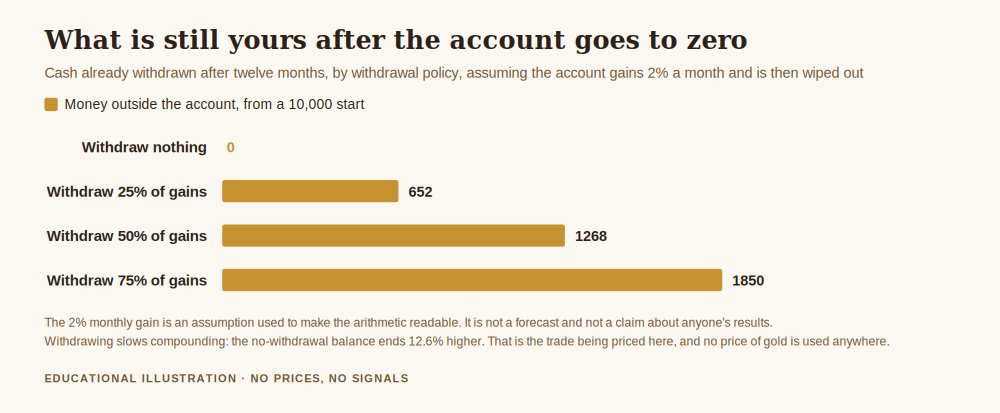
Now compare four policies. Withdraw nothing. Withdraw 25 per cent of each month’s gain. Withdraw 50 per cent. Withdraw 75 per cent. After twelve months, the balances come out at 12,682, 11,956, 11,268 and 10,617 respectively, and the cash sitting outside the account is 0, 652, 1,268 and 1,850.
Look at the cost of withdrawing first, honestly, because it is real. The trader who withdrew nothing finishes with a balance 12.6 per cent higher than the one who withdrew half of every gain. Compounding is not a myth, and taking money out of the machine slows the machine. Anyone who tells you withdrawing is free is selling something.
Now add the event that the industry prefers not to model. Suppose that at the end of the twelfth month, the account balance goes to zero. A bad week with size on, a gap through a stop, a platform you should not have trusted, a margin close out. At that moment the trader who withdrew nothing has 0, and the trader who withdrew half of each month’s gain has 1,268, because that money stopped being exposed the day it left.
You can find the break even point between those two policies. If you assign a probability to the account being wiped out at the end of the period, the two policies have the same expected value when that probability is 10.3 per cent. Below that, not withdrawing wins on expectation. Above it, withdrawing half of every gain wins. So the real question is not whether you believe in compounding. It is whether you think the chance of losing an entire retail trading account over twelve months is higher or lower than about one in ten.
I know what I think, and I suspect you do too.
Why Most Traders Never Withdraw Anything
The usual explanation is greed. I have not found that to be true. The people I have watched never take money out for three quieter reasons.
The first is that the balance has become a scoreboard. Withdrawing makes the number go down, and if the number is how you are keeping score, a withdrawal feels like a loss even though it is the only part of this activity that is unambiguously a gain. The fix is to keep two numbers: the balance, and a separate running total of everything you have ever taken out. The second number only ever rises, and once it exists, withdrawals start to feel like progress rather than subtraction.
The second is that every sum looks small compared to what it could become if it stayed. This is the trap that makes the withdrawal permanently premature. There is no balance at which this feeling goes away by itself, because the argument scales with the account. The only cure is a rule that does not consult your feelings.
The third is that withdrawing forces you to admit the number is real. While the money stays inside, gains are provisional, and so are losses. The day you send a sum to your bank account, the activity acquires a result you cannot revise. Quite a lot of people would rather not know, which is also why the same people do not track their trades properly.
The Other Reason the Money Never Leaves
There is a version of this problem that has nothing to do with your psychology, and everyone who trades online should know the shape of it.
The FBI’s Internet Crime Complaint Center publishes an annual report, and the 2024 edition records 859,532 complaints and a reported total of 16.6 billion dollars in losses, an increase of 33 per cent on the previous year. Investment fraud was the single largest category by money lost, with 47,919 complaints accounting for 6,570,639,864 dollars. Readers who trade gold might note the separate line for gold courier scams, 525 complaints and 219 million dollars, where criminals send couriers to collect cash and precious metals from victims in person.
The mechanism inside a large share of the investment fraud figure is described in the report itself. In cryptocurrency investment fraud, the confidence scheme often called pig butchering, victims are coached to invest more and more money into what appears to be an extremely profitable platform, only to be unable to withdraw their funds. That last clause is the entire con. The platform shows gains, the dashboard is convincing, the support agent is friendly, and the withdrawal never completes. Under Operation Level Up, the FBI notified 4,323 victims of cryptocurrency investment fraud, and reported that 76 per cent of them did not know they were being scammed, with estimated savings to victims of 285,639,989 dollars.
Draw the practical lesson from that. A small early withdrawal is not only a test of your own discipline, it is the cheapest possible test of whether the firm holding your money will actually give it back. A platform that makes depositing effortless and withdrawing complicated has told you something important, and it has told you while the sum at risk is still small. Run that test before the balance is worth defending, and check the firm’s registration with its regulator before you deposit at all.
A Withdrawal Policy You Can Actually Keep
A policy beats an intention because it does not require you to feel like withdrawing on the day. Four elements are enough.
Set a fixed share of gains, not a fixed sum. A share scales with what the account produces and it removes the negotiation. If the month produced nothing, the policy costs you nothing, which is what makes it survivable in a flat stretch.
Attach it to a date, not to a feeling or a milestone. The first business day of the month is ideal, because the alternative, withdrawing when it feels like enough, is exactly the feeling that never arrives.
Send it somewhere with friction. A separate savings account that takes two days to reach is better than one you can sweep back in thirty seconds. The point of the withdrawal is that the money is no longer exposed to a decision you might make on a Thursday afternoon.
Write down the share and review it twice a year. Not monthly, because monthly review is just the negotiation again with extra steps. If the account has grown enough that your share now takes out more than you want, change the number deliberately, in writing, in a calm week.
None of this requires you to be a better person than you are. That is the entire design goal.
What This Article Does Not Say
It does not say the gains are coming. The 2 per cent monthly figure above is a stated assumption used to compare four policies against each other, and every number in that comparison changes if you change the assumption. The relationship between the policies is the durable part, not the balances.
It is worth keeping the base rate in view. When the European Securities and Markets Authority restricted contracts for difference for retail clients, it published the evidence behind that decision, including national regulator findings that between 74 and 89 per cent of retail accounts typically lose money, with average losses per client running from around 1,600 to 29,000 euro. The ESMA announcement sets out the whole package. Most people reading this will not face the pleasant problem of deciding how much to withdraw. For the minority who do, the decision arrives quietly and is usually postponed.
And it does not say withdrawing is free. It costs you compounding, measurably, and the arithmetic above prices that cost rather than hiding it. What it buys is the one thing a trading account cannot give you: money that a future bad week cannot reach.
Get the free Gold Empire survival sheet, a one-page guide to protecting your account, including the withdrawal policy described in this article. One email, no spam, unsubscribe anytime.
Frequently Asked Questions
How much of my profits should I withdraw?
There is no universal figure, and anyone quoting one is guessing about your circumstances. What the arithmetic above shows is the shape of the trade: withdrawing half of each month’s gain leaves the balance 12.6 per cent lower after a year under the stated assumption, and leaves a meaningful sum beyond the reach of a bad week. Pick a share you can hold to for a year, write it down, and review it in six months.
Will withdrawing ruin my compounding?
It slows it, measurably, and the figures above quantify that rather than dismissing it. Whether the slowdown is worth paying for depends entirely on how likely you think a total loss of the account is. At a probability above roughly one in ten over a year, withdrawing half of each gain comes out ahead on expectation under these assumptions.
Why is my broker sending money back to my card instead of my bank?
Because anti money laundering rules generally require funds to return by the route they arrived, up to the amount originally deposited. Only the surplus above your deposits typically goes out by another method. It is a compliance requirement rather than an obstruction.
What if a platform refuses to process my withdrawal?
Treat it as the most serious warning sign there is. Being unable to withdraw is the defining feature of the investment fraud described in the IC3 report linked above, which recorded 6.57 billion dollars of investment fraud losses in 2024. Stop depositing immediately, keep all records, contact the firm’s regulator and file a complaint with the relevant national authority.
Where did the numbers in this article come from?
The balances, the withdrawn totals, the 12.6 per cent gap and the 10.3 per cent break even probability are arithmetic on one stated assumption, 2 per cent a month for twelve months from a 10,000 start, and you can reproduce them in a few lines of code. The fraud figures are quoted directly from the FBI IC3 2024 annual report and the regulatory figures from the ESMA announcement, both linked above. No gold price appears anywhere in this article.
Where Gold Empire Fits
Gold Empire is free to follow. Daily XAU/USD analysis on Telegram, with the reasoning stated before the trade rather than after it, losing days included. There is a free survival sheet for anyone who wants the capital protection material in one place, and an optional Kit for people who want the full method. Nothing here promises a profit and nothing here is a signal service.
The pillar this sits under is risk management for gold trading, the account setup groundwork is in how to open a gold trading account, and the funding side is covered in the best way to fund a brokerage account. More about who writes this is on the about page.
About the author. Matthew writes Gold Empire and spends most of his attention on the boring mechanics that decide whether an account is still open in two years. He has taken small withdrawals from every account he has ever run, mostly because he once watched a very good year become a rounding error in a single week and decided he would rather be slightly poorer on paper. Nothing in this article is a recommendation to trade, and no entry, stop or target discussed should be treated as a signal.
Disclaimer: This article is general educational content about account administration, withdrawal mechanics and risk policy in retail trading. It is not financial advice, not investment advice, not tax advice and not a recommendation to buy, sell or hold any instrument, product or firm. Broker terms, payment rules and verification requirements differ by firm and by jurisdiction, so check your own broker’s current terms and your own tax obligations before acting. The growth figures used are stated assumptions for arithmetic, not predictions or performance claims. Trading leveraged products carries a substantial risk of loss and most retail accounts lose money.
One step first
Where should we send the Gold Survival Sheet?
Leave your email and we will send the free one page checklist, then take you straight to the Telegram channel.
No cost and no obligation. Educational only, not financial advice, and nothing here promises a return. Unsubscribe any time in one click.
Leave a Reply