
There is a particular kind of message that arrives in the Gold Empire group after a fast hour, and it always has the same shape. The stop was set. The stop was hit. The account lost more than the stop said it would. Somewhere underneath that message is a question the person has never had to ask before, because nobody warned them it was a question at all: what happens if a market order is not filled at the price you were looking at when you sent it.
The honest answer is that a market order is almost never rejected outright, and that is exactly why the problem catches people. It fills. It just fills somewhere else. That distance is not a glitch, not your broker being dishonest, and not something you can appeal. It is written into the definition of the order type, and most people trading gold have simply never read it. This article is about where the distance comes from, how large it gets, when it gets large, and what it does to an account that was sized on the assumption it would not exist.
What happens if a market order is not filled at your price, in the regulator’s own words
Start with the definition, because the definition contains the whole answer and it is a single sentence. The United States Commodity Futures Trading Commission maintains a public glossary of market terms. Its entry for a market order reads:
An order to buy or sell a futures contract at whatever price is obtainable at the time it is entered in the order book, ring, pit, or other trading platform.
Read the phrase “at whatever price is obtainable” again, slowly. There is no reference to the price on your screen. There is no reference to the price you clicked. A market order is an instruction about urgency, not about price. You are telling the market that you want the trade done now and that you are accepting, in advance, whatever the market charges for doing it now.
Which means the question “what happens if a market order is not filled” is slightly the wrong question, and finding the right one is the useful part. The order will get filled. The thing that can fail is the assumption you attached to it. You assumed the price would be the one you saw. Nothing in the instruction you sent contained that assumption.
People accept this reasonably calmly when it applies to an entry. They do not accept it calmly when they discover where else it applies.
Your stop loss is a market order wearing a different name
Here is the same glossary, a few entries further down, defining a stop order:
This is an order that becomes a market order when a particular price level is reached. A sell stop is placed below the market, a buy stop is placed above the market. Sometimes referred to as stop loss order.
That is the sentence that changes how you should think about your risk. The protective order most traders rely on, the one that lets them say “my risk on this trade is fixed”, is not a promise of a price. It is a trigger that converts into a market order, and a market order takes whatever is obtainable. Your stop defines the moment you leave. It does not define the price at which you leave.
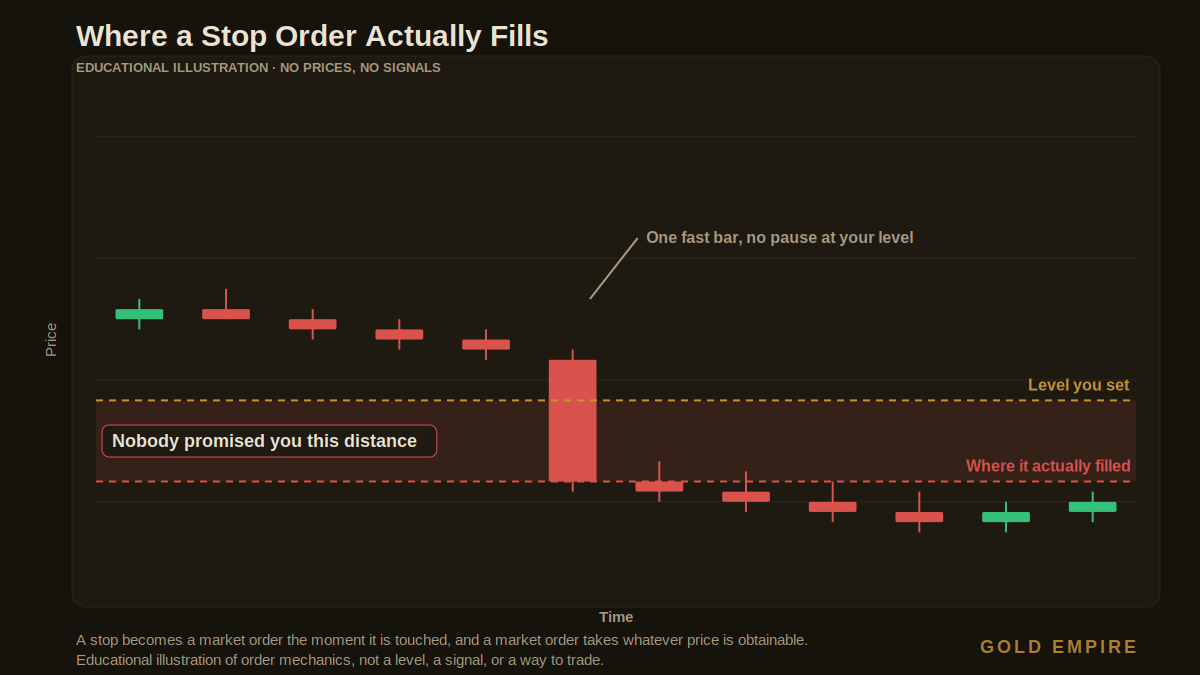
This is not a flaw somebody should fix. It is the only way a stop could work. An order that guaranteed your price would have to refuse to trade whenever your price was unavailable, which is precisely when you most need out. That version exists, it is called a stop limit, and its failure mode is worse: it can decline to fill at all and leave you holding a position you had decided to close. You get to choose which of the two ways your safety equipment is allowed to disappoint you. You do not get to choose neither.
The exchanges treat cascading stops as a known hazard rather than an edge case. The same CFTC glossary documents a feature on CME’s electronic platform called Stop Logic Functionality, which deliberately pauses matching when triggered stop orders would otherwise push the market too far too fast. The mechanism exists because stops firing into thin liquidity is a normal, expected event that markets are engineered around.
Why the fill moves furthest exactly when you need it most
The distance between your level and your fill is not random across time. It concentrates. To show how much, I took the daily gold benchmark published by the London Bullion Market Association, every afternoon auction in US dollars from 1 January 1975 to 24 September 2026, which is 12,979 day to day changes. I measured each day’s absolute move, added them all together, and asked how that total was distributed.
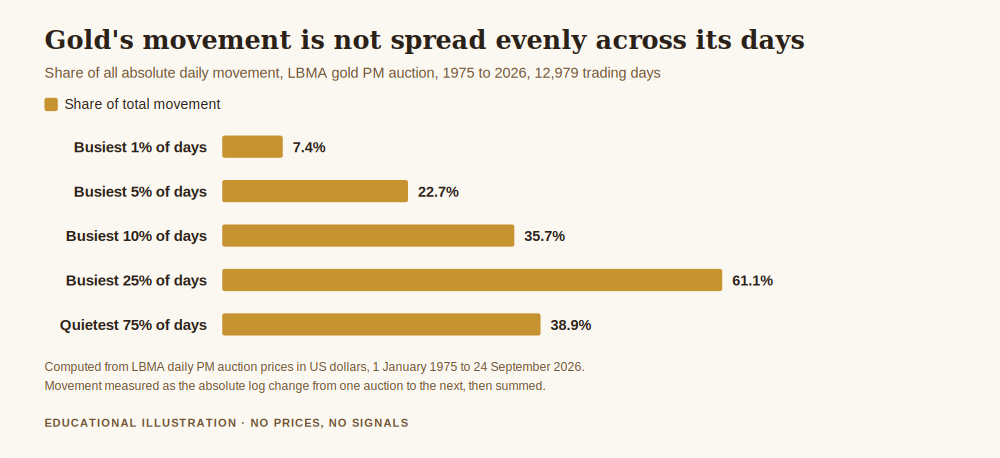
The busiest one percent of days, 129 sessions out of 12,979, carry 7.4 percent of all the movement gold has made in fifty one years. The busiest five percent carry 22.7 percent. The busiest ten percent carry 35.7 percent. The busiest quarter of all days carry 61.1 percent, which leaves the remaining three quarters of the calendar sharing 38.9 percent between them.
The median day moves 0.533 percent. Days that move two percent or more happen 7.85 percent of the time, and when they happen their average size is 3.10 percent, which is 5.8 times the median day.
Now put the two facts side by side. A stop is a market order, so its fill quality depends on how fast price is travelling when it triggers. And gold’s travelling is concentrated into a small number of days. Your stop does not trigger on a random day. It triggers disproportionately on the days that are moving, because those are the days that reach it. The distribution of days on which your protection is tested is not the distribution of ordinary days. It is skewed towards exactly the sessions where “whatever price is obtainable” is furthest from what you were looking at.
This is why comparing your average fill to your expected fill across a calm month tells you almost nothing about the month that matters.
What the distance costs, counted in planned risks
Say your stop sits one planned risk away from your entry. Call that distance 1R, which is simply the amount you decided in advance you were willing to lose on the trade. If the fill arrives past your level, the realised loss is no longer 1R. Here is the arithmetic, and the only assumption in it is that your winners pay two planned risks:
- Fill 10 percent of the stop distance beyond your level, and the loss is 1.10R. The winners needed to recover it rise by 10 percent.
- Fill 25 percent beyond, and the loss is 1.25R. Recovery cost rises 25 percent.
- Fill 50 percent beyond, and the loss is 1.50R. Recovery cost rises 50 percent.
- Fill a full stop distance beyond, and the loss is 2.00R. You now need a whole winner to undo one loser, where you had planned on half of one.
The number that should get your attention is not any single row. It is that this tax is charged on losing trades only. Slippage on an entry can help you as often as it hurts. Slippage on a stop is asymmetric by construction, because the stop only triggers when the trade is going against you, and going against you fast is precisely the condition that widens the fill. A cost that only ever lands on your worst days compounds differently from a cost spread evenly across all of them.
Notice what this does to position sizing. If you size so that a 1R loss is a survivable fraction of the account, and the real distribution of your losses has a tail at 1.5R and 2R, you have sized for a distribution you do not have. The gap is invisible in a quiet month and expensive in the month that is not.
The four ways a market order actually goes wrong
Rejection is real but rare, and the four failure modes deserve separating, because the response to each is different.
It fills away from your price. The common one, described above. Not an error, not appealable, and the only one that reliably costs money on stops.
It is rejected for insufficient margin. The account lacks free margin at the moment the order arrives, usually because something else moved against you in the meantime. This one is silent in a way the others are not, because you may believe you are in a trade that you are not in.
It is rejected because the instrument is not trading. Weekend, a scheduled break, or a venue level halt. Your order waits or dies depending on the platform, and the price on the other side of the pause is whatever the pause produces.
It is requoted. Some venues answer a market order during fast conditions with a new price and a request to confirm. In the seconds you spend deciding, the market keeps moving.
The first is a cost. The other three are a different problem, which is believing you are protected when you are not. That is why “did my order actually execute” belongs on the same short checklist as “where is my stop”, especially after any minute where price moved quickly.
The regulatory backstops define the floor rather than the fill. When European regulators intervened in retail contracts for difference, the measures included a margin close out rule and negative balance protection, both applied per account, alongside leverage caps. The same ESMA announcement recorded that between 74 and 89 percent of retail accounts lost money on these products. Negative balance protection bounds the worst case at the account. It does not mean your stop filled where you wanted.
What to do about it without pretending you can control it
You cannot control the fill. You can control four things around it, and all four are decisions made before the market is moving.
The first is to stop treating 1R as a ceiling and start treating it as an estimate. If your sizing only survives when every loss is exactly the planned size, it is not sizing, it is a hope.
The second is to measure your own fills instead of assuming them. Every platform shows the price you asked for and the price you received. Two columns in whatever record you already keep will tell you more about your real cost of trading than any general article can, including this one. If you do not have that record yet, how to track my trades covers what is worth writing down.
The third is to know which sessions you are asking your stop to work in. Holding through a scheduled release means holding through the part of the day where the distance is widest, which is the subject of how to trade gold through high impact news. That is not an instruction to avoid news, it is an instruction to know the trade you are making.
The fourth is to choose the level before the market is in front of you, so that when the fill arrives past it you are dealing only with the distance and not also with the decision. Where to place a stop loss on XAUUSD deals with that half.
None of this makes the fill better. It makes the account able to absorb a fill that is worse than planned, which is the only version of this problem that has a solution.
Get the free Gold Empire survival sheet, a one page guide to protecting your account through the kind of fast market this article describes. One email, no spam, unsubscribe anytime.
Frequently asked questions
What happens if a market order is not filled at all?
Outright rejection is uncommon and has specific causes: not enough free margin, the instrument not currently trading, or a platform level refusal during fast conditions. In each case no position is created, which matters most when the order was meant to close a trade rather than open one. Check the order status rather than assuming, because a rejected closing order leaves you exposed while you believe you are flat.
Is a fill away from my price the same thing as my broker cheating me?
Usually no. A market order is defined as accepting whatever price is obtainable, so a fill away from your screen price is the order working as specified. What would be worth investigating is a pattern that only ever runs one way across many trades in ordinary conditions. Without your own record you have no way to tell an ordinary cost from an unusual one.
Does a stop loss guarantee my maximum loss?
No, and this is the single most expensive misunderstanding in retail trading. A stop becomes a market order when touched, so it fixes the moment of exit, not the price of exit. The loss can be larger than planned, and it is largest in exactly the fast conditions that triggered it. Size on the assumption that some losses will exceed the plan.
How is this different from a limit order not filling?
Completely different, and in your favour. A limit order that does not fill costs nothing at all, because there is no trade: no spread, no commission, no exposure, as covered in what happens if a limit order is not filled. A market order that fills badly has already cost you money. One is a missed opportunity, the other is a realised expense.
What about an order that only partly fills?
That is a third case again, with its own consequences for the risk you are actually carrying, and what happens if an order is partially filled works through it. The short version is that a partial fill quietly changes your position size, so the risk you calculated is no longer the risk you have.
Would a stop limit order solve this?
It solves the price problem by creating a worse one. A stop limit will not fill beyond the limit you set, which sounds like protection until the market moves past your band without trading inside it. Then the order does nothing and you still hold the position. You are choosing between a bounded exit at an uncertain price and an uncertain exit at a bounded price.
Where did the numbers in this article come from?
The two definitions are quoted from the CFTC glossary, linked above. The movement statistics are my own arithmetic on the LBMA afternoon gold auction in US dollars, also linked, using every observation from 1 January 1975 to 24 September 2026, which is 12,979 daily changes. Movement is measured as the absolute logarithmic change between consecutive auctions, then summed. The stated limitation is that one auction price per day cannot see what happened inside the day, so these figures describe the shape of the distribution rather than the size of any individual fill. The R arithmetic is straightforward division under the single stated assumption that winners pay two planned risks. No gold price level appears anywhere in this article.
Where Gold Empire fits
Gold Empire is free to follow. Daily gold analysis with the reasoning written out, losing days included, plus an optional Kit for people who want the method in one place. There is no promise of profit here, because nobody honest can make one.
Knowing that your protective order is an estimate rather than a guarantee is a sizing question before it is anything else, which is why this sits under risk management in gold trading. If you are still setting the account up, how to open a gold trading account covers the ground before any of this applies, and you can read more about who writes this on the about page.
About the author
Matthew has spent a long time around gold, most of it learning things the slow way, and now writes them down so other people can learn them the fast way. He would rather explain the mechanism that quietly widens a loss than the setup that fills a timeline, because the first one is what decides whether an account is still here next year. Nothing in this article is personal advice, and no entry, stop or target discussed should be treated as a signal.
This article is educational content about order types and execution mechanics. It is not investment advice, not a recommendation of any broker, platform or order strategy, and not a solicitation to trade. The order definitions are quoted from the public glossary of the CFTC. The price series is the daily gold benchmark published by the LBMA, and every statistic drawn from it is my own arithmetic under the assumptions written out above, including the limitation that a single daily auction price cannot observe intraday execution. Historical frequencies describe what has already happened and are not a forecast of what any future order will do. Order handling, rejection rules, requote policy and margin treatment differ between venues, so check your own platform’s documentation and client agreement rather than relying on a general description. Trading carries risk of loss.
One step first
Where should we send the Gold Survival Sheet?
Leave your email and we will send the free one page checklist, then take you straight to the Telegram channel.
No cost and no obligation. Educational only, not financial advice, and nothing here promises a return. Unsubscribe any time in one click.
Leave a Reply