
A member wrote to me in September with one line: “My brother keeps telling me to put money into gold. Is buying gold worth it, or is he just repeating something he heard?” I liked the question because it was honest about not knowing, and because it is almost impossible to answer in the form it was asked. Worth it compared to what, over what period, and to do what job? Nobody can tell you what gold will be worth next year, and anyone who offers to is selling something.
What I can do is show you who actually buys the metal, in what quantity, and for what stated reason. That is a matter of public record, published quarterly, and it is far more useful than a forecast. So this article is a reading of the demand data, plus my own arithmetic on what holding gold costs you while you wait.
Every calculation below is mine, from assumptions I write out as I go. The tonnage figures come from the World Gold Council’s quarterly report, linked where I use them. There is no gold price anywhere in this article, no target, and no recommendation to buy anything.
Is buying gold worth it? Start by asking who is already buying
In the second quarter of 2026, total gold demand including over the counter activity came to 1,268.9 tonnes, unchanged against the same quarter a year earlier. The first half of the year ran to 2,522 tonnes, about two per cent higher than the year before, at a record total value of 380 billion dollars. Those figures are in the World Gold Council’s Gold Demand Trends report for the second quarter of 2026, published on 30 July 2026.
Underneath that flat headline, the composition is the interesting part. Four groups buy gold, and they do not want the same thing from it.
- Central banks and other institutions took 288.9 tonnes in the quarter.
- Bar and coin buyers, which is private individuals holding metal, took 307.1 tonnes.
- Jewellery consumption came to 278.2 tonnes, the lowest quarterly volume since the pandemic.
- Technology, mostly electronics, used 80.4 tonnes.
- Gold backed exchange traded funds went the other way entirely, shedding 44.8 tonnes.
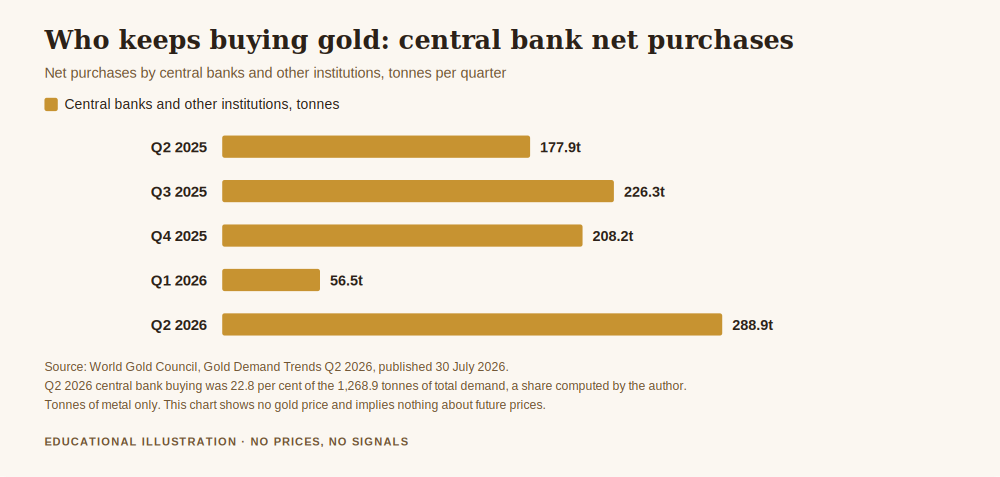
Run the division and central banks were 22.8 per cent of total demand in the quarter. That is my calculation, 288.9 divided by 1,268.9. Close to a quarter of everything bought was bought by institutions whose job is not to make a return.
The buyer who never explains himself in a quarterly call
I want to sit on the central bank number, because it is the one most retail arguments about gold ignore completely.
Look at the run of quarters. Central banks took 177.9 tonnes in the second quarter of 2025, then 226.3, then 208.2, then a sharp slowdown to 56.5 tonnes in the first quarter of 2026, then 288.9 tonnes in the second. Add the last four of those and you get 779.9 tonnes in a year, an average of 195 tonnes a quarter. That addition is mine, from the same published table.
Central banks are not momentum buyers. They do not have a stop loss, they are not trying to beat an index, and they are not going to sell because the chart looked ugly on a Tuesday. They hold gold because it is a reserve asset that is nobody else’s liability. That last phrase is the whole of it. A government bond is a promise from a government. A bank deposit is a promise from a bank. A bar of gold in a vault is not a promise from anyone, which is exactly why it is dull and exactly why institutions keep it.
You can watch this yourself month by month in the World Gold Council’s monthly central bank statistics, which are built from reported official reserve data rather than from anyone’s opinion.
Two sets of buyers walked in opposite directions last quarter
Here is the detail I find most instructive for a private buyer. In the same three months, central banks bought 288.9 tonnes while exchange traded funds shed 44.8 tonnes. The gap between the two is 333.7 tonnes, my subtraction.
The Council attributes the fund outflows to softer gold prices and to shifting expectations for inflation and interest rates, particularly in North America. That is a perfectly rational response from a fund investor, who is holding gold as a position and will reduce it when the case for the position weakens.
So the two groups are not disagreeing about the facts. They are holding gold for different jobs. One treats it as a trade that can be wrong. The other treats it as a reserve that does not need to be right this year. Before you decide whether buying gold is worth it for you, decide which of those two people you are. The answer changes everything that follows, including how much a bad quarter should bother you.
What it costs to hold, which almost nobody counts
Owning gold is not free, and the cost is quiet enough that people forget to subtract it.
Physical metal costs a dealer margin when you buy, a spread when you sell, and either storage or the risk of keeping it at home. A fund charges an annual management fee. That fee is small enough to ignore in any single year and large enough to matter over the holding period a reserve asset implies.
Let me put numbers on it. Assume a fee charged annually against the value of the holding, no trading, and no tax. The fraction of your stake the fee consumes over a period is one minus the quantity one minus the fee, raised to the number of years. On that basis:
- At 0.25 per cent a year, ten years consumes 2.47 per cent of the stake, and twenty years 4.88 per cent.
- At 0.40 per cent a year, ten years consumes 3.93 per cent, and twenty years 7.70 per cent.
- At 0.75 per cent a year, ten years consumes 7.25 per cent, and twenty years 13.98 per cent.
Those are my calculations, and the assumptions are stated above so you can redo them with your own fee. The point is not that 0.75 per cent is scandalous. The point is that a reserve you intend to hold for twenty years should be bought in the cheapest wrapper you can find, because the fee compounds against you for the entire holding period while the reason you bought it sits unchanged.
If you want the comparison between wrappers done properly, gold ETF versus physical gold returns and whether to buy physical gold or gold stocks cover the two choices either side of this one.
Where supply comes in, and why it moves less than you would think
Total supply in the quarter was also 1,268.9 tonnes, matching demand as it must in this accounting. Mine production contributed 965.6 tonnes, up two per cent on the year. Recycling contributed 326.1 tonnes, down six per cent, as softer prices discouraged people from selling old jewellery.
Notice how small those movements are. Mining gold is slow. A new deposit takes many years to reach production, which means supply cannot respond quickly to a change in demand. That is the structural fact behind most of gold’s behaviour, and it is worth understanding before you form a view on whether owning any is sensible.
Recycling is the faster valve, and it works in the direction you would expect: when the metal is dear, more old jewellery comes back to the refiners, and when it softens, less does. The six per cent decline is that valve closing slightly.
What gold does not do, said plainly
This is the part of the answer my member’s brother had skipped.
Gold produces no income. A bar in a vault pays no dividend, no coupon and no rent, and in twenty years it will still be the same bar. Everything you make or lose is the change in what somebody else will pay for it. That is a real limitation, not a technicality, and it is why gold is a poor substitute for assets that generate cash.
Gold is also not insurance in the sense people mean when they say it. It does not reliably rise when equities fall, in any given week or month, and a buyer who expects that precise behaviour will be disappointed on a regular basis.
And gold is capable of long, boring periods of going nowhere while other things rise. If you cannot sit through that without changing your mind, the demand data in this article will not save you, because the behaviour that erodes accounts is not usually the choice of asset. It is the changing of that choice halfway through under pressure.
Trading gold and owning gold are different activities
I should separate two things that get blurred, because most readers of this site arrive through the trading door.
Owning gold is a decision about what fraction of your savings sits in an asset that is nobody’s liability. It is measured in years and it does not involve leverage.
Trading gold is something else. It is a leveraged position on short term price movement, where the dominant risk is not whether gold is a sensible asset but whether your position is too large for your account. The demand numbers in this article tell you almost nothing about that, and I would not want anyone reading a 288.9 tonne figure as a reason to take a position of any particular size. If trading is what you are weighing, how much money to start trading gold is the more relevant piece, and the sizing arithmetic in it matters more than any demand statistic.
Get the free Gold Empire survival sheet, a one-page guide to protecting your account through the kind of market this article describes, including how to decide what a holding is for before you fund it. One email, no spam, unsubscribe anytime.
Frequently asked questions
Is buying gold worth it for a small saver?
That depends entirely on the job you want it to do, and I will not answer it as a recommendation. What the data supports is narrower: institutions bought 288.9 tonnes in the second quarter of 2026, close to a quarter of all demand, and they buy it as a reserve rather than for a return. If you want an asset that produces income, gold is the wrong instrument. If you want a small part of your savings in something that is not a promise from an institution, that is the case people are actually making, and the sensible size of it is a question for your own circumstances.
Why did funds sell gold in the same quarter central banks bought it?
Because they hold it for different reasons. Exchange traded funds shed 44.8 tonnes in the quarter, which the World Gold Council attributes to weaker prices and to shifting inflation and interest rate expectations. A fund investor holds gold as a position that can be wrong. A central bank holds it as a reserve that does not need to be right this year.
Does the record demand value mean gold is expensive?
No, and this is a common misreading. The first half of 2026 set a record total value of 380 billion dollars on 2,522 tonnes. Value equals tonnes multiplied by price, so a record value can come from a higher price rather than from more metal changing hands. Volume was up about two per cent. Read tonnes when you want to know about demand and value when you want to know about the size of the market.
How much does holding gold cost each year?
It depends on the wrapper. Physical metal costs a dealer margin at both ends plus storage. A fund charges an annual fee. On my arithmetic, assuming the fee is charged yearly against the holding, a 0.40 per cent fee consumes 3.93 per cent of the stake over ten years and 7.70 per cent over twenty. That is not a reason to avoid funds, it is a reason to compare fees when the intended holding period is long.
Is jewellery a good way to own gold?
Jewellery consumption was 278.2 tonnes in the quarter, the lowest since the pandemic, with spending up 14 per cent as prices rose and volumes fell. As an ornament it is its own reward. As a holding it carries a large making charge you rarely recover on sale, so the gap between the buying price and the selling price is wider than for a bar or a fund.
Should I trade gold instead of owning it?
They are different activities and the second is considerably more dangerous. Trading involves leverage, and with leverage the size of the position decides the outcome far more often than the view does. Nothing in this article is a reason to open a position, and no figure here says anything about where the price goes next.
Where Gold Empire fits
Gold Empire is a free education channel about surviving in gold before trying to grow in it. Everything here is free to read and free to follow on Telegram. The one optional piece is the survival sheet above, a single page on protecting an account. We do not promise profits, we do not publish account results, and we do not believe anyone can tell you what your account or your savings will do. If you want the fuller version of the thinking behind this site, risk management for gold trading is the piece everything else hangs off.
About the author. Matthew writes Gold Empire. He bought his first gold for the wrong reason, a forecast he had read and could not have defended, and he has spent the years since learning to ask what a holding is for before asking what it will be worth. Nothing in this article is financial advice or a recommendation to buy or trade, and no entry, stop or target discussed should be treated as a signal. Trading leveraged gold carries a substantial risk of loss and is not suitable for everyone.
One step first
Where should we send the Gold Survival Sheet?
Leave your email and we will send the free one page checklist, then take you straight to the Telegram channel.
No cost and no obligation. Educational only, not financial advice, and nothing here promises a return. Unsubscribe any time in one click.
Leave a Reply