

How do I complain about a broker is a question that arrives in my inbox in two very different states, and the answer depends entirely on which one you are in. Sometimes a trader is angry about something the broker is contractually entitled to do, and the complaint will go nowhere because there is nothing to complain about. Sometimes money has actually been taken, and the person is about to spend three weeks writing polite emails during the only window in which that money could have been frozen. Telling those apart in the first hour is the whole game.
So this is not a guide to writing a strongly worded letter. It is a guide to working out what happened, choosing the route that matches it, and moving at the speed that route rewards. I have included the published recovery figures, because they make the argument for urgency better than I can.
First, sort what happened into one of three boxes
Before you write anything, decide which of these you are dealing with. They have different routes and different odds.
One, a term you agreed to. The requirement was raised, the swap was charged, the weekend gap moved through your stop, the spread widened around a release. These feel like injustices and are almost never complaints, because the behaviour is in the contract you accepted. If this is your box, the useful action is to read the terms properly and decide whether you want to stay, not to file anything.
Two, a service failure. The platform was down while you held a position, a withdrawal has sat unprocessed past the published timescale, an order was handled contrary to the firm’s stated policy, or support has stopped answering. This is a genuine complaint, it goes through the firm’s complaints procedure first, and it can escalate to the regulator or an ombudsman scheme afterwards.
Three, fraud. The firm was never what it claimed, the withdrawal was refused with escalating demands for fees or taxes, the account statement does not correspond to anything real, or the entity has gone quiet. This is not a complaint at all. It is a crime report, and the clock on it is measured in hours rather than weeks.
Most of the damage I see comes from people in box three behaving as though they are in box two, working patiently through a complaints procedure at an organisation that has no intention of answering, while the money moves.
Why the speed matters so much in box three
This is the part worth internalising even if you never need it. When funds are reported fast enough, they can sometimes be frozen before they are gone, and there is a published record of how often that works.
The FBI’s Internet Crime Complaint Center runs a Recovery Asset Team, which exists to contact receiving financial institutions quickly and freeze fraudulent transfers. Its 2025 Annual Report gives the year’s figures directly: 3,900 incidents, $1,163,919,846 in attempted theft, and $679,013,183 frozen, which the report states as a 58 per cent success rate. Dividing the frozen total by the attempted total gives 58.3 per cent, so their headline figure and the underlying numbers agree.
Work out the per incident average and the point lands harder. Across those 3,900 incidents, the average attempted theft was about $298,400 and the average amount frozen was about $174,100. That is not a consolation payment, it is a substantial share of real money returning to real people, and the report is explicit about what makes it possible. Its own instruction reads: “Regardless of the amount lost, file a complaint at www.ic3.gov. Be sure to include the full transaction details in your report.” The report notes the process works best when complaints “are filed as quickly as possible”.
Nothing in that process is triggered by complaining to the firm that took your money. It is triggered by reporting the transaction to the people who can call the receiving bank.
How do I complain about a broker through the proper channel
For box two, the service failure, the sequence is boring and it matters that you follow it in order, because skipping a step usually gets your case returned to you.
Start with the firm’s own complaints procedure, in writing, addressed to the complaints function rather than to live chat. Most regulated firms are obliged to operate one, to acknowledge your complaint, and to issue a final response within a defined period. You want that final response in writing, because it is usually the document that unlocks the next stage. State what happened, when, what you want done about it, and attach your evidence. Keep it factual and unemotional, not because the firm deserves courtesy, but because a short factual complaint is harder to deflect than a long angry one.
If the final response does not resolve it, or the deadline passes without one, escalate to the regulator or dispute scheme that covers the firm. In the United States, derivatives customers have a specific forum: the CFTC reparations program, which the Commission describes as providing “an inexpensive, expeditious, and fair forum to resolve disputes between derivatives customers” and registered professionals. Three details from that page are worth knowing before you start. There is no size threshold: “You are not limited by a minimum or maximum amount of damages in your claim.” There is a deadline, and the page refers to a two year window for refiling a withdrawn complaint. And it is not quick: a voluntary proceeding is “typically decided within 12 months”, while summary and formal proceedings “typically require between 12 to 18 months”. An appeal to the Commission carries a $50.00 filing fee.
Twelve to eighteen months is the honest timescale for a contested dispute, and knowing that in advance is itself useful. It tells you that this route is for recovering a significant sum, not for settling a point of principle about a $40 swap charge.
The evidence you need, gathered before you write
Whichever box you are in, the quality of what you can show decides the outcome. Collect these before the account portal stops letting you in, which is a thing that happens.
- Full statements and the complete trade history, exported, not screenshotted where an export exists.
- Every deposit and withdrawal record from your own bank or payment provider, with dates, amounts, reference numbers and the receiving account details.
- The terms and conditions as they were when you opened the account, if you kept them, and the current version.
- All correspondence, including live chat transcripts, saved as files rather than left on their server.
- The firm’s regulatory details as advertised, and a note of what the regulator’s own register says, which is often where the story changes.
That last item is the one people skip. Checking the register against the claim is also the check that would have prevented most of this, and it is the same instinct I argue for in what an ECN broker actually is, where the marketing label and the legal reality frequently differ.
The scale of what sits in box three
It is worth seeing where investment fraud sits relative to everything else reported, because it changes how seriously you take the verification step.
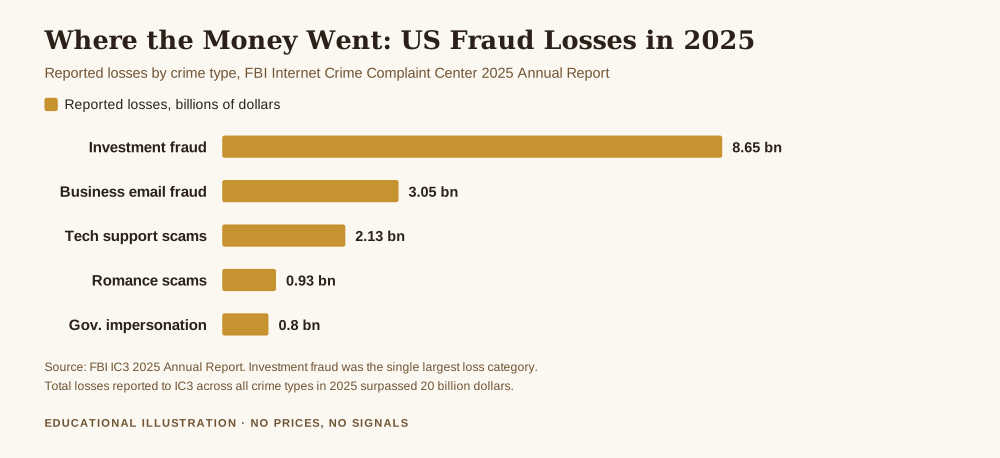
In 2025 the IC3 recorded 72,984 investment fraud complaints with reported losses of $8,648,617,756. That is the largest single loss category in the report, 2.84 times the next one, business email compromise, at $3,046,598,558. Dividing the loss by the complaint count gives an average reported loss of about $118,500 per complaint. The report also states that total losses across all crime types surpassed the $20 billion mark, so investment fraud alone accounts for something in the region of 43 per cent of everything reported.
An average of $118,500 is not a story about people losing pocket money to an obvious scam. It is a story about people losing substantial savings to something that looked credible enough to fund repeatedly, which is exactly why the verification habit matters more than the complaint procedure. The complaint is what you do when prevention has already failed.
What a complaint cannot do for you
I want to be direct about this, because false hope here costs people a second round of money to recovery firms that are themselves frauds.
A complaint cannot reverse a trading loss. If you took the position, the position moved against you, and the firm executed according to its terms, there is no forum that will give that money back, and no regulator who will accept that losing is itself a grievance. The distinction a regulator draws is between a firm that behaved improperly and a market that behaved normally, and most of what hurts is the second one. That is the whole argument for sizing positions so that the market behaving normally cannot end you, which is what risk management in gold trading is actually for.
A complaint also cannot create a regulator where none exists. If the firm is registered nowhere, or registered in a jurisdiction with no dispute scheme, there may be no civil route at all, and the crime report is the only meaningful action. This is the real cost of choosing a venue on spread alone, and it is a cost you pay only once, at the worst possible moment. The same logic runs through what happens if your forex broker goes bust, where the protections that matter were all decided before anything went wrong.
Finally, be suspicious of anyone who approaches you offering to recover funds for an upfront fee after you have been defrauded. Victim lists circulate, and the second approach is frequently run by people connected to the first. No legitimate route to recovery begins with a stranger contacting you and asking for money, a pattern I have written about separately in whether forex signal groups are legitimate.
What I would actually do, in order
If I believed money had been taken rather than lost, I would do these in this sequence, today, before writing a single complaint letter: contact my own bank or payment provider to report the transaction and ask what they can still stop, file the report with the national crime reporting body with full transaction details attached, notify the regulator the firm claims to be authorised by, and only then open a formal complaint with the firm itself if it is a real firm. If instead the firm is real and the issue is service, I would reverse that order entirely, start with the firm’s complaints procedure in writing, and hold the escalation in reserve.
One sentence is worth keeping from all of this. The complaint is the slow route and it is sometimes the right one, but the freeze is the fast route and it closes quickly, so decide which you are in before you decide how politely to write.
Get the free Gold Empire survival sheet, a one-page guide to protecting your account, including the checks on a venue that are far cheaper to do before you fund it than after. One email, no spam, unsubscribe anytime.
Frequently asked questions
How do I complain about a broker if it is regulated offshore?
Start by checking the regulator’s public register rather than the firm’s own claim, because the two disagree more often than people expect. If the registration is real, that regulator’s complaints route is your route, though the protections and timescales vary enormously between jurisdictions. If the registration does not exist, or names an entity different from the one holding your money, you are not in a complaint situation at all, and the crime report and your payment provider are the two calls worth making first.
Can I get my money back if my trades simply lost?
No, and it is kinder to say so plainly. If the firm executed within its published terms and the market moved against your position, there is no complaints body that treats a loss as a grievance. The route exists for improper conduct by the firm, not for an unprofitable outcome. This is why the protective work has to happen at position sizing, before the trade, rather than at the complaints stage afterwards.
How long does a formal complaint take?
Longer than almost anyone expects. For the US derivatives route, the CFTC’s own page states that a voluntary proceeding is typically decided within 12 months, while summary and formal proceedings typically require between 12 to 18 months. Firms also get a defined window to issue their final response before you can escalate at all. Plan for a year, and do not let that timescale stop you from making the fast reports first, which operate on a completely different clock.
Is it worth reporting if the amount is small?
Yes, and the IC3 report says so in as many words: “Regardless of the amount lost, file a complaint at www.ic3.gov.” Small reports build the pattern that identifies an operation, and the transaction details you provide can assist a freeze on somebody else’s larger transfer to the same account. Your individual odds on a small sum may be poor, but the reporting is close to free and the aggregate value of it is not.
Should I pay a recovery firm that contacts me?
No. Treat an unsolicited approach offering to recover your funds for an upfront payment as a second fraud attempt, because that is overwhelmingly what it is. Victim lists are traded, and the people who took the first payment are often connected to the people offering to retrieve it. Legitimate recovery runs through your bank, the crime reporting body and the regulator, and none of those three will cold call you asking for a fee.
What Gold Empire actually does
Gold Empire is a free channel about surviving in gold rather than getting rich in it. There is no signal service here and nothing is sold on the promise of a return. The free Gold Survival Sheet is a single page on protecting an account, and the checks it lists on a venue take about twenty minutes and are the cheapest insurance in this entire article. The only thing it asks for is an email address you can unsubscribe from.
The model is deliberate. Follow along for free, read the arithmetic, and decide for yourself. If a piece of writing ever makes you feel you must act immediately, that is a reason to be suspicious of the writing, including mine. The one exception is the subject above, where speed genuinely is the variable, and that is precisely why it is worth knowing the sequence before you need it.
About the author
Matthew writes Gold Empire. He spent a fortnight once helping someone compose an immaculate complaint to an entity that had never been authorised anywhere, which was two weeks in which nobody called a bank, and he has thought about the order of operations differently ever since. He has no interest in telling anyone where price is going. You can read more about the approach on the about page.
This article is educational and is not financial advice, and it is not legal advice. Trading gold carries a high risk of losing money rapidly, and no entry, stop or target discussed should be treated as a signal. The recovery figures, complaint counts and loss totals are quoted from the FBI Internet Crime Complaint Center 2025 Annual Report, and the reparations procedure, timescales and the $50.00 appeal fee are quoted from the CFTC’s published reparations program page, both linked above. The per incident and per complaint averages are my own arithmetic from those published totals. Procedures, deadlines and the protections available differ by country and by regulator, and your own firm’s terms and your own jurisdiction govern your situation, so verify both before acting. Decide your own risk, and never trade money you cannot afford to lose.
One step first
Where should we send the Gold Survival Sheet?
Leave your email and we will send the free one page checklist, then take you straight to the Telegram channel.
No cost and no obligation. Educational only, not financial advice, and nothing here promises a return. Unsubscribe any time in one click.
Leave a Reply