

Every few months someone asks me how to become a good trader, and they are almost always asking a different question underneath: how long until this works. I understand the impulse. I want to answer it with arithmetic rather than encouragement, because the arithmetic is more useful and, in the end, kinder.
There is no shortcut. That sentence gets said so often it has stopped meaning anything, so below I have worked out what it actually costs in trades and in time. No entry, stop or target discussed should be treated as a signal.
The number that decides everything else
Here is a question almost nobody asks before they start: how many trades does it take before your results can tell you anything at all?
This is a statistics problem with a clean answer. Suppose you have a genuine edge and win 55 percent of the time. I want to be plain that 55 percent is an arbitrary figure chosen to demonstrate arithmetic, not a target and not a claim about what anyone achieves. To show that a 55 percent rate is genuinely different from a coin flip, at 95 percent confidence with an 80 percent chance of detecting it, you need 617 trades.
Put that on a calendar. The LBMA Gold Price benchmark published on an average of 250.6 days a year across 2016 to 2025. At one trade per trading day, 617 trades is about two and a half years.
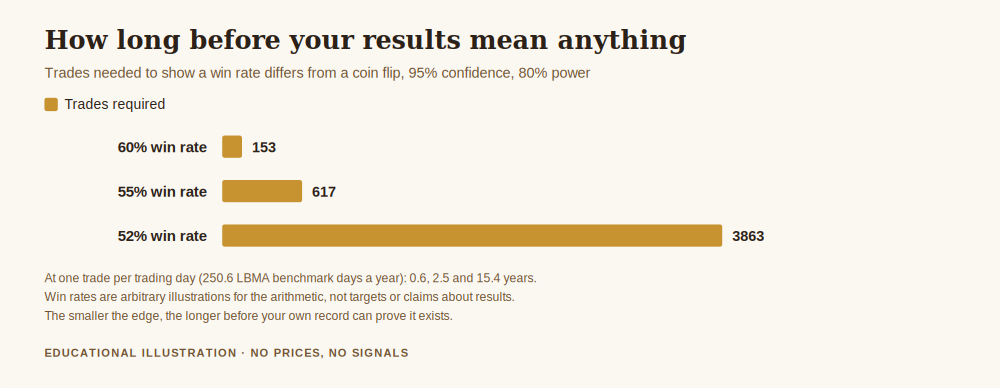
And it gets worse as the edge gets smaller, which is the part that surprises people. A 52 percent edge, still a real edge, needs 3,863 trades to demonstrate. That is over fifteen years at one a day. A 60 percent edge, which would be exceptional, still needs 153.
Sit with what that means. For most of your first two years, your account balance is not evidence. It is noise with a number attached. Anyone who tells you after three profitable months that they have found something has measured nothing at all, and the honest version of that sentence is that they do not yet know.
What that changes about the plan
If results cannot tell you whether you are good for a couple of years, then the plan cannot be built on results. It has to be built on two things you can control immediately: your process and how long you can survive while the process matures.
That is the whole reason the sequence below is in this order. It is not a syllabus. It is a survival schedule.
Step 1: Fund the learning, not just the account
The most common way this ends is not a blown account. It is a person who needed the money and had to stop.
Before the trading money, you want ordinary living expenses covered from ordinary income, and a cash reserve that has nothing to do with the market. This sounds like personal finance advice rather than trading advice, and that is exactly the point. A trader with rent due behaves differently from a trader without, and the difference shows up in every decision, always in the same direction: bigger, sooner, and held longer than the plan said.
If losing the trading capital entirely would change how you live, the amount is wrong. That is not caution, it is a precondition. How much money you need to start trading gold goes through the sizing side of this.
Step 2: Learn the rules of the game before the tactics
Most beginners start with entries because entries are what the internet sells. The rules of the instrument come first, and they are dull, finite and learnable in a few evenings.
What is the contract size. What does one point cost you. What is the spread and when does it widen. What happens to a position held overnight, and over a weekend. What is your broker’s margin call level and what exactly do they do when you reach it. When are the scheduled events that move this market.
None of that is a strategy. All of it is the arithmetic your strategy will be running inside, and not knowing it is how people discover their real position size by accident. This is also the cheapest knowledge in the whole endeavour, because it is written down and free.
Step 3: Understand the market before the indicators
An indicator is a formula applied to past prices. It cannot know anything the prices did not already contain, and every one of them is a rearrangement of the same data you are already looking at.
That does not make them useless, but it does mean that learning twelve indicators is not twelve pieces of knowledge. It is one piece of knowledge, twelve times. Time spent on why the market moves, who is on the other side, and when liquidity is thin, compounds. Time spent memorising settings does not.
I set out the constraints I actually use in 5 price action rules every trader needs to know, and the structural view in what market structure is in gold trading.
Step 4: Decide what would prove you wrong, in writing
Before real money, write down what you are doing and what result would make you stop doing it. Not a feeling, a threshold you set while calm.
The reason this step exists is that after six hundred trades you will want to know whether your approach worked, and you will only be able to answer that if you defined it beforehand. A method you revised quietly every month is a method you can never test, and you will have spent two years learning nothing you can rely on.
Step 5: Risk the smallest amount that still feels real
Paper trading teaches the mechanics and almost nothing about the pressure. Very small real money teaches both. The sizing framework sits in risk management for gold trading, and where the exit belongs in where to place a stop loss on XAU/USD.
The goal of the first year is not profit. It is to arrive at trade six hundred with your capital and your composure both intact, because that is the first moment your record means anything.
What a realistic first year looks like
People imagine the first year as a learning curve that bends upward. In practice it is closer to three separate jobs done in sequence, and mixing them up is what makes it take three years instead.
Months one to three, learn the machine. Contract sizes, costs, margin, the calendar, the platform. Take positions so small that the outcome is genuinely uninteresting, because the objective is to make ordering, sizing and exiting boring before anything is at stake. Nobody’s results from this period mean anything, and that is fine, because you are testing whether you can operate the equipment.
Months four to nine, hold one method still. This is the hardest part and the one most people skip. Pick an approach, write it down, and do not change it, because every change resets your count back to zero. You will be tempted to adjust after a bad fortnight. The arithmetic above is the reason not to: a bad fortnight inside 617 trades is not information.
Months ten onward, read what you wrote. Now you have enough trades to look for patterns in your own behaviour, which is different from patterns in the market. Which rule do you break, and when. Almost everyone finds it is the same rule, broken under the same conditions.
Notice what is missing from that year: profit. Not because it cannot happen, but because targeting it in year one reliably produces the behaviour that ends year one early.
How to become a good trader without paying for the lesson twice
There is a base rate worth knowing before any of this. When the European Securities and Markets Authority introduced its measures on contracts for difference, it reported that national regulators across EU jurisdictions found 74 to 89 percent of retail accounts typically lose money, with average losses per client between 1,600 and 29,000 euros.
That band is wide because different regulators measured different populations, and I would rather quote it honestly than sharpen it. What it establishes is that this is a difficult activity where most participants lose, and that the losses are not trivial sums.
Read alongside the 617 figure, it produces the most useful sentence I know on this subject. Most people who lose do not lose because they were wrong about the market. They lose because they ran out of money or patience before their sample size arrived. Those are two different failures and only one of them is about skill.
Which is why the sequence above front loads everything that extends your runway and delays everything that shortens it. Not because caution is virtuous, but because the arithmetic requires you to still be here in year three.
Get the free Gold Empire survival sheet, a one page guide to the constraints that keep an account alive long enough for the learning to pay off. One email, no spam, unsubscribe anytime.
Frequently asked questions
How long does it really take to become a good trader?
On the arithmetic above, roughly two to three years before your own results can distinguish a modest edge from luck, assuming you trade about once a trading day and keep your method stable enough to measure. People who change approach every few months never reach that point at all, because each change resets the count.
Can I speed it up by trading more often?
You can reach 617 trades faster, but you will pay the spread 617 times sooner and you will be taking positions on days that offered nothing, which tends to lower the edge you are trying to measure. Sample size accumulates faster, quality usually falls, and the two work against each other. It also means any mistake in your sizing compounds sooner.
Is a demo account worth using?
For learning the platform and the mechanics, yes, and it costs nothing. For learning whether you can follow your own rules when money is at stake, no. The pressure is the variable being tested and a demo removes it. Most people benefit from a short demo period followed by very small real positions.
Do I need to learn indicators at all?
You need to understand what they are: formulas on past prices, useful as summaries, incapable of adding information that was not already in the chart. One or two understood properly beats twelve half remembered. The mistake is treating the collection as progress.
What is the single biggest mistake at the start?
Sizing to the account you hope to have rather than the one you have. It ends the attempt before the learning can happen, and it is the mechanism behind most of the losses in the ESMA figures. Everything else is recoverable.
Should I take a paid course?
Some are genuinely useful and some are expensive entertainment, and the honest test is simple: does it tell you what would prove the method wrong. Anything that only shows you winning examples has not taught you a method, it has shown you a highlight reel. Be especially careful with anything that quotes a win rate without a sample size, because as you now know, a win rate without a sample size is not a fact.
Where Gold Empire fits
Gold Empire is a free Telegram channel where I post gold analysis with the reasoning stated before the move rather than after it, losing days included. There is nothing to buy in order to follow along, and an optional Kit if you want more structure later. I publish no profit claims, and after reading the section above you will understand why I distrust anyone who does.
The free survival sheet is the one page version of the constraints in this article.
About the author. Matthew writes Gold Empire. He is interested in the unglamorous half of this business, cost, size, frequency and the arithmetic of staying solvent, on the view that most accounts are lost to ordinary errors repeated patiently rather than to any single dramatic trade.
Disclaimer: This article is general educational content about learning to trade and about sample size. It is not financial advice and it is not a recommendation to buy or sell anything. Trading gold, CFDs and leveraged products carries a high risk of losing money rapidly. No entry, stop or target discussed should be treated as a signal. The 55, 52 and 60 percent win rates used above are arbitrary illustrations chosen to demonstrate statistical arithmetic, not targets, forecasts or claims about results. The trading day count is computed from the published LBMA Gold Price PM benchmark for 2016 to 2025, and external figures are linked so you can check them.
One step first
Where should we send the Gold Survival Sheet?
Leave your email and we will send the free one page checklist, then take you straight to the Telegram channel.
No cost and no obligation. Educational only, not financial advice, and nothing here promises a return. Unsubscribe any time in one click.
Leave a Reply