

Almost everybody who looks up how to set up a trailing stop loss is really asking one of two questions. Either they keep watching a good trade turn into a flat one and want the profit locked in, or they keep getting knocked out of trades that go on to work without them. The trailing stop is offered as the answer to both. It cannot be, and the reason it cannot be is arithmetic rather than opinion.
A trailing stop is a single setting that trades one of those problems for the other. Tighten it and you stop giving profit back, at the cost of being removed from more trades early. Loosen it and you stay in, at the cost of handing back more of every peak you reach. There is no distance that does both, and below is the simulation that shows exactly what each setting costs, along with the mechanics of the order itself and the one thing about it that catches people out at the worst possible moment.
How to Set Up a Trailing Stop Loss: The Mechanics First
The order has three moving parts, and getting them straight removes most of the confusion.
The trailing distance
This is how far behind the price the stop sits. Platforms express it as points, pips, a money amount, a percentage, or a multiple of a volatility measure. They are all the same idea measured in different clothes. Everything in this article is expressed in a neutral unit rather than points, because the right distance on one instrument is meaningless on another.
The ratchet
This is the part that makes it a trailing stop rather than an ordinary one. On a long position, when the price makes a new high, the stop moves up to stay the chosen distance below that new high. When the price falls back, the stop does not follow it down. It stays where the last high left it. The stop is therefore a record of the best price the trade ever saw, minus the distance you chose.
The trigger
How often the platform checks. Some trail on every tick, some on the close of each bar, and some, importantly, only trail while your terminal is running. That last one is a real trap on a desktop platform: close the laptop and the ratchet stops ratcheting, while the ordinary stop it left behind stays exactly where it was. If the order lives on the broker’s server it keeps working. If it lives in your terminal it does not. This is worth checking before it matters rather than after.
What the Order Promises, and What It Does Not
Here is the part that surprises people at the exact moment they can least afford a surprise, and it is not a broker quirk. It is what a stop order is.
The United States Securities and Exchange Commission puts it plainly on its investor education site: a stop order is an order to buy or sell once the price reaches a specified level, and when the stop price is reached, a stop order becomes a market order. The CFTC’s own glossary says the same thing in its own words: a stop order becomes a market order when a particular price level is reached.
Read that carefully, because a trailing stop is a stop order with a moving trigger. It does not promise you the price it is sitting at. It promises to try, at market, once that level trades. In a calm market the difference is small. In a fast one, or across a gap, the fill can be some distance away, and the trailing stop that looked like a guarantee of a locked in gain turns out to have been a request.
That distinction is the whole reason this article measures the cost of slippage separately below, rather than assuming it away.
The Trade-Off Nobody Puts a Number On
So how much does each setting actually cost? I ran the question rather than argued about it, and the assumptions are all on the table so you can disagree with any of them.
The simulation: 200,000 independent price paths, each 40 steps long. Each step adds a random shock with a standard deviation of one unit, plus a small positive drift of 0.10 units per step, so the trade has a genuine edge rather than being a coin flip. A long position opens at the start. The trailing stop sits a fixed distance below the highest price reached so far and ratchets up only. The trade closes when that level is touched, or at the end of the window if it never is. The exit is assumed to fill exactly at the stop, which is deliberately optimistic given what the SEC and the CFTC just told us. No spread, no commission, no financing.
Two costs get measured. Given back from the peak is how much of the best price the trade ever reached is handed back before the exit. Left on the table is how much further the trade would have gone in the remaining window after being stopped out.
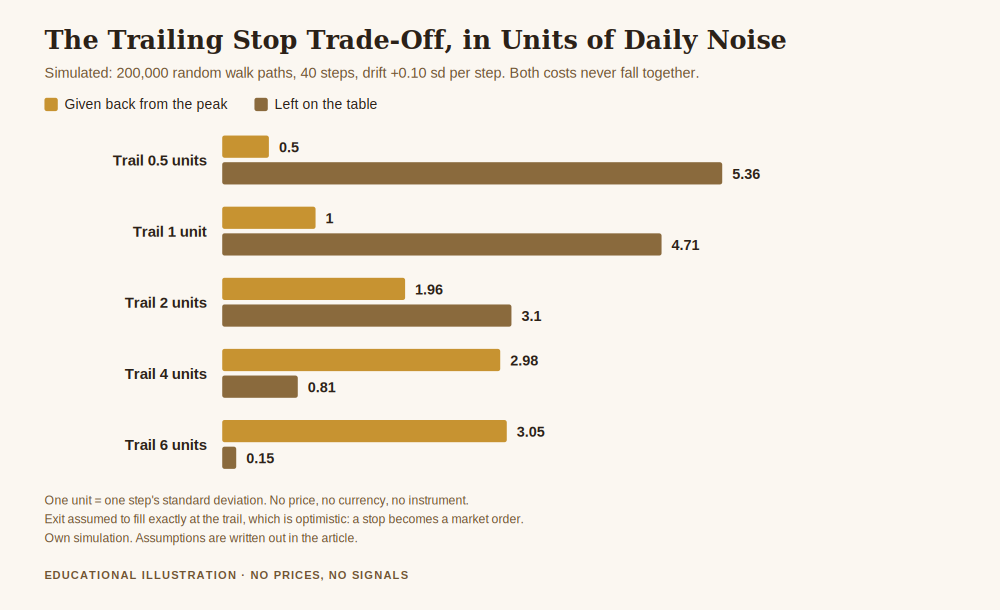
At a trail of half a unit, the position gave back 0.50 units from its peak and left 5.36 units on the table. It was stopped out on essentially every single path, with a median holding time of three steps.
At a trail of four units, it gave back 2.98 units and left only 0.81 on the table. It was stopped out on 64.86 percent of paths, with a median holding time of 29 steps.
Widening the trail from half a unit to four cut what was left on the table by 84.9 percent and multiplied what was given back from the peak by 5.96 times. Every intermediate setting sits somewhere along that same line. The two costs never fall together at any distance, which is the entire point.
Notice what this does to the two complaints at the top of the article. The trader who keeps giving profit back and the trader who keeps getting knocked out early are standing at opposite ends of one curve. Moving to fix one problem moves you toward the other. Nobody sells it that way, and the settings menu certainly does not say it.
Why a Tight Trail Pays the Slippage Bill More Often
Now put the SEC’s point back in. Run the identical simulation, but assume the stop fills a quarter of a unit worse than the level it triggered at, which is a modest assumption for a market order in a hurry.
At a trail of half a unit, the average outcome fell by 25.03 percent. At a trail of four units, it fell by 4.70 percent. At six units, by 1.27 percent.
The same slippage, five times more damaging at the tight setting. The reason is not that a tight stop slips harder. It is that a tight stop triggers more often. At half a unit the stop fired on 100 percent of paths, so the bill was paid every time. At four units it fired on 64.86 percent, and at six units on 32.58 percent, so the bill was paid on a third of them.
Slippage is charged per stop out, not per trade. Any setting that increases how often you get stopped out is also increasing how many times you pay a cost that the settings menu does not show you. That is worth knowing before deciding that tighter equals safer.
Get the free Gold Empire survival sheet, a one page guide to protecting your account through exactly the kind of decision this article describes. One email, no spam, unsubscribe anytime.
The Thing a Trailing Stop Cannot Do
One more result from the same simulation, and it is the one worth remembering longest.
Run the whole thing again with the drift removed, so the price is a pure coin flip with no edge at all. Every trailing distance still produces an average exit above zero, from 0.658 units at the tightest setting down to 0.296 at the widest, and every one of them still ends below the entry price on more than half of all paths, between 51.10 and 57.95 percent of the time.
Look at what that is saying. On a random walk, no trailing distance turns the exercise into a winning one, and the tightest setting is not safer than the widest, it is simply a different mix of small gains and frequent stop outs. The trailing stop rearranged the outcomes. It did not create an edge, because it cannot. It has no information about the future; it only knows where the price has already been.
This matters because of how the order gets sold and how it gets used. It is an exit management tool, and the thing it manages is the shape of the distribution, not the middle of it. A losing method with a well tuned trailing stop is still a losing method with a tidier equity curve. The decision about whether the trade should exist at all was made before this setting was ever touched.
Reading the Curve for Your Own Situation
None of the numbers above tell you a distance to use, and any article that hands you one is guessing at your circumstances. What the curve does give you is a way to reason about your own choice honestly.
If your own record shows trades that reached a good level and came back, you are at the wide end of the curve and the give back is the cost you are paying. If it shows repeated knock outs before the move continued, you are at the tight end, paying in missed continuation and in slippage bills.
The mistake is not picking the wrong end. It is picking a distance without knowing which cost you chose, then changing it after every trade that went badly, which turns a policy into a series of reactions and guarantees you pay both. Decide once, write it down, and let a run of trades produce enough evidence to judge it. Everything on that chart is an average over 200,000 paths; your own next five trades are not a sample of anything.
Frequently Asked Questions
What is the best trailing stop distance?
There is no single answer, and the simulation above shows why: every distance trades one cost for another, so the best one depends on which cost you would rather carry and on the volatility of what you are trading. Anyone quoting a universal number has answered a different question from the one you asked.
Does a trailing stop guarantee I keep my profit?
No. Both the SEC and the CFTC define a stop order as one that becomes a market order when its level is reached, so the fill is whatever the market gives at that moment. It can be worse than the level, sometimes considerably worse in fast conditions or across a weekend gap.
Does a trailing stop ever move backwards?
No, and that is the defining feature. On a long position it moves up as new highs are made and stays put when the price falls back. That one way ratchet is what makes it hand back exactly the trailing distance from the peak, no more and no less, before it triggers.
Does a trailing stop work when my platform is closed?
It depends entirely on where the order lives. Server side orders keep trailing whatever your terminal is doing. Orders that the desktop platform manages locally stop ratcheting when the platform closes, leaving an ordinary stop at whatever level it last reached. Check which kind yours is before you need to know.
Is a tighter trailing stop safer?
Not in the way people usually mean. It reduces how much you give back from a peak, and it increases how often you are stopped out, which increases how many times you pay slippage. In the simulation, a quarter unit of slippage cost 25.03 percent of the outcome at the tightest setting and 4.70 percent at a wide one.
Where did the numbers in this article come from?
The definitions of a stop order are quoted from the SEC’s investor education site and the CFTC’s glossary, both linked above. Every figure about give back, leaving money on the table, stop out rates and slippage comes from my own simulation of 200,000 paths under the assumptions written out in the text. It is a model, not a measurement of gold or of any real account, and no price level appears anywhere in this article.
Where Gold Empire fits
Gold Empire is free to follow. The daily work is posted on Telegram with the reasoning attached, losing days included, and there is a free survival sheet for anyone who wants the protective side written down in one page. There is an optional Kit for people who want more, and there is no promise of a return here, because nobody honest can make one.
How you leave a trade is a survival question before it is a technical one, which is why this sits under risk management in gold trading. If you are still deciding where the first stop goes, where to place a stop loss on XAUUSD comes before this article, what a break even stop is covers the simplest version of moving a stop once, and how to manage a gold trade after you enter is the wider habit this setting belongs inside.
About the author
Matthew has spent a long time around gold, most of it learning things the slow way, and now writes them down so other people can learn them the fast way. He is more interested in the mechanics that quietly drain accounts than in the setups that fill timelines. Nothing in this article is personal advice, and no entry, stop or target discussed should be treated as a signal.
This article is educational content about how a trailing stop order behaves. It is not investment advice, not a recommendation of any broker, platform, order type or setting, and not a solicitation to trade. The definitions of a stop order are quoted from the SEC’s investor education material on order types and the CFTC glossary; order handling differs between firms and jurisdictions, so confirm how your own provider implements these orders. Every other figure here comes from my own simulation of a random walk with the assumptions stated in the text, expressed in abstract units rather than any currency or instrument. It is a model chosen to illustrate a trade-off, not a measurement of gold, not a backtest, and not a claim about anyone’s results, mine included. No trailing distance is recommended anywhere in this article and no gold price level is quoted. Trading gold carries a real risk of losing money, including more than you deposit in some account types. Nothing accounts for your personal circumstances, and no entry, stop or target discussed should be treated as a signal. If you are unsure, speak to someone properly qualified in your own jurisdiction before you risk anything.
One step first
Where should we send the Gold Survival Sheet?
Leave your email and we will send the free one page checklist, then take you straight to the Telegram channel.
No cost and no obligation. Educational only, not financial advice, and nothing here promises a return. Unsubscribe any time in one click.
Leave a Reply