Category: Gold / XAU-USD Basics

  • What Is Leverage in Gold Trading? And Why It Cuts Both Ways

    What Is Leverage in Gold Trading? And Why It Cuts Both Ways

    Almost every blown beginner account has the same quiet moment in its history. The trader looks at their small balance, watches gold move a little, and feels almost nothing happen to their money. It is boring. So they reach for the one dial that makes the account finally move, they turn the leverage up. For a few trades it feels electric: small moves now swing the balance in real, satisfying numbers. Then gold does something completely ordinary, that same magnification runs the other way, and the account is gone in an afternoon.

    Nothing unusual happened in the market. The trader simply discovered, the expensive way, the single most misunderstood tool in trading. Leverage is not a profit button. It is a magnifying glass, and a magnifying glass does not care what it magnifies. Understand that one sentence and you are already ahead of most people who lose money to it.

    Leverage cuts both waysThe same move, magnified the same amount, whichever way it goesone price moveIn your favourmagnified gainAgainst youmagnified losssame size ↑same size ↓MARGIN CALL FLOOR, too big, and a normal move hits it firstLeverage does not improve your odds. It only enlarges the outcome.
    What leverage in gold trading really does: it magnifies the outcome of a move in both directions equally, never your odds of being right.

    What leverage actually is

    Leverage lets you control a position larger than the cash in your account. Your broker effectively lends you the buying power, so a relatively small amount of your own money can hold a much bigger trade. It is usually written as a ratio, 1:100, 1:200, 1:500, which tells you how much position each dollar of yours can control. At 1:100, one dollar controls a hundred dollars of gold exposure.

    That is genuinely useful, and it is why leverage exists. Gold is expensive; without leverage, taking a meaningful position would require far more capital than most retail traders have. Leverage makes the market accessible. The problem is never that leverage exists, it is what beginners believe it is for.

    Margin: the piece of your money the broker holds

    To open a leveraged position, the broker locks up a slice of your balance as a good-faith deposit. That slice is your margin. The rest of your balance is your free margin, the cushion that absorbs the trade moving against you before the broker steps in.

    This matters because of what happens when the cushion runs thin. If a losing position eats through your free margin, you get a margin call, and if it keeps going, the broker automatically closes your positions, a stop-out, to stop your balance going negative. It is not a punishment; it is the plumbing. But it means an over-leveraged account can be shut down by the broker at the worst possible moment, often just before the move it was right about. The bigger the position relative to your balance, the thinner the cushion, and the closer that floor sits beneath you.

    Why it cuts both ways

    Here is the part the excited beginner never quite hears. Leverage magnifies the outcome of a move, in both directions, by exactly the same amount. Look at the diagram again: the winning box and the losing box are the same size. A move in your favour is enlarged; an identical move against you is enlarged just as much. Leverage does not lean toward profit. It has no opinion about direction at all.

    What it absolutely does not do is improve your odds. It cannot make a trade more likely to work. It only changes the size of the consequence when it does or doesn’t. So a trader who adds leverage without changing anything else has not improved their edge by a single percent, they have simply agreed to feel every outcome, good and bad, much more intensely. And because losses compound against a shrinking balance, the bad side does structurally more damage than the good side repairs, the same brutal arithmetic behind every account that cannot climb back out of a hole.

    Leverage is not the risk. Using leverage to trade a position that is too big for your account is the risk, and the platform will happily let you.

    The real trap: it lets you size far too big

    This is the heart of it. High available leverage does not force you to take a large position, but it permits one, and permission is all an impatient trader needs. With generous leverage, the platform will cheerfully let you open a trade whose normal, everyday fluctuation is a huge percentage of your account. Nothing warns you. The button works exactly the same whether the size is sensible or suicidal.

    So the danger is not the leverage ratio printed on your account. It is that leverage quietly severs the link between your position size and your account size, and that link is the whole of survival. A trader on 1:500 who sizes every trade by risk is perfectly safe. A trader on 1:20 who maxes it out is in serious danger. The ratio is almost a distraction; the size you actually put on is everything. That is exactly why position size has to be calculated from what you are willing to lose, not from what the leverage lets you reach, the mechanics are in position sizing for gold and how much to risk per trade.

    The right way to think about leverage

    Reframe it and the tool becomes safe. Leverage is for flexibility, not for size. Its legitimate job is to let you hold a properly sized position without tying up all your capital as margin, leaving the rest as free margin cushion. Its illegitimate use is treating the available leverage as a suggestion to trade bigger because you can.

    In practice that means your process runs in a fixed order, and leverage comes last. First decide what you are willing to risk on the idea. Then find where the trade is invalidated. Then calculate the position size that makes those two numbers agree. Only then does leverage quietly do its job in the background, posting the margin for the size you already chose. Done this way, you could have almost any leverage on the account and it would change nothing about your risk, which is precisely the point. This is the same survival-first logic that runs through everything in our guide to risk management in gold trading, and it is the missing half of the question we tackled in how much money you actually need to start trading gold.

    If you would rather build these habits before you risk real money
    I break down the mechanics, sizing, margin, and why survival comes before everything, most days on the Gold Empire Telegram channel, alongside roughly 12,900 people who would rather understand the tool than get hurt by it. Free to follow, no countdown, leave whenever you like.
    Join the Gold Empire Telegram channel →
    Or grab the free VIP resource pack here, the beginner’s survival kit, no payment, no card.

    So how much leverage should a beginner use?

    The honest, slightly deflating answer is that the leverage number matters far less than beginners think, because it is the wrong thing to be looking at. A cautious trader is safe on high leverage and a reckless one is doomed on low leverage, because the outcome is decided by position size, not by the ratio. If a smaller maximum leverage helps you resist the temptation to over-size, the way a smaller plate helps some people eat less, then choose it for that reason, as a guardrail against yourself. But do not mistake a low ratio for safety, or a high one for danger. The dial that actually controls your risk is the size of the trade, and that dial is always in your hands. Beginners are best served starting on a demo, where all of this can be felt for free, and the practical first steps are in gold trading for beginners and how to open a gold trading account.

    Frequently asked questions

    What does 1:100 leverage mean?
    It means each dollar of your own money can control one hundred dollars of market exposure. So a small margin deposit can hold a much larger position. It does not mean you should use all of it, the ratio is a ceiling on what is possible, not a recommendation for how big to trade.

    Does higher leverage mean higher profit?
    No, and this is the costly misunderstanding. Leverage magnifies the outcome of a move equally in both directions; it does nothing to make a trade more likely to work. Higher leverage means larger swings, good and bad, on the same odds. It changes the size of the result, never the probability of it.

    What is a margin call?
    When a losing position eats through your free-margin cushion, the broker warns you (a margin call) and, if it continues, automatically closes positions to prevent your balance going negative (a stop-out). Over-leveraged accounts hit this floor easily, often getting closed at the worst possible moment on an ordinary move.

    Is high leverage always dangerous?
    The leverage itself is neutral, the danger is in the position size it lets you take. A trader who sizes every trade by risk can hold high leverage safely, because they never use most of it. A trader who maxes out even modest leverage is exposed. Focus on the size you actually trade, not the number on the account.

    A note on risk

    This article is educational and general in nature; it is not personal financial advice and does not account for your circumstances. Any figures or examples exist to illustrate mechanics only, no entry, stop or target discussed should be treated as a signal. Leveraged trading in gold carries a substantial risk of loss, and because of leverage you can lose money rapidly; most retail traders lose money. I make no claims about profits, returns or win rates, and you should be cautious of anyone who does. Before risking capital, make sure you understand how leverage and margin work, only ever use money you can afford to lose, size positions so a run of losses cannot damage you, and if you are unsure, seek advice from a licensed professional in your own jurisdiction.

    Free gold survival sheet

    Get the free Gold Empire survival sheet, a one-page guide to protecting your account through the kind of market this article describes. One email, no spam, unsubscribe anytime.

    Get the free survival sheet →

    About Matthew

    I turned the leverage up early, for exactly the reason everyone does: my account was small and I wanted it to feel like it mattered. For a little while it worked, which is the dangerous part, the wins were real and the magnification felt like skill. Then a completely unremarkable move ran the same magnification in reverse and the account was finished before I had properly understood what leverage even was. I had been treating a magnifying glass like a profit switch.

    What changed things was not learning to predict better. It was realising the leverage number was never my risk, my position size was, and that was the one dial I had been leaving to impulse. I run the Gold Empire Telegram channel, where around 12,900 people follow along, and the rules do not change: every idea comes with its reasoning, losing trades get posted next to the winners, and I never promise profit, not in a post, not in a DM, not ever.


  • How Much Money Do You Actually Need to Start Trading Gold?

    How Much Money Do You Actually Need to Start Trading Gold?

    It is the first question almost everyone asks, and it is the one with the least honest answer floating around: how much money do you actually need to start trading gold? Type it into a search bar and you will get numbers, “start with $100,” “you only need $50,” “$500 is plenty.” Most of those numbers are broker marketing, not trading advice. They tell you the smallest amount the platform will accept. They tell you nothing about whether you can survive.

    I am going to give you the boring, useful version instead. There is no magic minimum. The amount you need is whatever lets you take a real gold position while risking so little per trade that a bad run cannot hurt you. That sentence is the whole article. Everything below is just me showing my work.

    Your account size sets your risk unitThe account decides the trade, not the other way aroundSmall account1% = a few $Smallest gold tradealready risks moreForced to over-riskMid account1% = roomSmallest trade fitsinside the risk unitCan size sensiblyLarger account1% = bufferA losing streakis survivableSurvivability firstThe question is not “what is the minimum deposit”, it is “how small can my risk be and still trade”
    How much money you need to start trading gold depends on your risk unit, not the broker’s minimum deposit.

    Why the “minimum deposit” is the wrong number

    A broker’s minimum deposit answers a legal and technical question: what is the smallest balance we will open an account with? Gold, though, does not care what your balance is. Gold moves in dollars per ounce, and it can move a lot in a day. The distance between where you enter and where you would admit the idea was wrong, your stop distance, is set by the chart and by volatility, not by how much you deposited.

    So the deposit and the risk are two different conversations that beginners constantly merge. You can meet a $50 minimum and still be unable to trade gold sensibly, because the smallest position the market lets you take already risks a painful slice of that $50 the moment price wobbles. Meeting the minimum gets you a login. It does not get you room to be wrong safely, and being wrong safely is the entire job.

    The number that actually matters: your risk unit

    Here is the reframe that changes everything. Stop asking “how much do I need to start?” and start asking “how small can my risk per trade be, and still place a real gold trade?”

    Serious traders risk a small, fixed percentage of the account on any single idea, often around half a percent to one percent. That percentage is your risk unit. On a small account, one percent is only a few dollars. The problem is that the smallest gold position the market offers may already put more than a few dollars at risk over a normal stop distance. When that happens, you are quietly forced to break your own rule: to place the trade at all, you have to risk five, ten, twenty percent. One ordinary losing streak, and losing streaks are ordinary, and the account is gone. Not because you were wrong about gold. Because the account was too small to let you be wrong.

    This is why the honest answer is a range, not a figure. You need enough that one percent of your balance comfortably covers the smallest real gold trade over a sensible stop, with margin to spare. Below that line, the arithmetic of survival simply does not close, no matter how good your analysis is. If you want the mechanics in full, I walk through them in position sizing for gold and how much to risk per trade.

    The small-account trap

    There is a specific way small accounts kill beginners, and it is worth naming because it feels like ambition rather than a mistake. You deposit a small amount. You want the returns to matter, a few dollars a week does not feel like trading, it feels like a hobby. So you size up. You tell yourself you will be careful, you will use a tight stop, you will watch it closely. And for a while it works, which is the trap tightening. Then gold does something normal and violent, your oversized position takes a normal loss that is now enormous relative to your balance, and you are done.

    The market did nothing unusual. The account was structured to fail. A small balance combined with a desire for large returns can only be reconciled by large risk, and large risk plus enough repetitions equals ruin. This is not pessimism; it is just multiplication. The way out is not a better entry. It is either a smaller ambition or a larger, properly funded account, money you have genuinely set aside to risk.

    Risk capital: the money you are allowed to use

    Whatever amount you land on, it has to come from the right pocket. Trading capital is risk capital, money you can lose in full without changing how you eat, sleep, pay rent, or treat the people around you. It is not the emergency fund. It is not next month’s bills. It is not borrowed. If losing it would be a genuine problem in your actual life, it is the wrong money, and it will trade you instead of the other way around, because fear makes people close good trades early and hold bad ones in hope.

    So the sizing question has two halves, and both must be true at once: enough that your risk unit can cover a real trade, and little enough, relative to your whole financial life, that losing it would sting but not wound. For a lot of people starting out, that second constraint is the binding one. It is completely reasonable to conclude that the responsible amount to start with today is smaller than the amount that makes the math work, and that the right first move is to wait, save, and practise rather than force it.

    Which is the honest destination of this whole piece: the goal is not to find the lowest number that lets you press “buy.” It is to protect your capital well enough that you are still here to learn, the same principle behind everything in our guide to risk management in gold trading.

    Before you fund anything: use a demo

    You do not need to risk a single real dollar to learn most of what a beginner needs to learn. A demo account trades live gold prices with fake money, and it will teach you the platform, the speed, the way gold behaves around news, and, most importantly, how you behave when a position is red. The only thing a demo cannot teach is the emotion of real money on the line, which is exactly why it is a mistake to skip it: get every mechanical error out of the way for free first, so that when you do fund an account, the only new variable is your own psychology.

    When you are ready to move from practice to a funded account, the practical steps, and what actually matters in a broker beyond the deposit number, are in how to open a gold trading account and choosing the best broker for gold trading.

    If you would rather learn the mechanics before you fund anything
    I break gold down most days on the Gold Empire Telegram channel, what is moving, why, and how sizing keeps you in the game, alongside roughly 12,900 people who would rather understand the trade than gamble on it. Free to follow, no countdown, leave whenever you like.
    Join the Gold Empire Telegram channel →
    Or grab the free VIP resource pack here, the beginner’s survival kit, no payment, no card.

    So, what is the actual answer?

    The one you can hold onto: enough that risking one percent per trade lets you place the smallest real gold position with room to spare, and little enough that losing it would not damage your life. For many people that is more than the broker’s minimum and less than they hoped, and the gap between those two numbers is where patience lives. Start on a demo. Size the account to the math, not to your impatience. And treat the first months as tuition you pay by staying small, not as a sprint to a number.

    Frequently asked questions

    Can I really start trading gold with $100?
    A broker may let you open an account with $100, but that is not the same as being able to trade gold sensibly. On a balance that small, a properly sized risk unit often cannot cover the smallest real position over a normal stop distance, which pushes you toward over-risking. You can open the account; whether you can survive it is a different question.

    Is a bigger account safer?
    A bigger account is not safer by itself, someone can lose a large balance just as fast with bad risk habits. What a larger, properly funded account buys you is room: the ability to risk a small percentage per trade and still place a real position, so an ordinary losing streak is survivable rather than fatal. Size discipline matters more than size.

    Should I use leverage to trade gold with a small account?
    Leverage lets a small balance control a large position, which sounds like the solution and is usually the trap. It magnifies losses exactly as much as gains, and on a small account it is the mechanism by which a normal move wipes you out. Leverage is a tool for controlling position size within a risk plan, not a way to escape needing enough capital.

    Do I have to trade real money to learn?
    No, and you shouldn’t at first. A demo account trades real gold prices with fake money and teaches you almost everything mechanical for free. Save real money for the one thing a demo cannot replicate: how you handle the emotion of a live position. Get the free lessons out of the way before you pay for the expensive one.

    A note on risk

    This article is educational and general in nature; it is not personal financial advice, and it does not account for your circumstances. Any figures or examples exist to illustrate reasoning and teach mechanics only, no entry, stop or target discussed should be treated as a signal. Trading gold carries real risk of loss. I make no claims about profits, returns or win rates, and you should be cautious of anyone who does. Before risking capital, make sure you understand the product, only ever use money you can afford to lose, size positions so a run of losses cannot damage you, and if you are unsure, seek advice from a licensed professional in your own jurisdiction.

    Free gold survival sheet

    Get the free Gold Empire survival sheet, a one-page guide to protecting your account through the kind of market this article describes. One email, no spam, unsubscribe anytime.

    Get the free survival sheet →

    About Matthew

    When I started, I did the exact thing this article warns against. I funded a small account, wanted it to feel like real money, and sized up to get there. It felt like commitment. It was actually just risk wearing commitment’s clothes, and one unremarkable week took the whole thing. Nothing about gold had surprised me, I had simply built an account that could not afford to be wrong.

    What changed my results was not a better strategy. It was accepting that the account has to be built to survive being wrong before it is ever built to be right, and that sometimes the responsible answer to “how much do I need?” is “more than I have today, so I’ll wait.” I run the Gold Empire Telegram channel, where around 12,900 people follow along, and the rules never change: every idea comes with its reasoning, losing trades get posted next to the winners, and I never promise profit, not in a post, not in a DM, not ever.


  • What Actually Moves the Price of Gold

    What Actually Moves the Price of Gold

    You watch the news. A conflict escalates, headlines turn grim, everyone on your feed says gold is about to fly, and gold does nothing. Or worse, it drops. A week later, on a quiet Thursday with no story anywhere, gold rips higher for no reason you can see.

    If you have watched gold for a few months, you have felt this. It looks arbitrary. Most traders eventually give up on understanding why and just stare at the chart, hoping the pattern will tell them something the world would not.

    The chart is not the enemy, but price is the last step in a chain, not the first. Gold moves for consistent, mechanical, boring reasons, just not the ones headlines emphasise. Four matter most: the US dollar, real interest rates, central-bank buying, and fear. Once you can name which is in the driver’s seat this month, gold stops looking random. It does not become predictable, nothing does, but it becomes legible, and that is worth far more.

    The Four Forces That Move GoldGOLD PRICEno yield, no earningsUS DOLLARDollar stronger→ pressure on gold, DOWNREAL INTEREST RATESReal yields rising→ holding gold costs more, DOWNCENTRAL-BANK DEMANDOfficial buying steady→ slow floor under price, UPFEAR & GEOPOLITICSUncertainty spikes→ fast rush into gold, UPpushes price downpushes price upWhen two forces pull opposite ways, gold chops sideways.
    A simple map of what moves the price of gold: four forces pushing on one metal that pays no interest of its own.

    Why Gold Is Priced Differently From Everything Else

    Start with the strange thing about gold: it produces nothing. A company pays dividends, a bond pays a coupon, property pays rent. Gold sits in a vault and costs money to store, no earnings to discount, no cash flow to value.

    That absence is the key. With no internal value to anchor it, gold’s price is set by what happens around it. All four forces below answer one question from different angles: what is the cost, right now, of owning something that just sits there? When that cost is low, money drifts toward gold. When it is high, money drifts away. The rest is detail.

    The US Dollar: Gold Wears a Dollar Price Tag

    Gold is quoted in US dollars almost everywhere. That is a plumbing fact, not a philosophical one, and it creates a mechanical relationship that catches out new traders.

    Imagine gold is unchanged in real terms. Now the dollar strengthens. For a buyer in Europe, Japan or India, gold has just become more expensive in their own money, though nothing about gold changed. Some buyers step back, demand softens at the margin, the dollar price slips. Run it the other way: a weaker dollar makes gold cheaper in euros, yen and rupees, foreign demand firms up, and the dollar price drifts higher.

    This is why gold and the dollar usually move in opposite directions, and why experienced traders check the dollar index before forming any opinion on gold. It is not a law, it breaks down in panics, when everyone runs to both at once. But as a default assumption it is sound: a rising dollar is a headwind for gold; a falling dollar is a tailwind. If you cannot explain why gold fell, look at the dollar first. Very often that is the entire story.

    Real Interest Rates: The Quietest and Most Powerful Driver

    This is the one most people never learn, and it explains more of gold’s big multi-month moves than anything else on this list.

    A “real” interest rate is simply the interest rate after inflation. A bond paying 5% while inflation runs at 3% gives you a real return of roughly 2%. The same bond paying 5% while inflation runs at 6% gives you roughly minus 1%, you are losing purchasing power slowly.

    Now put gold next to that. Gold pays nothing, forever, by design. So the cost of choosing gold over a bond is whatever the bond would have paid in real terms. That is opportunity cost, and it is the hinge of the whole thing:

    • Real yields rise β†’ bonds now pay a meaningfully positive return after inflation β†’ holding a zero-yield asset costs you more β†’ capital rotates out of gold β†’ pressure down on gold.
    • Real yields fall β†’ bonds pay little or nothing after inflation β†’ gold’s zero yield stops being a disadvantage β†’ capital rotates toward gold β†’ support under gold.
    • Real yields go negative β†’ holding bonds guarantees a slow loss of purchasing power β†’ gold’s zero suddenly looks generous by comparison β†’ historically, this is the environment where gold has run hardest.

    Notice what this does to a headline you have certainly seen: “inflation is rising, so gold must rise.” Not necessarily. If inflation rises but the central bank raises rates faster, the real yield goes up and gold can fall in the middle of an inflation scare. That single mechanism explains a large share of the moments when gold appears to betray common sense. It is not betraying anything, you were watching inflation, the market was watching inflation minus interest rates.

    This is why so much of gold trading is really central-bank watching. The market reacts less to the rate decision itself than to the change in expectations about rates versus inflation. How that plays out minute by minute around a release is covered separately in how to trade gold through high-impact news.

    If this is the kind of explanation you have been looking for

    I break down what is actually driving gold, dollar, yields, official buying, fear, most days on the Gold Empire Telegram channel, alongside roughly 12,900 people who would rather understand the move than guess at it. Free to follow, no countdown, leave whenever you like.

    Join the Gold Empire Telegram channel β†’
    Or pick up the free VIP resource pack here, no payment, no obligation.

    Central Banks: The Slow, Heavy Buyer in the Room

    Central banks hold gold in their national reserves, and over the past decade many, particularly outside the West, have been steady net buyers. Their reasons are not a trader’s: diversifying away from any single foreign currency, insulating reserves from sanctions risk, or following a multi-year policy set by a committee. None of that changes because gold had a bad Tuesday.

    The effect on the market is distinctive. Central-bank demand is:

    • Slow. It shows up in quarterly reports, not in real time.
    • Price-insensitive. These buyers execute a mandate rather than chase a level, and tend to keep buying into weakness.
    • Sticky. Gold that enters national reserves rarely comes back out quickly.
    • Structural, not tactical. It shapes the floor of a multi-year range far more than this week’s candle.

    This is why gold has sometimes refused to fall as far as the dollar and real yields alone would suggest. A large, patient, non-speculative bid sits under the market and appears on no indicator. You cannot trade it directly, but knowing it is there stops you being shocked when a clean bearish dollar setup fails to produce the drop you expected.

    Fear and Geopolitics: The Fastest Mover With the Shortest Memory

    Now the one everybody already believes in, and mostly misunderstands.

    Yes, gold rises on fear. When a conflict breaks out, a bank looks unstable or a currency wobbles, money moves quickly into assets with no counterparty risk. Gold has been that asset for thousands of years. The reflex is real, but two things about fear-driven moves catch traders out constantly.

    First, the market prices anticipation, not the event. By the time a conflict is on the front page, positioning has already moved, the rally happened over the previous week while the situation was building. Buying the headline often means buying the top of the fear spike from someone happily selling into your enthusiasm.

    Second, fear premium decays. Unless a crisis actually damages the financial system, real credit stress, real currency failure, the risk premium bleeds out within days or weeks. Traders call this gold “giving back” its geopolitical gains. It is the standard outcome, not the exception: fear moves gold fastest and holds it least.

    The dollar and real yields decide where gold lives. Central banks decide how far down it can go. Fear only decides how loud a single week gets.

    Practically: fear-driven days bring wide candles, thin liquidity and brutal spreads. They are the days position sizing matters most and the most account damage is done, which is why risk management in gold trading is the foundation everything here sits on. Understanding the drivers without controlling exposure just means losing money with better vocabulary.

    Why Gold Sometimes Ignores the News Entirely

    Here is where it comes together, and where the confusion at the top of this article gets resolved. The four forces do not take turns politely. They act at the same time, at different speeds, and frequently in opposite directions. Consider a very ordinary week:

    • A geopolitical flare-up pushes fear demand up.
    • The same flare-up sends money into Treasuries and the dollar, pushing gold down.
    • Inflation data comes in hot, rate cuts look further away, real yields rise, gold down again.
    • Central banks keep buying quietly in the background, a slow bid up.

    Net result: gold goes almost nowhere while the news screams. Nothing is broken, the forces cancelled out. This is what most “gold makes no sense” weeks actually are: a balanced tug-of-war you could not see because you were holding one end of the rope.

    The useful skill is not predicting all four. It is asking each week, which force is currently dominant? Sometimes it is obviously the dollar. Sometimes the market trades a single yield number. Sometimes it is pure fear and nothing else matters for 48 hours. When you can name the dominant force, you also know what would invalidate your view, worth more than any prediction.

    How to Actually Watch These Drivers, Without Drowning

    You do not need a Bloomberg terminal or an economics degree. Four things, about ten minutes, once a day.

    • The dollar index. One chart. Rising, falling or flat this week? That is your first-pass explanation for most of gold’s drift.
    • Government bond yields, especially the 10-year. Rising yields with a stable inflation outlook usually means rising real yields, a headwind. Falling yields, the reverse.
    • The economic calendar. Inflation prints and central-bank decisions are the scheduled moments when rate expectations get repriced. You do not have to trade them, but you do have to know they are coming. Session timing interacts with this heavily, which is why when you choose to trade gold often matters as much as what you trade.
    • A short list of real risk events. Not every headline, only the ones with a plausible route into the financial system.

    One practical note: this analysis is worth nothing if your execution environment works against you. On fast, gapping days, spreads, slippage and financing decide whether a correct read becomes a survivable trade. Worth reviewing what to look for in a broker for gold trading and what happens mechanically when you open a gold trading account, most people never check.

    Beyond that, watching four drivers well beats watching forty poorly. Most traders lose money not from lack of information but from acting on all of it.

    Free gold survival sheet

    Get the free Gold Empire survival sheet, a one-page guide to protecting your account through the kind of market this article describes. One email, no spam, unsubscribe anytime.

    Get the free survival sheet →

    Frequently Asked Questions

    Does gold always rise when inflation rises? No, this is one of the most persistent myths in the market. What matters is inflation relative to interest rates: the real yield. If inflation rises but central banks raise rates faster, real yields increase and gold often struggles despite the inflation headline. Gold has historically done best when inflation is high and policymakers are unwilling or unable to raise rates to match it.

    Why did gold fall during a war or crisis? Usually one of three reasons. The move was priced in before the news broke and traders sold the fact. Or the same crisis drove money into the dollar, and dollar strength outweighed the fear bid. Or investors were forced to sell gold to meet margin calls elsewhere, in severe liquidity events gold gets sold precisely because it is easy to sell.

    Is central-bank buying something I can trade on? Not directly, and be sceptical of anyone who suggests otherwise. The data is published quarterly, well after the fact. Treat it as context explaining why the downside has felt cushioned in recent years, not as a timing tool.

    Do I need to understand all of this to trade gold? You can place trades without it. But if you have ever been stopped out by a move you could not explain and concluded the market was rigged, this is the missing context. Understanding the drivers will not tell you where price goes next. It tells you what environment you are in, which risks are live, and when your reasoning has been invalidated, and that is what keeps decisions calm.

    A Word on Risk

    Everything above is education about how a market functions. It is not financial advice, not personalised to your situation, and not a recommendation to buy or sell anything.

    Trading gold, particularly with leverage, carries a genuine risk of losing money, including more than you initially deposit with some products. Volatility around news events can be severe and prices can gap past your intended exit. Any levels, scenarios or examples in my content exist to illustrate reasoning and teach mechanics only, no entry, stop or target discussed should be treated as a signal.

    Past behaviour of these drivers does not guarantee future behaviour; relationships that hold for years can break down for months. I make no claims about profits, returns or win rates, and be cautious of anyone who does. Before risking capital, consider whether you understand the product, size positions so a string of losses does not damage you, and if unsure, seek advice from a licensed professional in your own jurisdiction.

    About Matthew

    I traded gold for years without knowing any of this. I could draw a clean structure, mark my levels, manage a position properly, and I was blind to the machinery underneath. When gold moved against a textbook setup, I assumed I had misread the chart, so I studied more chart. It took an embarrassingly long time to realise the chart was fine and I simply had no idea what the market was reacting to.

    Learning to read the dollar, real yields, official demand and fear did not make me right more often. It made me wrong in ways I could see coming, the more valuable upgrade, and the one I try to pass on.

    I run the Gold Empire Telegram channel, where around 12,900 people follow along. The standards there are simple and do not change: every idea comes with the reasoning behind it, so you can disagree with the logic rather than just follow a number. Losing trades get posted the same as winning ones, because a record you can only see half of is not a record. And I never promise profit, not in a post, not in a DM, not ever. If you want someone to tell you gold is going up, there is no shortage of options. If you want to understand why it might, come and sit with us.


    Related from Gold Empire


  • Why the Market Moves Toward Where the Crowd Is Losing

    Why the Market Moves Toward Where the Crowd Is Losing

    There is a moment almost every gold trader remembers with a little sting. You mapped the level. You placed your protective stop just beyond the recent high, exactly where the textbook seemed to say it belonged. Price crept toward it, tapped it by a hair, took you out, and then turned around and went the way you originally expected. It felt targeted. It felt personal. It felt like the market had reached into the chart, found your order, and flicked it away.

    I have felt that too, more times than I would like to admit. But after enough years watching XAU/USD trade, I have come to see that moment very differently. The market was never hunting you. It cannot see you. What it can do is flow toward the places where a great many people have quietly agreed to lose at the same price. That agreement is invisible on the surface, yet it shapes almost everything that happens next.

    Where the crowd hides its stops, and where price goes to find them BUY-SIDE LIQUIDITY, the crowd’s stops, just above the obvious high SELL-SIDE LIQUIDITY, the crowd’s stops, just below the obvious low Obvious resistance (recent high) Obvious support (recent low) 1. Price sweeps the stops… 1. …and again, on the other side 2. …then reverses 2. …then reverses
    Why the market moves toward where the crowd is losing: buy-side and sell-side liquidity pools sit just beyond the obvious levels, so price reaches for the crowd’s clustered stop-losses before it turns.

    The Herd Leaves Footprints, and Footprints Become Targets

    Retail traders are more alike than they think. We read similar books, follow similar accounts, and reach for the same handful of tools. So when a fresh high forms on gold, thousands of us look at it and reach the same conclusion at the same time: the safe place for my stop is just above that high. Below a recent low, the mirror image happens. Everyone tucks their stop a few ticks under it, feeling clever and protected.

    The problem is that “just above the high” and “just below the low” are not secret hiding spots. They are the most crowded rooms in the building. When enough orders pile into the same narrow zone, they stop being individual decisions and start being something else entirely: a pool. A concentration of resting orders that, if triggered, will release a burst of buying or selling in one direction.

    Your stop-loss is not just your exit. To someone else, it is an order waiting to be filled.

    That last idea is the hinge of everything. When your stop to sell gets hit, someone on the other side is buying from you. Large participants who need to fill sizeable positions cannot simply click “buy” and expect the market to hand them everything at one price; there is not enough resting liquidity in a quiet zone to absorb them without moving the price against themselves. But where do orders sit in a nice, dense cluster, ready to be taken? Exactly where the crowd parked its stops. The market drifts toward that pooled liquidity for the same reason water finds the low ground. It is not malice. It is structure.

    Buy-Side, Sell-Side, and the Map Nobody Hands You

    It helps to give these pools plain names. The resting orders sitting above obvious highs are often called buy-side liquidity, because triggering them creates buying. The orders resting below obvious lows are sell-side liquidity, because triggering them creates selling. You will hear more experienced traders talk about price “reaching for” one side or the other, and once you understand what they mean, you cannot unsee it.

    Picture the chart not as a line drawing but as a landscape with reservoirs. Above the swing highs, a reservoir of stop orders and breakout buy orders has gathered. Below the swing lows, another reservoir waits. Price does not wander randomly between them. It tends to move with intention toward the fuller reservoirs, because that is where the transactions that larger players need can actually be completed.

    This is why a level that looks “obvious” is often the least safe place to lean on. The more obvious the high, the more certain you can be that the crowd has stacked its orders just beyond it, and the more attractive that shelf of liquidity becomes as a destination. Obviousness is not protection. On a chart, obviousness is a magnet.

    I want to be careful here, because this is exactly the point where hype merchants go wrong. Understanding that price gravitates toward liquidity does not hand you a crystal ball. Gold can reach for a pool and keep going. It can ignore an obvious pool for days. It can sweep one side, reverse, and then sweep the other. The map tells you where the interesting neighborhoods are. It does not tell you the exact minute the traffic arrives. Anyone who promises you that certainty is selling you something.

    Why Fear and Greed Build the Very Pool That Drowns You

    Here is the part that is almost poetic, if it were not so expensive. The crowd builds the trap out of its own emotions, and then walks into it.

    Think about what a stop-loss really is. It is fear, written down. It is the price at which you have decided your pain will become unbearable and you will bail out. Now think about a breakout order: someone who missed the move and is desperate not to miss it again, placing a buy order just above the high. That is greed, written down. Fear and greed, from thousands of people, pooling at the same coordinates.

    When price finally touches that zone, both emotions fire at once. The fearful get stopped out and their orders flood the market. The greedy chase the breakout and add fuel. For a few seconds there is a rush of one-directional flow, and then, having consumed that pool, price is free to do whatever the larger picture dictated all along. If that turn happens to be against the breakout crowd, they experience it as a “fakeout.” It was not fake. It was the pool being emptied.

    The uncomfortable truth is that the crowd’s collective emotion is the raw material. A market with no clustered stops would have far fewer of these reaches, because there would be nothing pooled to reach for. We manufacture the liquidity with our fear, advertise its location with our predictability, and then feel victimized when it gets used. The market is not personal. It is just very good at finding the path of least resistance to the orders it needs.

    Stop Standing Where Everyone Else Is Standing

    So what does a disciplined trader actually do with this? Not what most people assume. The lesson is emphatically not “predict the sweep, place a genius trade, and get rich.” That framing has drained more accounts than any losing streak. The real work is quieter and far more durable.

    The first shift is to stop treating the obvious level as sacred. If you find yourself placing a stop at the exact spot the textbook, the influencer, and your own first instinct all agree on, pause. That agreement is precisely the signal that you are standing in the crowded room. It does not mean the level is wrong. It means you should think one layer deeper about where your invalidation truly lives versus where it merely looks tidy.

    Distance is protection, but only when it is paid for

    One honest response is to give a trade a little more room, so a routine liquidity grab does not evict you from a thesis that is still intact. But room is not free. A wider stop means a smaller position for the same risk, because the amount of capital you are willing to lose on the idea has not changed and never should. Traders who widen their stop while keeping the same position size are not being clever; they are quietly increasing their risk and calling it patience. If you place your invalidation with more breathing space, you size down to match. The math is not negotiable.

    Sometimes the answer is simply: not here

    There is another response that almost nobody talks about, because it is not exciting. When a setup requires you to place your stop right on top of an obvious pool, the most professional decision is often to pass. Not every level deserves a trade. The account is not kept alive by the trades you take; it is kept alive by the ones you decline. Sitting out a low-quality, high-liquidity trap is a skill, and it is one of the few that compounds.

    Make the Stop-Run a Line Item, Not a Catastrophe

    Now to the part that matters more than any chart pattern. You will get swept sometimes. Even with wider stops, thoughtful placement, and patience, gold will occasionally reach right through you and carry on. This is not a flaw in your process. It is a cost of doing business, and the entire question is whether you have priced it in.

    A trader who risks only a small, predetermined slice of capital on any single idea experiences a stop-run as a paper cut. Annoying, forgotten by the next session, utterly survivable. A trader who oversizes, doubles down, or moves the stop further away in the heat of the moment to avoid being “wrong” experiences the same stop-run as a wound that can end the account. Same market event. Same pool. Wildly different outcomes, decided entirely by risk management long before the candle ever printed.

    The market decides where price goes. You decide how much it costs you to be wrong. Only one of those is yours to control.

    This is why, at Gold Empire, every conversation about structure eventually circles back to the same unglamorous foundation. Position size. Predefined risk. A loss you decided on before you clicked, not after. The reason we obsess over these is that they are the only variables that reliably keep you in the game long enough for skill to matter. Understanding liquidity makes you a more thoughtful trader. Managing risk is what makes you a trader who is still here next year.

    And I owe you an honest line, the kind the hype accounts skip: most retail traders lose money. Trading leveraged gold is genuinely hard, past performance never guarantees future results, and no framework, mine included, changes those facts. What good education can do is help you lose smaller, think more clearly, and stop handing the market the easy, predictable orders it feeds on. That is not a promise of profit. It is a path toward survival, and survival is where every real edge begins.

    The traders who last are not the ones who decode the sweep every time. They are the ones who stopped placing their trust, and their stops, exactly where the whole crowd placed theirs, and who made sure that being wrong was always affordable. Learn to see the pools. Then learn to think for yourself about whether you belong near them. That combination, patience plus protection, outlives every clever call. If you want to watch that thinking in action, our community shares free daily gold analysis with the full reasoning laid bare, so you can learn to read the market rather than blindly follow it. You can find the daily breakdowns at Gold Empire whenever you are ready, on your own schedule and no one else’s.

    Free gold survival sheet

    Get the free Gold Empire survival sheet, a one-page guide to protecting your account through the kind of market this article describes. One email, no spam, unsubscribe anytime.

    Get the free survival sheet →

    Frequently Asked Questions

    Does the market really hunt my personal stop-loss? No. The market has no idea you exist. What actually happens is that thousands of traders place stops in the same obvious zones, forming a pool of resting orders, and price tends to move toward that pooled liquidity because that is where large transactions can be filled. It feels personal, but it is structural.

    If price reaches for liquidity, can I just predict the sweep and profit? Not reliably, and treating it that way is dangerous. Liquidity gives you a sense of where price may be drawn, never a guarantee of when or whether it happens. Price can run a pool and keep going, ignore it entirely, or reverse. Use the concept to think more carefully about stop placement, not to gamble on a prediction.

    Should I just use a much wider stop so I never get swept? Only if you shrink your position to match. Risk on a trade is stop distance multiplied by size, and that total should stay small and constant. Widening the stop while keeping the same size quietly multiplies your risk. Sometimes the better answer is simply not to take a trade whose invalidation sits on an obvious pool.

    What is the single most important takeaway here? That you control how much being wrong costs you, not where price goes. If a stop-run is a small, planned expense, it is survivable and even ordinary. Understanding liquidity makes you thoughtful; disciplined risk management is what keeps you trading long enough for that thoughtfulness to pay off.

    About the Author

    Matthew is the founder of Gold Empire, a community of roughly 12,900 traders focused on XAU/USD. Every day he shares free gold analysis with the full reasoning shown, not just a call to copy, because his goal is to help members learn to read the market for themselves rather than lean on anyone else’s conviction. He does not promise returns and has little patience for those who do. His approach is built on discipline, capital protection, and playing the long game, in the belief that the traders who survive are the ones who think independently and manage risk relentlessly.

    Risk disclaimer: This article is for educational purposes only and is not financial or investment advice. Trading leveraged gold and other instruments carries a substantial risk of loss and is not suitable for everyone. Most retail traders lose money. Past performance is not a guarantee of future results, and nothing here should be taken as a recommendation to enter any specific trade. Always assess your own circumstances and consider seeking independent, licensed advice before risking capital.


    Related from Gold Empire


  • What a Liquidity Sweep Really Is (and Why Your Stop Keeps Getting Hit)

    What a Liquidity Sweep Really Is (and Why Your Stop Keeps Getting Hit)

    A calm gold trader watching a candlestick chart dip below a level then reverse, a liquidity sweep
    Understanding a liquidity sweep, where price grabs your stop before it turns.

    You place a trade. You do everything the way you were taught. Price drifts toward your stop-loss, taps it by a hair, closes you out for a loss, and then, almost as if the market were watching your screen, it turns around and moves exactly where you thought it would. If that has happened to you more than once, you are not unlucky, and you are not being personally targeted. You are running into one of the most common and misunderstood mechanics in the market: a liquidity sweep.

    In this article I want to explain, in plain language, what a liquidity sweep really is, why clustered stop-losses tend to get hit, and, most importantly, what a calmer, more disciplined trader does with this knowledge. My goal here is not to hand you a trick for catching reversals. It is to help you understand market structure well enough that you protect your capital, place your stops with more care, and stop feeling like the market is out to get you personally. Let’s take it one step at a time.

    Diagram of a liquidity sweep Price Time → Recent low, where everyone hides stops Liquidity pool: clustered stop-losses 1 2 3 1. Price dips below the low → your stop fires as a SELL order 2. Large buyers absorb that liquidity 3. Selling fades → price REVERSES up
    A liquidity sweep: price grabs the clustered stops below a low, then reverses, why your stop-loss keeps getting hit.

    What “Liquidity” Actually Means

    Before we talk about a sweep, we need to be clear about the word liquidity, because it gets thrown around a lot without much definition.

    Liquidity is simply the presence of orders waiting to be filled. Every time price moves, it moves because a buyer and a seller agreed on a price and a trade happened. For a large participant to buy a meaningful position, someone has to be willing to sell to them at that moment, and in the size they need. Liquidity is that pool of willing counter-orders sitting in the market.

    Now, where do those resting orders tend to gather? In predictable places. Retail traders, quite reasonably, tend to put their stop-losses in similar spots, just beyond an obvious swing high, just under a recent swing low, a little past a round number. When thousands of people are taught the same “logical” places to hide a stop, those stops pile up in the same zones. A stop-loss, remember, is itself an order. A stop to close a long position is a sell order waiting to trigger. A cluster of them is a pool of resting sell orders sitting in one neighborhood of price.

    That is the key idea: your stop-loss is liquidity for someone else. Not because anyone knows your name, but because your order sits in the same crowded doorway as everyone else’s.

    So What Is a Liquidity Sweep?

    A liquidity sweep is when price moves into one of those crowded zones, triggers the cluster of resting orders, and then, often quite quickly, reverses and moves the other way.

    Here is why it happens in mechanical terms, without any conspiracy. Imagine a large participant wants to buy. To buy in size, they need sellers. The biggest, most convenient pool of sell orders is sitting right below a recent low, where a crowd of retail long positions have placed their protective stops. When price dips below that low, all those stops trigger as sell orders. That sudden burst of selling gives the large buyer exactly the counter-orders they need to fill their position, and once they are filled, the downward pressure fades and price can turn back up.

    From your seat, it looks like a cruel fake-out. In reality, it is the market doing what it always does: moving toward liquidity because that is where transactions can actually happen. Price is not attracted to your stop because it is yours. It is attracted to the pool because that is where the fuel is.

    The tell-tale shape

    A classic sweep often leaves a distinctive footprint on the chart. Price pushes past an obvious level, a prior high or low that everyone can see, with a sharp, sometimes long wick, and then closes back on the other side of that level. The break “failed.” The level that looked like it was giving way turns out to have been a trap door that snapped shut. You will hear traders call these stop hunts, liquidity grabs, or false breakouts. They are describing the same phenomenon from different angles.

    I want to be careful here: not every wick is a liquidity sweep, and reading them with certainty after the fact is far easier than trading them in the moment. This is an explanation of a common behavior, not a signal to act on. Hold that thought, it matters for the rest of this article.

    Why Your Stop-Loss Keeps Getting Hit

    Let’s connect this directly to the frustration that probably brought you here.

    If you place your stop-loss in the most obvious spot, a couple of pips beyond the exact swing high or low that is staring everyone in the face, you have placed it inside the crowd. You are standing in the doorway with everyone else. When the market reaches for that liquidity, your stop is part of the pool that gets swept. The move that stops you out is not evidence that your idea was wrong. Often the idea was fine; the placement was fragile.

    This is an important distinction, and it changes how you feel about losses. There is a difference between:

    • A stop that got swept, price grabbed the obvious liquidity, reversed, and your direction was actually reasonable, but your stop sat in the crowded zone.
    • A stop that got proven wrong, price broke the level and kept going, because your read on direction was simply off.

    Both show up as a loss in your account. But they call for very different responses. The first is a lesson about where you hide your stop. The second is a lesson about whether you should have been in the trade at all. Traders who confuse the two either keep placing fragile stops, or they abandon good ideas because they blame the concept when they should have examined the placement.

    The Wrong Lesson, and the Right One

    When people first learn about liquidity sweeps, there is a very tempting wrong turn, and I want to name it clearly so you can avoid it.

    The wrong lesson is: “Great, now I’ll just wait for the sweep and jump in on the reversal to catch the big move.” This turns a piece of structural understanding into a new way to chase. It feels sophisticated, but it quietly reintroduces every bad habit, over-trading, forcing setups, sizing up because you feel you’ve cracked a code, and treating a probabilistic pattern as if it were a promise. Markets do not owe you a reversal just because a level was swept. Sometimes a break past a level is exactly what it looks like: a real move that keeps going. Chasing “the sweep” with confidence is how understanding turns back into gambling.

    The right lesson is quieter and far more durable. Understanding liquidity is primarily a tool for defense, not offense. It should make you:

    • More thoughtful about stop placement, asking “is my stop sitting in the obvious crowd, or is it behind a level that actually invalidates my idea?”
    • More patient, willing to let a level get tested and hold, rather than entering into the exact zone where liquidity is likely to be grabbed.
    • Calmer after a loss, able to review whether you were swept or genuinely wrong, instead of spiraling.
    • More protective of your capital, because the whole point of surviving in this game is to still be here next month.

    Placing Stops With More Care (Principles, Not Numbers)

    I won’t give you specific pip values or “put your stop exactly here” instructions, because that would be irresponsible, every instrument, timeframe, and account is different, and no one should trade off a stranger’s numbers. But I can share the principles that calmer traders use to think about stop placement.

    Anchor your stop to your idea, not to the crowd

    Ask yourself: “At what point is my reason for this trade actually wrong?” Your stop belongs at the level that invalidates your thesis, not at the tightest possible spot that keeps your risk small and pretty. A stop placed only to minimize loss, with no relationship to structure, is a stop begging to be swept.

    Respect that obvious levels are obvious to everyone

    If a swing high is so clean that you can see it instantly, so can thousands of others, and so their stops are near yours. That doesn’t mean never trade near it. It means understand that the exact edge of an obvious level is a high-traffic, high-risk zone, and factor that into where you hide your protection and how much room you allow.

    Let position size, not a tight stop, control your risk

    Here is a mindset shift that helps enormously. Many traders squeeze their stop dangerously tight because they want a bigger position without risking more money. That’s backwards. Decide first how much you are willing to lose on the trade in total, a small, fixed portion of your account that you’ve defined in advance. Then let the sensible, structure-based stop distance determine how small your position needs to be to respect that limit. Your stop should be where the idea dies. Your size is the dial you turn to keep the loss survivable. This single reframe protects more accounts than any pattern ever will.

    Accept that some losses are simply the cost of doing business

    Even with careful placement, you will still get stopped out sometimes, including on sweeps you couldn’t have foreseen. That is not failure. A loss taken within your predefined risk is the system working, not breaking. The trader who survives is not the one who avoids all losses, that person doesn’t exist, but the one who keeps every loss small enough that no single trade, and no bad week, can knock them out of the game.

    The Real Takeaway: Discipline Over Cleverness

    If you remember one thing from this article, let it be this. Understanding liquidity sweeps should make you calmer, not busier. It should reduce the number of trades you take, sharpen the ones you keep, and soften the sting of the losses that were always going to happen. It is a lens for protecting your capital, not a lever for extracting quick wins.

    The market is not hunting you personally. It is doing what liquidity-seeking markets have always done. Once you truly absorb that, the emotional charge drains out of those “unfair” stop-outs. You stop feeling betrayed and start thinking structurally. And thinking structurally, patiently, and defensively, over months and years, not minutes, is the whole game. Confidence in trading doesn’t come from a secret pattern. It comes from a process you can repeat, on your worst day, without falling apart.

    Free gold survival sheet

    Get the free Gold Empire survival sheet, a one-page guide to protecting your account through the kind of market this article describes. One email, no spam, unsubscribe anytime.

    Get the free survival sheet →

    Frequently Asked Questions

    Is a liquidity sweep the same as a stop hunt or a false breakout? They largely describe the same behavior from different angles. “Stop hunt” emphasizes that clustered stop-losses were triggered; “false breakout” emphasizes that a level appeared to break and then failed; “liquidity sweep” emphasizes that price reached for a pool of resting orders. In practice you can treat them as close cousins pointing at the same underlying mechanic: price moving toward where the orders are.

    Does this mean a big player is personally targeting my trade? No, and this is an important reframe. Large participants are drawn to pools of liquidity because that is where they can fill sizeable orders, not because they can see your individual stop. Your order simply happens to sit in the same crowded zone as thousands of others. It feels personal; it isn’t.

    Can I make money by trading the reversal after a sweep? This article isn’t trading advice, and I’d gently push back on treating any pattern as a reliable money-maker. Sweeps are a tendency, not a guarantee, plenty of “breaks” are simply real moves that continue. Trying to chase reversals confidently is how a useful concept turns back into gambling. Use this knowledge mainly to improve your defense: stop placement, patience, and risk control.

    Where should I actually put my stop-loss, then? There’s no universal number, and anyone who gives you one without knowing your instrument, timeframe, and account is guessing. The principle is to place your stop at the level that genuinely invalidates your reason for the trade, not at the tightest, most obvious spot, and then to size your position small enough that hitting that stop only costs a small, predefined portion of your account.

    How do I tell if I was swept or if I was just wrong? Review the trade calmly afterward. If price grabbed an obvious level, reversed, and your directional read was otherwise sound, that’s a lesson about fragile placement. If price broke the level and kept traveling in that direction, that’s a lesson about your read. Both are losses, but they teach different things, and honest sorting is how you improve.

    About the Author

    Matthew is the mentor behind Gold Empire, where he writes about gold (XAU/USD) trading for everyday retail traders who want to grow without gambling. His approach rests on three quiet pillars: clear analysis, structured capital management, and disciplined risk control. He is far less interested in flashy setups than in whether a trader will still be standing, with their capital and their sanity intact, a year from now. His mission is simple and unglamorous: to help you trade with more confidence, protect your capital, and grow your profits sustainably, one disciplined decision at a time.

    A Word on Risk

    This article is for educational purposes only and does not constitute financial, investment, or trading advice. Nothing here is a recommendation to enter, exit, or size any particular trade. Trading gold, forex, and other leveraged instruments carries a real and significant risk of loss, and it is possible to lose some or all of your capital. Leverage magnifies both gains and losses. Past behavior of the market, including the patterns described here, is not a reliable indicator of future results, and no method removes the risk of loss. Never trade with money you cannot afford to lose, and consider seeking guidance from a licensed financial professional who understands your personal circumstances before making any trading decision. Your decisions, and their outcomes, are your own responsibility.


    Related from Gold Empire


  • How to Read a Gold Chart With a Clear Head (and Not Let It Control You)

    How to Read a Gold Chart With a Clear Head (and Not Let It Control You)

    Picture the moment. You sit down, open your platform, and pull up the gold chart. The candles are moving. Your heart picks up a little. You lean in, and somewhere in the back of your mind a quiet voice is already whispering what you want to happen. Up. It has to go up. You’ve decided.

    And here is the strange thing about that moment: you are no longer really reading the chart. You are reading your own hope, painted onto the candles. The market has become a mirror.

    I’ve watched this happen to more traders than I can count, and if I’m honest, it happened to me for years before I understood what was going on. The chart didn’t change. My state of mind did. And that changed everything I “saw.”

    So let’s slow down together. Learning to read a gold chart is a real skill, and I want to teach you the basics of it plainly. But the deeper lesson, the one almost nobody tells beginners, is that the biggest edge isn’t in the lines. It’s in the head you bring to them. A clear head reads the chart. An anxious head lets the chart read you.

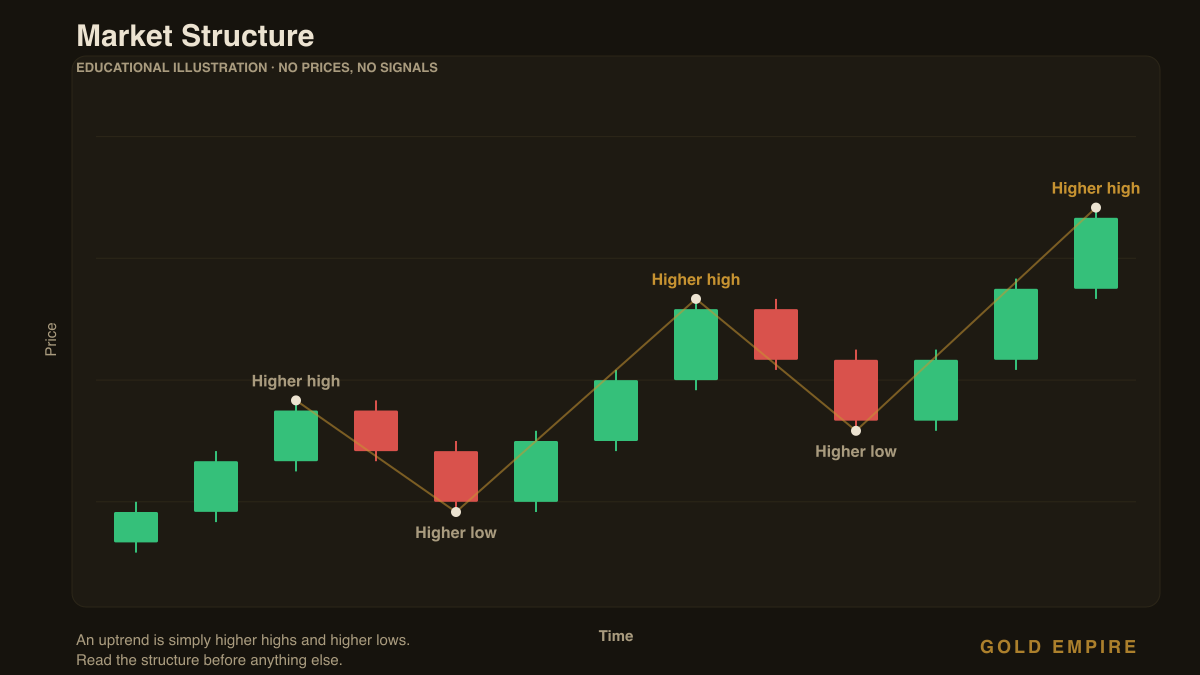
    Gold Empire XAU/USD chart showing market structure, higher highs and lower highs on the gold trend
    A Gold Empire XAU/USD chart, reading the trend through market structure (higher highs, lower highs, higher and lower lows) with a clear head.

    What “Reading a Gold Chart” Actually Means

    When people say they want to learn to read a gold chart, they usually imagine memorizing patterns, a shape here, an indicator there, and suddenly the future reveals itself. That’s not what reading is.

    Reading a chart of gold (XAU/USD) is closer to reading a room. You’re not predicting exactly what every person will do. You’re getting a feel for the mood, the direction things are leaning, and where the tension sits. Price is just the record of a long argument between buyers and sellers, printed as candles over time.

    Look at a chart like the one above. Before you draw a single line, before you think about any level, ask one honest question: which way is this leaning? Not “where will it go next”, just “what has it been doing.” That question alone puts you in the right posture. You become an observer, not a gambler waiting for confirmation of a wish.

    What a Trend Really Is (Up, Down, and Sideways)

    Everything in chart reading starts with the trend, so let’s be clear about what a trend actually is. A trend is simply the general direction price has been travelling over a stretch of time. There are only three:

    • An uptrend: price is generally making higher peaks and higher dips as it moves along. The overall drift is upward.
    • A downtrend: price is generally making lower peaks and lower dips. The overall drift is downward.
    • A sideways (or ranging) market: price is drifting mostly flat, bouncing between a rough ceiling and a rough floor with no clear direction.

    That’s it. Most of the confusion beginners feel comes from arguing with the chart instead of naming it. If gold is drifting sideways and you’ve decided it’s about to break upward, you’ll interpret every small bounce as proof, and you’ll be trading a story, not a trend.

    Naming the trend out loud, in plain words, is the first discipline. “Right now, on this timeframe, gold looks like it’s leaning up.” Or down. Or nowhere. You don’t need to be a genius to do this. You need to be honest.

    Market Structure in Plain Language

    Once you can name the trend, the next skill is seeing market structure, and this word scares people far more than it should. Market structure just means the pattern of highs and lows that price leaves behind as it moves.

    Think of price walking up a staircase. In a healthy uptrend, each step reaches a higher high than the last, and when it pulls back, it stops at a higher low than the previous dip. Higher highs, higher lows. That rhythm is the structure of an uptrend. Flip it upside down, lower highs and lower lows, walking down the staircase, and you’ve got the structure of a downtrend.

    Layered on top of that are two more plain ideas:

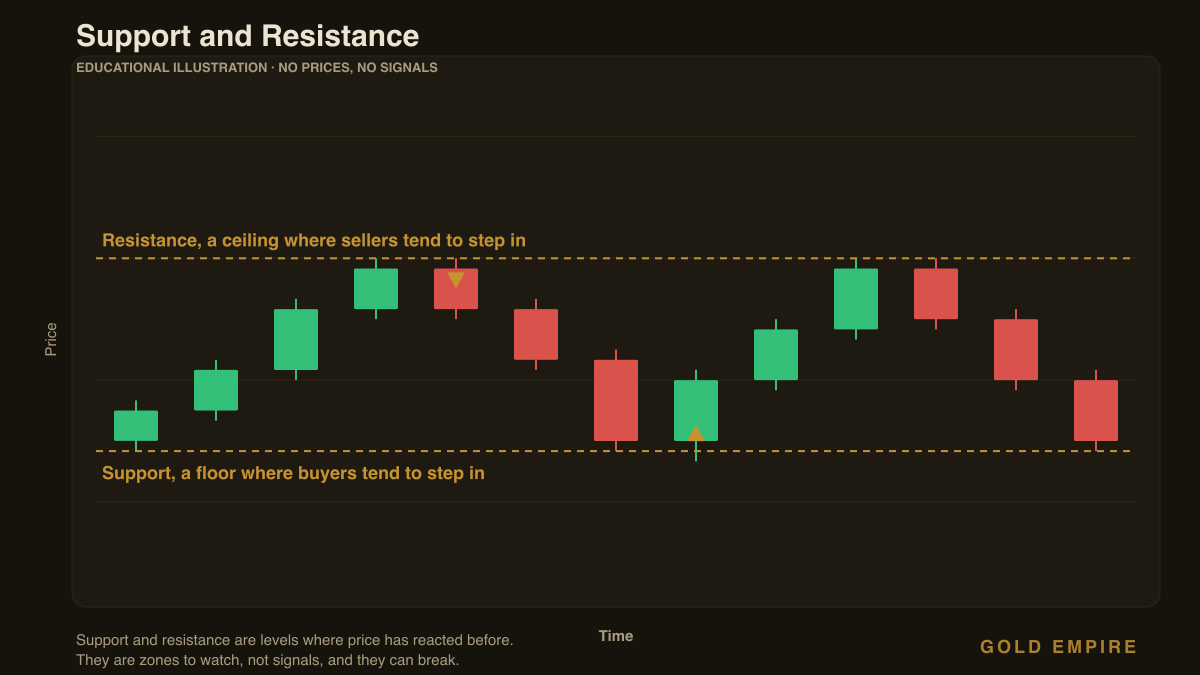
    • Support is an area where price has repeatedly stopped falling and turned back up, a kind of floor where buyers have shown up before.
    • Resistance is the opposite, an area where price has repeatedly stopped rising and turned back down, a kind of ceiling.

    These aren’t magic lines and they’re not exact. They’re zones, not precise numbers. When you learn to read a gold chart, you’re really learning to spot these floors, ceilings, and staircases at a glance, and to notice when the rhythm breaks. When an uptrend suddenly makes a lower low, the structure is telling you something has shifted. You don’t have to react. But you should notice.

    The chart isn’t hiding the answer from you. It’s showing you a rhythm. Your only job is to see it clearly, not to argue with it.

    Moving Averages: A Guide, Not a Command

    Beginners often reach for indicators hoping one of them will make the decision for them. I want to gently steer you away from that. Indicators don’t decide. They describe.

    A moving average is one of the simplest and most useful. It takes price over a chosen number of periods and averages it into a single smooth line, so the jitter of individual candles quiets down and the underlying direction becomes easier to see. When the line is generally sloping up and price is holding above it, that supports the read that gold is in an uptrend. When it’s sloping down and price sits below it, that supports a downtrend read.

    Notice my language: it supports a read. It doesn’t hand you a trade. A moving average is a trend guide, a way to confirm what your eyes are already telling you about direction, and to keep you honest when your emotions want to argue. It is not a green light and it is not a signal to act. No single line, on its own, is a reason to enter the market.

    Used this way, moving averages are calming. They take a noisy chart and remind you, plainly, which way the weather is blowing.

    Your Timeframe and Your Mood Change What You See

    Here’s something that trips up almost everyone. The same gold chart can look bullish and bearish at the same time, depending on the timeframe you’re looking at.

    Zoom out to a higher timeframe and you might see a calm, steady uptrend. Zoom into a very short timeframe and that same market looks like chaos, lurching up and down every few minutes. Neither view is lying. They’re just different distances from the same object. A beginner staring only at a fast, low timeframe often feels a constant urge to act, because at that zoom level everything looks urgent.

    This is why the timeframe you choose is a decision about your own nerves as much as your strategy. Faster charts demand faster reactions and pull harder on your emotions. Slower charts give you room to think.

    And then there’s mood, the quiet factor almost no course mentions. When you’re calm, you see the chart. When you’re anxious, bored, or desperate to make back a loss, you see what you need to see. Fear makes real setups look dangerous. FOMO makes weak setups look like the opportunity of a lifetime. Boredom invents reasons to trade when the honest answer is “there’s nothing here right now.” The candles didn’t change. Your eyes did.

    The Clear Head: Stepping Away and Coming Back

    This brings me to today’s real lesson, the one our channel keeps circling back to. Sometimes the smartest thing you can do with a gold chart is close it.

    It sounds almost like a joke, the trader who steps away. But I mean it seriously. When you notice your heart racing, when you catch yourself arguing with the chart, when you feel that pull to “just get in before it’s gone”, that is not the moment to read structure. That is the moment to stand up, get a glass of water, walk to the window, and let your nervous system settle.

    Because here’s the truth I’ve learned the slow way: the market will still be there when you come back. Gold has been traded for a very long time and it will keep printing candles tomorrow. The opportunity you’re afraid of missing is one of thousands you’ll see. But a decision made from a racing heart is expensive, and you often can’t take it back.

    When you return with a clear head, something quietly remarkable happens. The same chart looks different, not because it changed, but because you did. You can name the trend without flinching. You can see the structure without needing it to say yes. You can decide that the right move is no move at all, and feel fine about it.

    An anxious head lets the chart read you. A clear head reads the chart. The difference isn’t talent, it’s the state you choose to sit down in.

    A Calm Chart-Reading Routine

    Here’s a simple routine you can run every time you open a gold chart. It’s not about being right more often. It’s about approaching the chart from a settled place, so that whatever you decide, you decide it clearly.

    1. Name the trend first. Before you touch anything, say it plainly: up, down, or sideways on the timeframe in front of you.
    2. Mark the structure. Where are the recent higher highs and lows, or lower highs and lows? Where are the obvious support and resistance zones?
    3. Check your emotional state. Honestly, are you calm, or are you anxious, bored, or trying to win something back? Name it.
    4. Define your risk before anything else. Decide what you’re willing to lose on any idea before you think about what you might gain. Risk first, always.
    5. If you’re unsure, step away. Uncertainty plus a racing heart is not a setup. Close the chart, breathe, and come back later. The market waits.

    Not every setup wins, and no routine changes that. Consistency doesn’t come from finding a perfect pattern. It comes from following a structured process, in a steady frame of mind, over and over, especially on the days you’d rather not.

    Free gold survival sheet

    Get the free Gold Empire survival sheet, a one-page guide to protecting your account through the kind of market this article describes. One email, no spam, unsubscribe anytime.

    Get the free survival sheet →

    Frequently Asked Questions

    How do I know the trend of gold? Look at the general direction of the highs and lows over the timeframe you’re studying. If price is broadly making higher highs and higher lows, it’s leaning up; lower highs and lower lows, it’s leaning down; roughly flat between a ceiling and floor, it’s sideways. Say it out loud in plain words before you do anything else.

    What is market structure? It’s simply the pattern of peaks and dips that price leaves behind, the staircase of higher highs and higher lows in an uptrend, or lower highs and lower lows in a downtrend, along with the support and resistance zones where price has repeatedly turned. It’s a way of describing the market’s rhythm, not a prediction of its next move.

    Which timeframe should a beginner use? There’s no single correct answer, but very fast timeframes tend to pull hardest on your emotions and demand quick reactions, which is a lot to handle when you’re learning. Many beginners find it calmer to start on higher timeframes, where there’s more room to think and less pressure to act. Choose the one your nerves can actually handle.

    How do emotions affect chart reading? Enormously. Fear can make a reasonable idea look dangerous; FOMO can make a weak one look irresistible; boredom invents reasons to trade when there’s nothing there. Your emotional state quietly edits what you “see” in the candles. That’s exactly why checking your state, and stepping away when it’s off, is part of reading the chart, not separate from it.

    About the Author

    I’m Matthew, and I run the Gold Empire community, around 12,900 traders who care more about process than hype. My approach is simple and, I’ll admit, a little unglamorous: structured process, honest reasoning, and discipline over noise. I share real setups with the thinking behind them, so you can see how a decision is made, not just what it is. I don’t promise returns and I never will, because anyone who does is selling you a feeling, not a skill. What I offer is guidance, a steadier way to look at the market, and at yourself while you’re looking.

    Risk disclaimer: This article is for educational purposes only and is not financial, investment, or trading advice. Trading gold (XAU/USD) and other financial instruments carries a significant risk of loss and is not suitable for everyone. Nothing here is a recommendation to buy, sell, or hold any instrument. Past market behavior does not predict future results, and any growth or movement mentioned is purely illustrative. Always do your own research and consider seeking advice from a licensed financial professional before making any decision. Never risk money you cannot afford to lose.

    If you’d like to learn this way of thinking alongside other traders who value patience over noise, you’re welcome to join us on Gold Empire on Telegram. No pressure, and no rush, the door is simply open whenever a clear head brings you there.


    Related from Gold Empire


  • How to Trade Gold Through High-Impact News Without Getting Wrecked

    How to Trade Gold Through High-Impact News Without Getting Wrecked

    A few weeks back, gold moved more than 36 points in a single stretch. The headlines were about US–Iran tension, and you could feel the fear and the greed hit the market at the same time. Within minutes, some traders had made their week. Within the same minutes, others had erased a month of careful work. Same chart. Same candle. Two completely different outcomes.

    I’ve watched this movie enough times to know how it usually ends for the person who tries to “catch the news.” So let me talk to you honestly, the way I’d talk to a friend who called me right before a rate decision, thumb hovering over the buy button.

    This isn’t a guide to profiting from news. It’s a guide to surviving it. Because in this business, the trader who is still standing after the storm is the one who eventually wins. Before we go further, one thing needs to be said plainly: most retail traders lose money trading gold and CFDs. This is education, not financial advice, and nothing here is a signal or a promise.

    Why News Turns Gold Into a Different Animal

    On a normal day, gold has a personality you can read. It breathes. It respects levels. It gives you time to think.

    During a high-impact news release, a central bank rate decision, a CPI print, a sudden geopolitical flare-up, that personality vanishes. Liquidity thins out because the big players pull their orders back to avoid getting run over. Spreads widen. Price gaps. The “smooth” market you were trading turns into a set of stairs with missing steps.

    Here’s what most people don’t understand until it costs them: your stop loss is a request, not a guarantee. In a violent move, price can jump straight past your stop and fill you somewhere far worse. That’s slippage, and news events are where it lives. The 36-point spike I mentioned didn’t travel in a straight, orderly line, it whipsawed. It spiked up, ripped down, then reversed again, hunting stops on both sides before anyone knew which direction actually mattered.

    So the first mental shift is this: news doesn’t just make gold move fast. It makes gold move unfairly. The rules you rely on, clean fills, predictable spreads, orderly candles, are temporarily suspended. If you walk in expecting the usual rules, you’ll get taught an expensive lesson.

    Why “Predicting the Number” Is a Losing Game

    Every news event tempts you with the same fantasy: If I just guess right, I’ll ride the spike and bank a fortune.

    Let me take that fantasy apart.

    Even if you somehow predicted the exact CPI figure or the exact wording of a central bank statement, you still would not know how the market will react to it. I’ve seen gold rip higher on “bad” news and collapse on “good” news, because price had already positioned for one outcome and the crowd unwound the other way. The number is only half the equation. The reaction, the psychology of thousands of traders repricing all at once, is the half you can’t model.

    And here’s the part that stings: to profit from a news spike, you need to be right about the number, right about the direction of the reaction, right about the timing, and get a decent fill in a market that’s actively working against you. That’s four coin flips in a row, in conditions designed to punish you. Betting your capital on that isn’t trading. It’s gambling with extra steps.

    The professionals I respect don’t win by predicting the news. They win by not needing to.

    The Framework: Before, During, and After

    Here’s the posture I actually use. It’s not glamorous. It won’t give you a story to brag about at dinner. But it has kept me in this game for years, and staying in the game is the whole point.

    Before the news: decide in advance, then get smaller or step aside.

    The most important decisions are made before the candle prints, when your mind is still calm. Know what’s on the economic calendar for the week, the rate decisions, the inflation prints, the scheduled speeches. Geopolitics you can’t schedule, but the recurring big-ticket events you absolutely can.

    Once you know what’s coming, you have three honest choices, and none of them is “bet big”:

    1. Reduce your size dramatically, so that whatever happens, the outcome can’t hurt you badly.
    2. Stand aside entirely and let the event pass, cash is a position, and often the best one.
    3. Protect what you already hold, if you’re in a trade with open profit, consider whether you want to be exposed through the event at all.

    When our channel saw that volatility spike building around the US–Iran situation, the message to members wasn’t “here’s how to play it.” It was: make risk management your top priority and protect the profits you’ve worked to earn. That’s not caution for its own sake. That’s how you make sure there’s a “next trade” at all.

    During the news: keep your hands still and widen your expectations, not your risk.

    The moment the number drops, your job is mostly to not act. The first move is frequently a trap, a stop-hunt designed to shake out both the longs and the shorts before the real move begins. Chasing that first candle is how accounts die.

    If you must have exposure through the event, understand that everything is wider now: wider spreads, wider swings, wider ranges. The mistake most people make is widening their stop to survive the noise while keeping their position size the same, which quietly doubles or triples their real risk. If anything, it should work the other way. Widen your expectation of how far price can travel, and shrink your position so that width can’t hurt you. Your risk per trade should get smaller when volatility gets bigger, not larger.

    After the news: let the dust settle before you trust the chart again.

    There is no prize for being first. Once the spike has fired and reversed and fired again, the market eventually shows its hand. Spreads normalize. A real trend, if there is one, establishes itself. That’s when the chart becomes readable again, and that’s when a patient trader can actually think.

    Waiting isn’t weakness. Waiting is a decision. The trader who sits on their hands for twenty minutes after a CPI release, and then acts on a market that has calmed down, is playing a completely different, far saner game than the one who tried to front-run the candle.

    The eye of a storm with a single gold coin resting calmly at the still center

    Protect Capital First, Everything Else Is Second

    I want to strip this down to the one idea that matters most.

    Your capital is the only thing that lets you keep playing. Lose it, and it doesn’t matter how good your analysis becomes next month, you’re out. That’s why capital protection comes before profit, before being right, before everything.

    News events are the sharpest test of that principle because they offer the loudest temptation. The spike is thrilling. The story you tell yourself, “this is the one”, is intoxicating. And that’s exactly why discipline has to be louder than adrenaline.

    I’ve come to believe something that took me years to accept: success in this game isn’t about how many indicators you stack on your chart, or how often you’re right, or how clever your prediction was. It’s about mental discipline and emotional resilience. It’s about being the person who can watch a 36-point spike, feel the pull, and still choose the boring, correct thing, smaller size, or no trade at all.

    The market will always offer you another chance. The only way to guarantee you can take it is to still be here when it comes.

    A Word to the Trader Tempted by the Spike

    If you’re reading this with a news event coming up and a plan to “just try it once,” I understand the pull completely. I’ve felt it. But ask yourself an honest question: if this trade goes against you in the worst way the spread and slippage allow, can your account absorb it and keep going?

    If the answer is no, you don’t have a trade. You have a wager. And the house, the volatility, the slippage, the whipsaw, is built to win that wager over time.

    The long game rewards the patient and punishes the greedy. That’s not a motivational slogan. It’s just the math of survival compounding in your favor.

    Free gold survival sheet

    Get the free Gold Empire survival sheet, a one-page guide to protecting your account through the kind of market this article describes. One email, no spam, unsubscribe anytime.

    Get the free survival sheet →

    Frequently Asked Questions

    Should I close all my trades before a big news release?

    That’s a personal risk decision, not a rule I can make for you. What I can say is that many disciplined traders reduce their exposure or step aside entirely around scheduled high-impact events, precisely because fills and spreads become unreliable. The question to ask yourself is whether you’re comfortable holding through conditions where your stop loss may not protect you the way it normally would. If the honest answer is no, that tells you something.

    Can’t I just use a wider stop loss to survive the volatility?

    A wider stop without a smaller position is a trap, it simply increases how much you can lose. If you widen your stop to accommodate news-level swings, your position size has to come down to keep your actual risk the same or lower. Volatility going up should mean your risk per trade goes down, not up. Most people do the opposite, and that’s why news events wreck them.

    Isn’t standing aside just missing opportunity?

    I used to think so. Now I see cash as a legitimate position and patience as an edge. You don’t get paid for the trades you avoid, but you also don’t lose on them, and in a game where survival is everything, avoiding a catastrophic loss is worth more than catching a lucky spike. There will always be another setup. There isn’t always another account.

    About the Author, Matthew

    I’m Matthew, and I trade and study gold (XAU/USD) the slow, unglamorous way, risk first, ego last. I’m not interested in selling anyone a dream about getting rich from a single candle. I’ve been around this market long enough to have made the painful mistakes myself, and most of what I teach is simply the discipline I wish someone had drilled into me earlier. Through Gold Empire, I share how I think about volatility, risk, and the long game, because I believe the traders who last are the ones who learn to protect their capital before they chase a profit. Trade calm. Trade small when it’s loud. Stay in the game.

    Risk disclaimer: This article is for educational purposes only and does not constitute financial, investment, or trading advice. Trading gold, forex, and CFDs carries a substantial risk of loss, and most retail traders lose money. Any numbers or scenarios mentioned are generic illustrations, not recommendations, and are not entry, stop-loss, or take-profit advice. Past performance does not guarantee future results. You are solely responsible for your own decisions, consider your circumstances carefully and seek independent, licensed advice before risking capital you cannot afford to lose.

    πŸŽ“ Lesson 3 of 14 Β· The Survival School

    You reached the end. Nice work. πŸ‘

    Read the lesson through, then claim your 100 XP and climb a rank in the Survival School. Progress saves on this device, no sign-up, no email.

    πŸŽ‰ Lesson 3 of 14 complete, progress saved to your Survival School.
    Read the lesson to unlock this.


    Related from Gold Empire


  • The Best Time to Trade Gold (and When to Just Stay Out): A Straight-Talk Guide for New XAU/USD Traders

    The Best Time to Trade Gold (and When to Just Stay Out): A Straight-Talk Guide for New XAU/USD Traders

    The coffee was still warm when the account was gone.

    Ninety seconds. Maybe less. I’d sat down early, on purpose, feeling smart about it, a big US number was dropping, and I wanted to be in before the crowd. That was the whole plan. Beat everyone to the chair.

    Then the number hit. Gold jumped. Not my way. It tore off in the opposite direction so fast I got thrown out of my own trade before I’d finished reading the headline that was supposed to make me rich. My eyes were still crossing the words. The position was already dead.

    I’d sat down at the loudest minute of the day like it was any other minute.

    That’s the part nobody warns you about. The market didn’t get me. When I chose to sit down got me. I picked the most violent minute on the clock and walked in like it was a quiet Tuesday afternoon.

    Now put yourself in that chair. The screen jumps. You don’t know why. Your finger’s already moving. That fear, of getting swept out in seconds, of watching a small account bleed to nothing before you understand what happened, that’s what I want to talk to you about. Because there is no magic hour that makes you win. The best time to trade gold has two faces, and most people only ever look at one.

    Failing to prepare is preparing to fail.

    What the best time to trade gold really means (it’s not a magic hour)

    The best time to trade gold is when the market has enough liquidity and movement for a plan to actually run, mostly the London and New York hours. The best time to stay out is when nothing’s moving, when big news is about to land, or when your own head isn’t right. Both matter. One keeps you in the game. The other keeps you from bleeding out.

    Here’s what new traders miss. Gold, XAU/USD, just the price of one ounce quoted in US dollars, trades almost around the clock. Nearly 24 hours a day, five days a week. And because the door never closes, you start to believe every hour is the same hour. It isn’t. Not even close.

    So “best time” isn’t some magic hour you punch in and win. It’s two faces: when the market’s awake enough that a prepared plan has room to breathe, and when the smartest thing your hands can do is sit still. Picking the right time isn’t about winning more. It’s about not walking into the exact minutes most likely to wipe you out, the thin, jumpy, headline-soaked minutes where small accounts quietly disappear before the coffee goes cold. I’ve been the one who showed up at the worst minute of the day and called it good timing.

    Up or down was never the question. When you sit down is.

    If the words themselves are still fuzzy, what gold even is, why it moves, start with Gold Trading for Beginners and come back. This one builds right on top of it.

    Gold trading sessions: when gold sleeps and when it wakes up

    Let’s start with the clock, because that’s where the two faces come from. Gold trades almost around the clock. But it doesn’t move around the clock. That took me years, and a few burned accounts, to feel in my gut instead of just nodding at.

    A session is just a chunk of the day, named after whichever financial city is awake and pushing the money around. Tokyo at its desk, that’s the Asian session. London opens, that’s London. New York sits down, that’s New York. But not every city trades gold with the same weight in its hands. (If the whole idea of trading sessions is new to you, Investopedia has a plain, neutral rundown, worth two minutes.)

    Here’s the part I wish someone had said to me plainly, back when I was staring at a screen wondering what was wrong with me. For long stretches, gold sleeps. Price drifts sideways, the range tightening like the market is barely breathing. Then a big session opens, and the whole thing sits up. Movement. Fuel. Price finally goes somewhere instead of shuffling its feet.

    Two sessions carry gold: London and New York. That’s where the big money moves, where the orders stack deep, where the range yawns open widest. If gold is going to travel, it usually travels then.

    The Asian session is the quiet one. Tokyo, Sydney, gold tends to go tight, flat, sideways. And I want to be careful here. Quiet isn’t bad. It’s a different animal. If you’re a slow, patient person, that calm might suit you fine. The trap is reading quiet as safe. A still market feels like a soft place to lean in and load up. It isn’t. Sleepy and safe were never the same thing, and my early accounts paid the difference.

    Two more to file away. Monday can open with a gap, a jump from where price left off Friday. And big US holidays run thin, fewer people at their desks, which can make gold jerk around in ways that don’t quite make sense.

    The London–New York overlap: gold’s most alive (and most dangerous) window

    Now the sharpest hour of them all, the one that got me in that opening story.

    There’s one window in the day when gold stops drifting and starts running. Late afternoon in London, early morning in New York, for a few hours both cities trade gold at the same time. Two of the biggest rooms in the world, awake at once, leaning on the same price. That’s the overlap. Two sessions bleeding into one.

    And gold feels it. This is when it moves furthest, fastest. Price can drain out of a level like water leaving a bathtub, quick, and gone before your hand reaches the plug. If gold naps through the quiet hours, the overlap is when it’s up and pacing the room.

    Here’s the part new traders get backwards. They see all that movement and read it as easy. More motion, more chances, more money. That’s not how it works. Alive doesn’t mean easy. Fast doesn’t mean easy.

    That movement is enough for a plan you’ve prepared to actually run. It’s also enough to punish a plan you haven’t. The overlap doesn’t care which one you brought to the table. It just moves, and hands you the bill. I’ve paid that bill: sat down for the overlap once with nothing but a hunch, mistook the noise for opportunity, and got walked out of the room before my coffee went cold.

    Failing to prepare is preparing to fail.

    So hear me on this. You don’t have to trade the overlap just because it’s the loudest hour on the clock. Its being alive is a tendency, not a promise, some days the move never really comes. Whether you sit down for it is a separate question, and that one’s yours.

    Trading gold during news: where new traders get swept away

    I told you the news hit me before I finished reading the headline. Here’s what I didn’t understand yet.

    The big US numbers, NFP, the monthly jobs report; CPI, the inflation reading; the Fed deciding what to do with interest rates, mostly land during New York hours. So the market’s most awake window and its most violent window sit right on top of each other. That fooled me for years. I saw a fast, crowded, wide-open session and thought, this is where the money is. What I didn’t see: I’d pulled my chair up at the exact minute the floor could give way.

    That’s the trap in one line: the loudest hour and the deadliest hour are often the same hour. When one of those numbers prints, gold doesn’t drift. It lurches. Hard, in a matter of minutes. And it doesn’t check which way you’re leaning first. That’s where new traders get swept away, sitting in a position they opened early because they felt clever, watching the candle rip the other way before the words even make sense.

    Why does gold care so much? On a quiet day, the forces that move it take turns, interest rates and the Fed, the dollar (gold is priced in dollars, so a stronger dollar tends to press gold down), the safe-haven rush when people scramble for somewhere solid to hide. News drops, and they all pull the rope at once.

    Here’s what took me too long to learn. You don’t have to trade the news. Most days the strongest move you can make is to sit on your hands until the dust settles. Which brings us to the harder skill: knowing when to stay out on purpose.

    When to just stay out (Part 1): no clear setup means wait, patience is a position

    There’s a line you’d scroll right past: “No clear setup yet; patience and discipline while monitoring market structure.” Read it slow. When nothing lines up, you wait. You watch how price moves. You keep your hand off the mouse.

    Here’s what took me years to feel in my gut: choosing not to trade is a trade. A real decision, and it’s the one that protects your account. For a long time, doing nothing felt like falling behind. It wasn’t. It was the trade.

    The lie that costs the most is the quiet one. A flat market looks harmless, nothing’s moving, so nothing can hurt you, right? Wrong. A chart going nowhere, plus an itchy finger, plus a little boredom: that’s the most expensive mix in this whole game. Not the violent minutes after the news drops. The dull ones before. I know because I paid for it, sat in front of a dead-flat market, no setup anywhere, and jumped in anyway. Not because I saw something. Because I was bored. My hands wanted a job, so I gave them one, and the market handed me the bill. That’s not trading. That’s fidgeting with real money.

    When there’s no clear reason to be in, the reason is simple: stay out. Patience isn’t sitting on the bench. It’s your position.

    When to just stay out (Part 2): cancel the setup, and know your own worst window

    The first way to stay out is simple to say: no trade yet. This second way is harder. It means walking away from a trade you already believed in.

    Some days I’d map a setup, wait for it, get in, and then price would start doing something that had nothing to do with why I was there. My reason was gone. On the channel, I say it flat: “Cancel setup: price action no longer supports original thesis.” The plan I loved five minutes ago is dead. Close it, step back, before it costs me more. That’s an ego thing, not a chart thing. The chart already moved on, I’m the one still wanting to be right. I’m wrong plenty. I only learned to survive when I stopped arguing with the screen.

    Then there’s the other window, yours. The market’s most alive hour can land right on your worst one. You’re tired. You just took a loss and you’re still sour about it. You skipped your homework. The overlap can be wide open and you can still be the wrong person to sit down at that desk.

    I know that window because I burned accounts inside it, lost a trade, felt the sting, shoved on more size to win it back, then dragged my stop-loss wider to give the trade “room to breathe,” which was just me refusing to say out loud that I was wrong. The nail in my own tire. (Where that stop actually belongs is its own conversation, I wrote it out in Where to Place Your Stop-Loss on XAU/USD.)

    So here’s the sharpest thing I’ve got for you. Sometimes the best time to trade gold is not to trade at all.

    Your simple timing plan: what to actually do tonight

    You don’t need a fancy system tonight. You need four questions, the ones I run through before I ever touch the chair. Skip them and you’re guessing.

    One. Learn the clock. Find when London and New York trade in your own local time, and mark where they overlap. Write it on a sticky note, stick it on your monitor. That overlap is when gold wakes up. Know it before you feel it.

    Two. Open the economic calendar before you sit down. Anything big today, jobs data, an inflation print, a rate call from the Fed? If yes, give yourself permission to stay out until the dust settles. That’s not weakness. It’s a decision.

    Three. Write the setup down before you enter, and write what would kill it. Then honor the kill. If price stops backing your idea, you’re out. No arguing with the chart because your ego picked a side.

    Four. Check yourself, not just the screen. Tired? Still sore from a loss? Bored, hunting for something to do? Any yes is a stay-out signal, the market’s hottest window can land right on your worst one.

    That’s preparing, not predicting. None of it promises a win. It just tips the odds toward walking away with your account intact. I’m wrong plenty, but I get swept far less than I used to.

    Failing to prepare is preparing to fail. Survive first, then grow.

    Free gold survival sheet

    Get the free Gold Empire survival sheet, a one-page guide to protecting your account through the kind of market this article describes. One email, no spam, unsubscribe anytime.

    Get the free survival sheet →

    Frequently asked questions

    What is the single best time of day to trade gold? There isn’t one magic hour. The most active stretch is the London–New York overlap, late London afternoon into the New York morning, when both big markets trade gold at once and price moves furthest, fastest. But active isn’t the same as easy. It’s the best window for a plan you’ve prepared, and the worst for a hunch.

    Is it safe to trade gold during news like NFP or CPI? It’s the least safe time for a new trader. When those numbers print, gold lurches hard in minutes, and it doesn’t check which way you’re leaning first. That’s exactly where small accounts get swept out. Most days the smartest move is to stand aside until the dust settles.

    Should I trade gold during the Asian session? You can, it just behaves differently. Gold tends to go tight, flat, and sideways through Tokyo and Sydney hours. That calm can suit a slow, patient style. The danger is reading quiet as safe and loading up. Sleepy and safe were never the same thing.

    Is it bad to not trade at all some days? No, it’s often the whole skill. Choosing not to trade is a real decision, and it’s the one that protects your account. A flat market plus an itchy finger plus boredom is the most expensive mix in this game.

    How do I know when to cancel a trade I already planned? When price stops supporting the idea you got in for. If the chart starts doing something that has nothing to do with your original reason, the reason is gone, close it and step back. The hard part isn’t the chart; it’s your ego wanting to be right.

    A quick, honest note

    This is education, not financial advice. Trading gold carries real risk, and you can lose money. I’m not promising results, and nothing here is a sure thing, every link between price and news is a tendency, not a formula.

    About me. I’m Matthew. I trade XAU/USD and run the Gold Empire Telegram channel, where I post my real trades, green months and red ones, out in the open. No certificates to wave. My only authority is the accounts I burned early on, learning this the hard way. I learned this by paying for it.

    If you want to sit in the room where I trade in the open, come join us on Telegram: t.me/GoldEmpire. And if you haven’t yet, grab the free Survival Sheet, it’s the checklist version of everything above: https://goldempirefx.com/survival-sheet/.

    Survive first, then grow.

    πŸŽ“ Lesson 2 of 14 Β· The Survival School

    You reached the end. Nice work. πŸ‘

    Read the lesson through, then claim your 100 XP and climb a rank in the Survival School. Progress saves on this device, no sign-up, no email.

    πŸŽ‰ Lesson 2 of 14 complete, progress saved to your Survival School.
    Read the lesson to unlock this.


    Related from Gold Empire


  • Gold Trading for Beginners: What Actually Moves the XAU/USD Price

    Gold Trading for Beginners: What Actually Moves the XAU/USD Price

    Let me guess what brought you here.

    You opened a gold chart for the first time, and the numbers were already moving before your coffee went cold, a language you couldn’t read. Green, red, up, down, no reason you could see. And underneath the confusion sat a quieter, colder thought: if I put money on this, I’m going to lose it.

    Good. Sit with that a second, because that fear is smarter than most people give it credit for.

    Before I go further: this is educational, not financial advice. Trading gold carries a real risk of loss. I’m not handing you a shortcut. I’m writing this because I remember standing exactly where you’re standing.

    So let me be straight with you. I’ve blown gold accounts with my own two hands, not the market’s, mine. I’d take a loss, feel that hot little sting of being wrong, and pile on size the next trade to win it back faster. I’d drag my stop loss out so the trade “had room to breathe”, a polite way of saying I refused to admit I was wrong. Gold moves fast, and that speed felt like opportunity. It was, in a way. A fast way to empty an account.

    So let me say your fears out loud, because that’s where they start to shrink:

    You’re scared of getting wiped out in the two minutes after some news drops. You’re scared your small account will just quietly bleed to zero. You’re scared the price jumps around and none of it makes sense.

    Here’s what I can promise, and what I can’t. I can’t teach you to predict where gold goes next, nobody can. But I can help you understand the playing field, so those wild jumps stop looking like chaos and start looking like forces you can name. That’s really what gold trading for beginners comes down to: not a crystal ball, just a map.

    That’s the whole point. Survive first, then grow.

    What Is XAU/USD, Really? (In Plain English)

    Before you can care about what moves the price, you have to know what the price even is. So let me clear it up the way I wish someone had, back when I was staring at the screen pretending I understood.

    XAU/USD. It looks like a password someone typed with their elbow. But it’s simple once you crack it open. XAU is just the market’s code for gold, the “X” tags it as a commodity, and “AU” is the chemical symbol for gold. Put USD on the end and you’ve got the whole thing: XAU/USD is the price of one ounce of gold, measured in US dollars. That’s it. That’s the mystery.

    Here’s the part that trips up almost every beginner, so read it twice. When you trade XAU/USD, you’re not buying a bar of gold to hide in a drawer. Nobody ships you anything. You’re placing a bet on the direction of the price, whether gold goes up or down against the dollar. Up or down. That’s the whole game underneath the noise.

    Think of it like betting on which way a scale tips, not owning the thing sitting on it.

    And here’s the one line I want you to carry into every section below:

    Because gold is priced in dollars, anything that makes the US dollar stronger or weaker hits this number directly.

    That’s the hinge the whole door swings on. Every force we’re about to unpack, interest rates, the dollar’s strength, fear, big money, is really one story about gold and the dollar pulling against each other. Once you see the price this way, it stops looking like a random number twitching on a screen and starts looking like something with reasons behind it, reasons you can learn to read.

    So let’s name those reasons, one at a time.

    Interest Rates and the Fed

    Here’s the lever that scared me most when I started: interest rates. And the Fed, the US Federal Reserve, the central bank that sets those rates, is the hand on the lever.

    The logic is simpler than it sounds once someone lays it out plainly. Gold pays you nothing. No interest, no dividend, no monthly trickle into your account. It just sits there, being gold. So when rates are high, plain cash and bonds start to look attractive, they actually pay you to wait. Next to that, gold can feel like dead weight, and it often loses some of its shine. But when rates are low, the cost of holding gold, the return you gave up by not parking your money somewhere that pays, gets small. Holding gold hurts less. So gold often becomes the more tempting place to sit.

    That’s the whole relationship, and I want to be straight about what it is: a tendency, not a formula. I can’t hand you a number, “rates go here, so gold goes there.” Nobody honestly can. It’s a pull, a lean, not a switch you can set your watch by.

    Which brings me to my scar. Early on, there was a Fed announcement sitting on the calendar, and I told myself I understood exactly what was coming. I’d read the takes. I was certain. So I sized up, too big, because certainty makes you brave in all the wrong places. Then the statement dropped, the words weren’t quite what the crowd had braced for, and gold lurched in a direction I hadn’t priced in at all. My “sure thing” took a chunk out of me. Not the market’s fault. Mine. I’d mistaken having an opinion for having an edge.

    So here’s the small comfort I can hand you. The next time you watch gold jump the second the Fed opens its mouth, and the chart feels haunted, it isn’t a ghost. That’s interest rates, moving. Now you know its name. And on my channel, you’ll watch me sit through the next one live, real trade, green day or red.

    The US Dollar, Why Gold Often Moves Opposite the Dollar

    Here’s something that used to make me feel a little crazy. I’d watch gold slide for no reason I could see. No news. No Fed. Nothing on my screen said “sell.” And still the number kept dropping, quiet and steady, like water leaving a bathtub. I’d stare at the chart and take it personally, like the market had a grudge.

    It didn’t. The dollar was flexing, and I just wasn’t looking at it.

    Go back to the key from earlier: gold is priced in US dollars. So the dollar isn’t some bystander to this game. It’s the other end of a seesaw. When the dollar gets stronger, gold usually gets heavier and sinks. When the dollar gets weaker, gold usually floats up. Traders call that relationship inverse, one side up, the other side down. Not every time. But that’s the usual pull.

    There’s a tool people glance at to read the dollar’s strength: the DXY, an index that measures the US dollar against a basket of other currencies. Think of it as a quick temperature check. When the DXY is climbing hard, that’s often the invisible hand pressing down on gold. So before you decide gold “randomly” turned on you, ask one question: what was the dollar doing right then?

    Now one honest warning, because I won’t hand you a rule that quietly breaks your account. This is a tendency, not a law. Some days gold and the dollar drift the same way and leave everyone scratching their heads. When that happens, something bigger, fear, or interest rates, is usually drowning out the normal pull. So don’t marry the inverse. Respect it, watch it, but don’t bet the farm on it holding every single candle.

    Understanding this won’t tell you where gold goes next. Nobody knows that. But it turns one more mystery into something you can actually read.

    Inflation, Safe-Haven Fear, and the Big Money Behind the Curtain

    Here’s something I wish someone had told me early: gold rarely moves for one clean reason. Several forces pull on it at once, and they don’t take turns. They pull together, sometimes against each other, and the price you see is the tug-of-war, not a single hand on a switch.

    Start with inflation, money slowly losing its buying power, so the same note buys less bread next year than it does today. For a long time, people have reached for gold to store value while cash quietly bleeds out. So when the fear of inflation rises, some money drifts toward gold. But, and this matters, it’s not mechanical. Inflation tangles up with interest rates and with what people expect to happen next, so you’ll get days when the fear is loud and gold barely flinches. Don’t build a religion out of one relationship.

    Then there’s safe-haven demand, the place money runs to hide when it’s scared. When the world feels unstable, geopolitical tension, a financial crisis, war, plain market panic, money looks for somewhere to sit that isn’t on fire, and gold has worn that role a long time. When traders flip “risk-off”, protecting what they have instead of reaching for more, that rush can lift gold fast and hard. You can almost feel it on those days: the headlines go tight, everyone’s shoulders climb toward their ears, and gold catches a bid out of nowhere. Flip the mood back to “risk-on,” and that same pull quietly fades.

    And underneath all of it, the central banks and the big money. National banks buy and sell gold as part of their reserves, and the large funds move size most of us can’t picture. That slow, heavy buying presses on the price beneath everything else, less a jolt, more a tide across the medium and long term.

    So when gold jumps and you can’t name why, it’s usually not random. It’s inflation nerves, or fear, or the big money shifting its weight. Several hands. One price.

    When Gold Comes Alive: London, New York, and the Overlap

    There’s one more force that has nothing to do with news and everything to do with the clock.

    Gold trades almost around the clock, nearly 24 hours a day, five days a week. That fools a lot of new traders. If the market’s always open, they figure, then it doesn’t much matter when they sit down. It matters more than almost anything else you’ll do.

    A session is just a chunk of the trading day, named after the financial city that’s awake and driving it. And gold doesn’t move the same in all of them. For long stretches it barely breathes, drifting sideways, half asleep. Then a big session opens and the whole thing sits up.

    Two of them matter most: London and New York. That’s where the real money moves, where the buying and selling pile up thick and the price swings widest. And the wildest window of all is the overlap, London’s afternoon running straight into New York’s morning, when both cities trade gold at once. Price can cover a lot of ground, fast, in that stretch.

    Now put one more thing on top. The big US news, jobs numbers, inflation readings, interest rate decisions, tends to land during New York hours. When it drops, gold can lurch violently in the space of a few minutes. That’s exactly where beginners get swept out.

    I know, because it happened to me. Early on I put a trade on minutes before a US release, feeling clever, feeling early. The number hit and gold jumped, not my way. I was flicked off my chair before I’d even finished reading the headline. I’d sat down at the hottest minute of the day like it was any other.

    So here’s the point. Knowing when the field turns hot matters as much as knowing what pushes the price. You don’t have to trade the overlap. You don’t have to touch a news release. But walk in blind at the loudest moment of the day, and gold will teach you the hard way.

    Big Moves Cut Both Ways: The Truth About Gold’s Volatility

    Here’s the part I need you to hear, even if you skim the rest.

    Gold moves big. The price can travel a long way fast, a run that takes other markets days, gold can cover before your coffee goes cold. And that speed is the bait. You watch a chart rip and something in you says: this is it, this is the trade that changes things. That same speed is what drains a small account in an afternoon when there’s no risk control behind the click.

    Big moves cut both ways. Big chance and big danger aren’t two things, they’re one coin, and you don’t get to hold only the side you like. The wildness that makes gold exciting is the exact same wildness that can hurt you. Nobody sells you that half.

    And let me be honest about where the damage actually comes from. When I blew accounts early on, it wasn’t the market ambushing me. It was me. I’d take a loss, feel the sting, and size up on the next trade to “win it back.” I’d drag a stop because I couldn’t stand to be wrong. I was the nail in my own tire, the air was already hissing out, and I kept driving anyway.

    So here’s the sharp thing, plain: understanding what moves gold does not mean you’ll predict it. Those are two different skills. You can read every driver in this article, rates, the dollar, fear, the big money, and still be wrong tomorrow. I’m wrong plenty. Anyone who swears they aren’t is selling you something.

    Understanding lowers your surprise. It doesn’t hand you the future.

    That’s why being right was never the goal. Staying in the game is.

    Free gold survival sheet

    Get the free Gold Empire survival sheet, a one-page guide to protecting your account through the kind of market this article describes. One email, no spam, unsubscribe anytime.

    Get the free survival sheet →

    Understand the Game First, Then Grow, and Where to Watch It Live

    Remember that chart from the top of this article, the one that looked like numbers jumping for no reason, the one that let your coffee go cold while you tried to read a language you didn’t speak?

    Look at it again.

    It’s still moving. But it isn’t noise anymore. When it jumps, you can start asking the right question: is that the Fed talking about interest rates? The dollar leaning the other way, remember, gold is priced in dollars, so when the dollar rises, gold usually gets pulled down? Fear pushing money into a safe corner? A central bank you’ll never see, buying quietly? You won’t always land on the answer. But you’re not staring at chaos anymore.

    And here’s what I wish someone had told me before I blew those first accounts: for anyone starting gold trading, understanding the game is not the same as predicting it. The point of everything you just read isn’t to make you right. It’s to keep you in your seat long enough to learn. Don’t rush your money in before you understand what moves the price. Keep your risk small. Stay in the game long enough for the lessons to land.

    Survive first, then grow.

    If you want to watch this play out with real money on the line, I run a Telegram channel called Gold Empire, where I post my actual XAU/USD trades, the green months and the red ones, out in the open. Come sit with it: t.me/GoldEmpire. And if you want a plain starting point, I put together a free Survival Sheet you’re welcome to grab: https://goldempirefx.com/survival-sheet/.

    No promises. Just an honest seat next to someone who’s still in the chair.


    About Matthew

    I trade gold, XAU/USD, and I run the Gold Empire channel on Telegram, where I post my real trades, winners and losers alike. I don’t have a certificate to wave at you, and I won’t show you screenshots of profits to impress you. What I have is scars: early accounts I blew with my own two hands, sizing up after losses, moving stops I should’ve left alone. I learned this by paying for it. That honesty is the only authority I’ll claim. Survive first, then grow.


    FAQ

    Do I need to buy physical gold to trade XAU/USD? No. When you trade XAU/USD, you’re not buying gold to store in a drawer, you’re taking a position on the direction of gold’s price against the US dollar, up or down. No vault required.

    What single thing moves gold the most? There isn’t one clean answer, and be wary of anyone who hands you one. Interest rates and the Fed tend to pull hard, and the dollar’s strength matters a lot because gold is priced in dollars, but inflation, safe-haven fear, and big institutional money all tug too, often at the same time. It’s a mix, not a switch.

    When is the best time to trade gold as a beginner? Gold moves most during the London and New York sessions, especially where they overlap. That’s also when US news drops and price can whip around in minutes, exactly where new traders get caught. Knowing the hot window exists matters more than rushing into it.

    Can I predict where gold will go? No, and neither can I, not every time. Nobody does. The goal isn’t prediction. It’s understanding the forces well enough to manage your risk and stay in the game. Survive first, then grow.

    I’m brand new. Where should gold trading for beginners actually start? Start by understanding what moves the price before you risk a cent, the Fed and interest rates, the dollar, fear, the big money, and the hours when gold turns violent. Keep your position sizes small enough that a bad day can’t end you. The first job isn’t to win. It’s to still be here next month.


    This article is educational, not financial advice. Trading gold carries a real risk of loss.

    πŸŽ“ Lesson 1 of 14 Β· The Survival School

    You reached the end. Nice work. πŸ‘

    Read the lesson through, then claim your 100 XP and climb a rank in the Survival School. Progress saves on this device, no sign-up, no email.

    πŸŽ‰ Lesson 1 of 14 complete, progress saved to your Survival School.
    Read the lesson to unlock this.


    Related from Gold Empire