GOLD EMPIRESurvive First, Then Grow

Category: Tools & Brokers

  • Difference Between Cent Account and Standard Account, in Risk

    Difference Between Cent Account and Standard Account, in Risk

    The difference between cent account and standard account is not a difference in the market, the spread you pay or the chart you look at. It is a difference in the size of the smallest mistake you are allowed to make. That sounds like a small thing. It is actually the whole thing, because on a small balance the smallest trade your broker will accept is often already larger than the risk your account can survive, and no amount of discipline fixes an arithmetic problem.

    I want to do something more useful than list the features of two account types. I measured how far gold actually moves in a day, then worked out how big an account has to be before the minimum trade size on each account type fits inside a sane risk budget. The answer is a clean multiple of one hundred, and once you see it, the marketing language around cent accounts stops mattering.

    What the Difference Between Cent Account and Standard Account Really Is

    Both account types trade the same instrument through the same broker, usually with the same spread and the same execution. What changes is the unit your balance is counted in, and therefore the size of one lot.

    On a standard gold account, one lot is one hundred troy ounces. A one dollar move in the price of an ounce is one hundred dollars to you. Most brokers let you go down to one hundredth of a lot, which is a single ounce, so the smallest trade you can place moves one dollar for every dollar the metal moves.

    On a cent account, your deposit is displayed in cents rather than dollars, so a deposit of one hundred dollars shows as a balance of ten thousand. Everything else scales with it. One lot on that account is one hundredth of a standard lot, and the smallest trade you can place is one hundredth of an ounce. The numbers on the screen look bigger and the money at risk is one hundred times smaller.

    That is the entire mechanical difference. A cent account is not a demo account, the money is real and the losses are real. It is not a different market, and it does not give you better fills. It is a smaller ruler.

    The Only Question Worth Asking: What Does the Smallest Trade Cost You

    An account type is not good or bad in the abstract. It is either compatible with your balance or it is not, and compatibility is measurable. To measure it I need two things: how far gold typically moves, and how much of your account you are willing to lose on one trade.

    How far gold actually moves in a day

    I took the published LBMA gold benchmark, the afternoon fix, and measured the average absolute change from one published session to the next. Over the most recent 250 sessions that average is 1.26 percent, with a median of 0.99 percent. Over the last 1,250 sessions, roughly five years, the average is 0.79 percent and the median 0.56 percent. Gold has been livelier lately than its own five year habit.

    I am going to use one average daily move as the stop distance in everything below. Not because you should place your stop there, you should place it where your reasoning says the idea is wrong, but because it is a measured, neutral stand in for “a stop with enough room to breathe”. Using a tighter one would flatter the arithmetic, and I would rather the arithmetic be honest.

    The account size the minimum trade demands

    Set your risk budget at one percent of the account, which is the common convention and, in my experience, already generous for a beginner. Now ask the question backwards. If the smallest trade you can place is one ounce, and your stop is 1.26 percent of the value of that ounce, how big does your account have to be for that loss to equal one percent of it?

    The answer is that your account must be worth about 1.26 ounces of gold. Below that, the smallest trade a standard account permits risks more than one percent, and you are no longer choosing your risk, the broker’s minimum is choosing it for you.

    Here is the same calculation across several account sizes, with everything expressed in ounces so it holds regardless of where the gold price sits:

    • Account worth 10 ounces: the minimum standard trade risks 0.13 percent. Comfortable.
    • Account worth 5 ounces: 0.25 percent. Comfortable.
    • Account worth 2 ounces: 0.63 percent. Workable.
    • Account worth 1 ounce: 1.26 percent. Already above a one percent budget.
    • Account worth half an ounce: 2.52 percent. Four losing trades in a row and you are down a tenth of the account.
    • Account worth a quarter of an ounce: 5.04 percent. Twenty trades of that size is the whole account.

    On a cent account the same calculation gives 0.0126 ounces, because the minimum trade is one hundredth of the size. That is the number that matters, and it is exactly one hundred times smaller. Everything else people argue about, the platform, the bonus, the leverage on offer, is decoration compared with this.
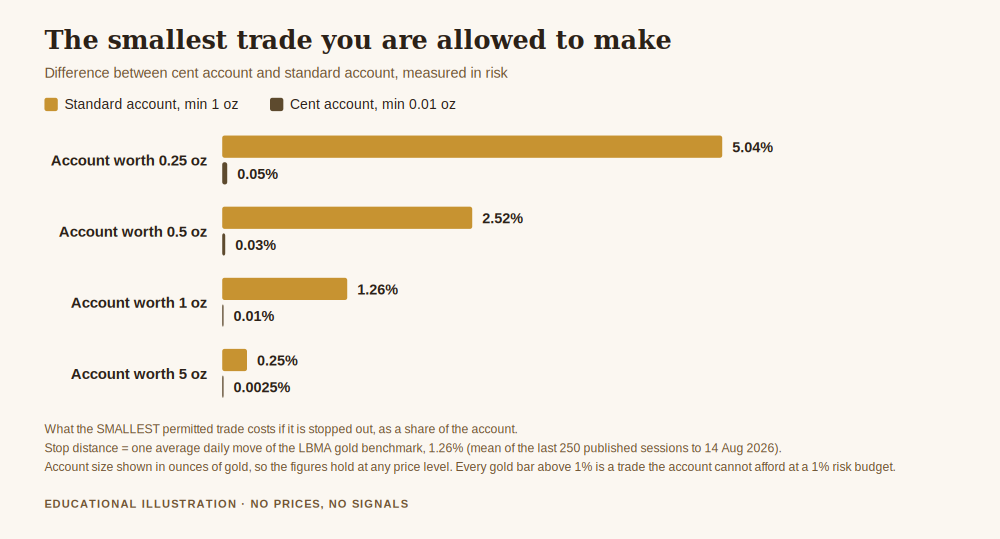
    Difference between cent account and standard account shown as the risk of one minimum size gold trade at different account sizes
    The difference between cent account and standard account, expressed as what the smallest permitted trade costs when it goes wrong. Stop distance is one average daily move of the LBMA benchmark, 1.26 percent, measured over the last 250 sessions.

    Leverage Does Not Solve a Small Account, It Postpones the Conversation

    The usual objection at this point is that leverage makes the account size irrelevant. It does not, and the regulator’s own numbers show why.

    Under the European product intervention rules, retail leverage on gold is capped at 20 to 1, which is the same bracket as non major currency pairs and major indices. Twenty to one means the margin you post is five percent of the position’s value. Now put the daily move next to it. One average day, 1.26 percent of the position, is 25.2 percent of the margin you posted. Not of your account, of the margin backing that one position.

    Read that again, because it is the sentence I wish someone had put in front of me early. At the maximum leverage a European regulator considers acceptable for retail clients on gold, an ordinary day, not a shock, not a news event, an ordinary day, moves a quarter of your posted margin. Four ordinary days in the wrong direction, with no stop, is the position gone.

    The same ESMA analysis found that 74 to 89 percent of retail accounts trading contracts for difference typically lose money, with average losses per client ranging from 1,600 to 29,000 euros. Those are supervisory figures collected across national regulators, not a survey and not marketing. Leverage is the mechanism by which a small account reaches the size of a large mistake, which is the opposite of what it is usually sold as.

    What a Cent Account Is Genuinely Good For

    I am not against cent accounts. I think they are the honest answer to a real problem, and the problem is that most people cannot start with an account worth several ounces of gold.

    A cent account lets you take a real trade, with real money, at a risk fraction that is actually sane. You can hold a position through a session and feel what that does to you, which is information a demo account cannot give you because nothing is at stake. You can run twenty or fifty trades of a plan and see the shape of the results rather than the shape of one lucky week. You can find out whether you actually follow your own rules when the number on the screen is red, and you can find that out for a cost that will not end your participation.

    That last point is the real argument. The purpose of the first year is not to make money. It is to still be here at the end of it with a record of what you did, and a cent account makes the tuition affordable.

    What a Cent Account Cannot Teach You

    Two things, and both of them catch people on the way up.

    The first is emotional scale. Losing 30 cents when your rules say you should lose 30 cents is not the same experience as losing 30 dollars, or 300. The habit of following the plan is real and worth building, but the pressure that breaks the habit is not present at this size. Expect a step change when you move up, and plan for it by moving up slowly rather than in one jump.

    The second is cost as a share of the position. Spread and commission do not shrink when the position shrinks, they are per ounce and they stay put. On very small positions the fixed cost of trading is a much larger share of the outcome, so a cent account will usually understate the quality of your edge, not overstate it. If your plan roughly breaks even on a cent account, it may be better than it looks. If it loses steadily there, it will lose faster with size, because the losses scale and the discipline does not automatically come with them.

    How I Would Actually Choose

    Work out what your account is worth in ounces, then read it off. If the account is worth less than about one and a quarter ounces at a one percent risk budget, a standard account cannot give you a position small enough, and the choice is a cent account or waiting until you have funded more. If it is worth several ounces, a standard account is fine and a cent account will mostly be an inconvenience, because the reporting is in a unit nothing else in your life uses.

    Two things to check before you open either. Confirm the minimum lot size in writing, because “0.01” means one ounce on one account type and one hundredth of an ounce on the other, and the number alone tells you nothing. Confirm what happens when you want to move up, whether the same broker lets you transfer to a standard account without closing the relationship and starting again.

    And then treat the choice as what it is, a decision about the size of your unit of learning, not a decision about how much you will make. The related pieces here go deeper on the two halves of that: how to calculate lot size for gold and forex for the arithmetic of the position itself, and how to trade gold with a small account for what to do once the size question is settled. The foundation under both is risk management in gold trading.

    Free gold survival sheet

    Get the free Gold Empire survival sheet, a one-page guide to sizing a position so that no single trade can end your account, whichever account type you are using. One email, no spam, unsubscribe anytime.

    Get the free survival sheet →

    Frequently Asked Questions

    Is a cent account real money or is it like a demo?

    It is real money. The balance is shown in cents, so a hundred dollar deposit reads as ten thousand, but deposits, losses and withdrawals are all real. A demo account risks nothing, which is precisely why it teaches you less.

    Which is better for a beginner, a cent account or a standard account?

    Better depends on the size of your balance rather than your experience. If one minimum trade on a standard account would risk more than your intended percentage, the standard account is not offering you the choice you think it is. The measurements above put that threshold near an account worth one and a quarter ounces of gold at a one percent risk budget and a stop of one average daily move.

    Do cent accounts have worse spreads?

    Sometimes, and it is worth checking rather than assuming, because it is one of the few places where a broker can quietly charge for the convenience. The more reliable effect is arithmetic rather than pricing: the same spread is a larger share of a smaller position, so trading costs weigh more heavily on a cent account.

    How long should I stay on a cent account?

    I would not set that by time. I would set it by evidence, a stated plan and enough trades executed to that plan that you can see whether you actually followed it. Then increase size in steps small enough that no single step changes how you behave.

    Can I use higher leverage instead of using a cent account?

    You can, but it does the opposite of what people hope. Leverage does not make a position smaller, it makes the money backing it smaller. At the 20 to 1 retail cap for gold, one average daily move is 25.2 percent of the margin posted for that position, so higher leverage buys you a shorter distance between an ordinary day and a closed position.

    Does the difference between cent account and standard account affect my strategy?

    It should not affect what you consider a good trade. It affects how many of them you can survive being wrong about, and that is a bigger factor in the first year than the quality of any entry.

    Where Gold Empire Fits

    Gold Empire is a free Telegram channel where I post gold analysis with the reasoning stated before the move rather than after it, losing days included. Nothing needs to be bought to follow along, and there is an optional Kit later for people who want more structure. I publish no profit claims, and I do not rank brokers for payment.

    The free survival sheet is the one page version of the sizing discipline in this article. If you want the neighbouring pieces, how much money to start trading gold approaches the same question from the funding side, and what is leverage in gold trading covers the mechanism that makes small accounts fragile.

    About the author. Matthew writes Gold Empire. He is interested in the unglamorous half of this business, cost, size, frequency and the arithmetic of staying solvent, on the view that most accounts are lost to ordinary errors repeated patiently rather than to any single dramatic trade.

    Disclaimer: This article is general educational content about how two account types differ in minimum position size. It is not financial advice, not a recommendation of any broker, account type or platform, and not a suggestion to open any particular position. Trading gold and leveraged products carries a high risk of losing money rapidly. No entry, stop or target discussed should be treated as a signal. The volatility figures above were computed by me from the published LBMA gold benchmark, afternoon fix, over the most recent 250 and 1,250 published sessions to 14 August 2026, and the account size figures follow from them by arithmetic under the stated assumptions of a one percent risk budget and a stop of one average daily move. The leverage cap and the client loss statistics are from ESMA and apply to retail clients in the European Union; your jurisdiction may differ. Contract sizes are broker specific and must be confirmed with your own broker. No gold price is quoted anywhere in this article and no trading results are represented. Past behaviour of a public benchmark is not a prediction.


  • The Best Chart Settings for TradingView, and What the Data Says They Add

    The Best Chart Settings for TradingView, and What the Data Says They Add

    Every few weeks somebody asks me for the best chart settings for TradingView, and what they usually want is a list: these three indicators, these period numbers, this colour scheme, copy it and the chart will start telling the truth. I understand the appeal. I spent about eighteen months of my own trading life believing that the arrangement of things on my screen was a solvable problem, and that once I solved it the rest would follow. It did not follow. What actually happened is that I kept adding, because adding felt like progress and removing felt like giving something up.

    So rather than hand over another list, I did something I should have done years earlier. I took the published daily gold benchmark for the last ten years and measured how much the popular indicators actually disagree with each other. Not how they look, not how they feel on a Tuesday afternoon, but how much independent information a second, third and sixth indicator adds once the first one is already on the chart. The answer turned out to be smaller than I expected, and it changed how my own screen looks.

    What People Mean When They Ask for the Best Chart Settings for TradingView

    The question is almost never really about settings. Underneath it there is usually one of three worries, and they are worth separating because they have different answers.

    The first worry is am I missing something. Somebody saw a screenshot with six panes and assumed the person behind it was seeing more of the market than they were. The second is am I being fooled. A trader has been stopped out a few times in a row and suspects the chart itself is misleading them. The third is genuinely mechanical: what timeframe, what colours, what defaults, so the thing is readable at seven in the morning without squinting.

    Only the third one is a settings question. The first two are questions about information, and information is measurable, which means we do not have to argue about it.

    I Measured How Much Six Indicators Actually Disagree

    The test

    I used the London Bullion Market Association daily gold benchmark, the afternoon fix, from January 2016 to the end of December 2025. That is 2,506 published sessions. After allowing for the warm-up each indicator needs before it produces a value, 2,457 sessions had a reading from all six of the indicators I tested. The data is public and free, and I have linked it at the end so you can rerun this yourself rather than take my word for it.

    The six were chosen because they are the ones that appear on most crowded charts, and because they are supposed to be measuring different things: RSI on 14, Stochastic %K on 14, CCI on 20, Bollinger %B on 20 with 2 standard deviations, the MACD histogram on 12, 26 and 9, and the plain percentage distance between price and its 50 period simple moving average.

    Then I asked a boring question. Across those 2,457 sessions, how closely does each pair move together?

    What came back

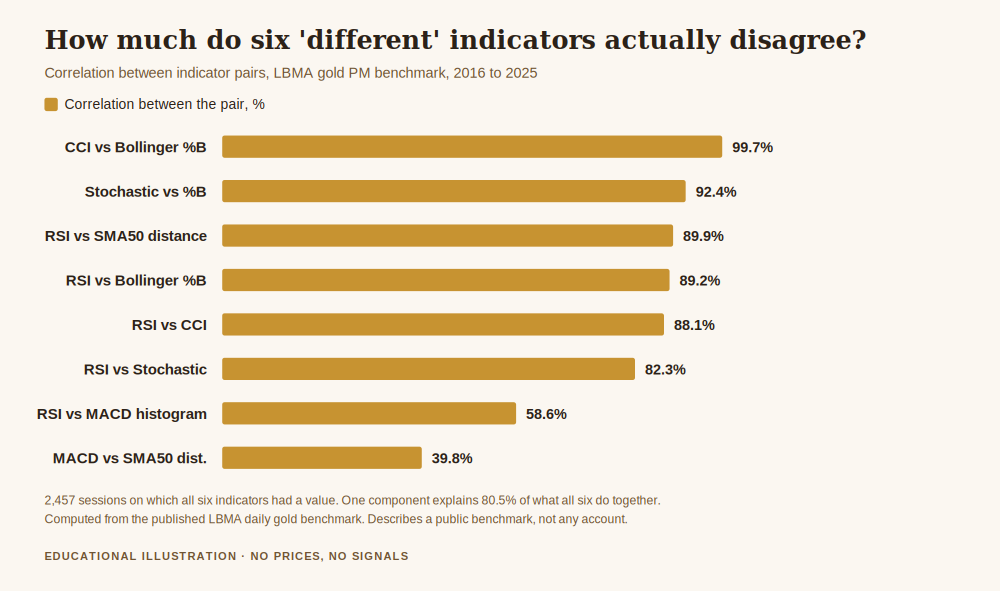
    The median correlation across all fifteen pairs was 0.72. That alone is worth sitting with. Half the pairings of supposedly independent tools move together more than seventy percent of the way.

    The extreme case was almost comic. CCI on 20 and Bollinger %B on 20 correlated at 0.997. Those two are not two indicators. They are the same measurement with different arithmetic on top and a different y axis, and if you have both on your chart you have drawn one line twice and given yourself the impression of confirmation.

    The most independent pairing was the MACD histogram against the distance from the 50 period average, at 0.40, and even that is a long way from unrelated. RSI against the distance from the 50 period average came in at 0.90.

    Best chart settings for TradingView, chart showing how closely six popular indicators move together on ten years of LBMA gold data
    The best chart settings for TradingView start with knowing which indicators are already telling you the same thing. Correlations computed on 2,457 LBMA gold sessions, 2016 to 2025.

    Then I ran the sharper version of the question. If you treat those six indicators as six sources of information and ask how many genuinely separate signals are hiding inside them, the answer is that a single underlying component explains 80.5 percent of everything the six of them do. Two components explain 91.8 percent. Six inputs, and by the second one you have accounted for more than nine tenths of the variation.

    The practical translation is not that indicators are useless. It is that the fifth and sixth ones are decoration. You are paying screen space, attention and reaction time for something like eight percent of additional information, and you are paying it at the exact moment when attention is most expensive.

    The Period Number Matters Less Than You Think

    The other half of the settings question is the numbers. Should RSI be 14 or should it be 7, because somebody on YouTube said 14 is for beginners.

    On the same ten years of gold data, RSI on 14 and RSI on 21 correlated at 0.98. RSI on 14 and RSI on 7 correlated at 0.94. The widest gap in the family, 7 against 21, was still 0.87.

    That is what tuning a period number buys you. You are not switching to a different instrument, you are adjusting the smoothing on the same one, and at the margins where it does differ it differs by being faster and therefore noisier, or slower and therefore later. There is no setting that is both. Anyone offering you one is selling something.

    I am not saying the number is arbitrary. I am saying that if you are changing it in the hope that a different number will change your results, the change you are looking for is not in there. I have watched traders spend a fortnight on this while the actual leak in their account, which was size, sat untouched. If that sounds familiar, risk management in gold trading is the piece I would read before touching a single chart setting.

    What a Crowded Chart Actually Costs You

    The cost is not that indicators lie. It is a mismatch of frequency, and it is easy to miss because it accumulates quietly.

    Take one indicator at its default settings. Over those ten years, RSI on 14 crossed up through 70 sixty two times and down through 30 twenty six times. That is roughly nine alerts a year from a single tool, doing what it was designed to do, with nothing wrong with it.

    Now count what the market actually offered. Over the same period, gold completed sixty one distinct five percent moves, which is about six and a third a year.

    So one indicator, alone, at factory settings, produces about nine invitations a year against roughly six substantial moves. Add five more indicators, each with its own thresholds and crossings, and the invitation count multiplies while the number of real opportunities does not move at all. The chart has not become more informative. It has become more talkative, and the arithmetic of what that does to an account is covered in how to stop losing money day trading, because frequency is where most of it goes.

    There is a second cost that is subtler. I checked how often all six indicators sat on the same side of their neutral line at the same time: 60.4 percent of sessions. Most of the time, then, your six confirmations are one confirmation wearing six hats. When they finally do disagree, which is the moment a second opinion would actually be worth having, you have trained yourself to read disagreement as noise, because for six sessions out of ten it has been.

    So What Settings Do I Actually Use

    Here is the honest answer, offered as description rather than prescription. My gold chart has price, one moving average for context, and the levels I drew myself. That is it. No oscillator panes. I add one temporarily when I have a specific question, and I remove it when I have the answer.

    The reasoning is not aesthetic. It comes from the numbers above. If one component accounts for four fifths of what six indicators do, then one carefully chosen reference plus my own reading of structure gets me most of the available information with none of the false quorum. And the thing I most need protection from at seven in the morning is not a shortage of data. It is the feeling of confirmation, which is manufactured very cheaply by putting two versions of the same measurement side by side.

    For the mechanical part of the question, the part that genuinely is about settings, my only real opinions are these. Pick a timeframe you can actually watch given your job and your sleep, and stop switching. Turn on the session separators if you trade gold, because gold does behave differently by session and it helps to see the boundary. Make sure the instrument you are charting is the one your broker actually fills you on. And set the chart so the numbers are large enough that you are not leaning in, because leaning in is a physical tell that you are about to overtrade.

    What This Does Not Mean

    It does not mean indicators are worthless. A tool that compresses a hundred candles into one readable line is doing real work, and there is nothing wrong with using one, or two, if you know what each is for.

    It also does not mean my six were the right six, or that a correlation measured on the daily benchmark carries over unchanged to a five minute chart. It will not, exactly. Shorter timeframes are noisier and the numbers will shift. What almost certainly does carry over is the direction of the finding, because the underlying reason is structural: nearly every one of these tools is a transformation of the same recent price history, so they are related by construction, not by coincidence.

    And it does not mean that having a clean chart makes you profitable. It removes one specific way of fooling yourself. That is all it does, and it is still worth doing.

    Free gold survival sheet

    Get the free Gold Empire survival sheet, a one-page guide to protecting your account through the kind of market this article describes. One email, no spam, unsubscribe anytime.

    Get the free survival sheet →

    Frequently Asked Questions

    What are the best chart settings for TradingView for gold specifically?

    The gold specific parts are the session separators, because gold’s behaviour differs meaningfully between the Asian, London and New York sessions, and making sure your chart symbol matches the instrument your broker actually fills. Beyond that, the measurements above suggest the number of indicators matters far more than which ones you pick, and fewer is the cheaper error.

    Is RSI 14 or RSI 7 better?

    On ten years of daily gold data they correlate at 0.94, so the choice is between slightly faster and noisier, or slightly slower and later. Neither is better in general. If you cannot articulate why you want the faster one, the default is fine.

    How many indicators should I have on one chart?

    I cannot give you a number that fits everyone, but I can give you a test. For each indicator on your chart, say out loud what question it answers that nothing else on the chart answers. If two of them get the same sentence, one of them is redundant, and the measurements above suggest that will happen more often than you expect.

    Does a cleaner chart improve results?

    Not by itself, and I would be careful with anyone who claims otherwise. What it does is remove the illusion of independent confirmation, which is one specific and common way traders talk themselves into a position they had already decided to take.

    Do these numbers apply to other markets?

    The exact figures are gold’s. The mechanism is not gold specific: these indicators are mathematical transformations of the same price series, so high correlation between them is structural. I would expect the same pattern elsewhere with different decimals, but I have not measured it, so treat that as an expectation rather than a finding.

    Where Gold Empire Fits

    Gold Empire is a free Telegram channel where I post gold analysis with the reasoning stated before the move rather than after it, losing days included. Nothing needs to be bought to follow along, and there is an optional Kit later if you want more structure. I publish no profit claims and I do not rank brokers for payment.

    The free survival sheet is the one page version of the discipline described here. If you want the neighbouring pieces, how to read a gold chart with a clear head covers what to do with the space you free up, and what is a moving average in gold trading explains the one line I did keep.

    About the author. Matthew writes Gold Empire. He is interested in the unglamorous half of this business, cost, size, frequency and the arithmetic of staying solvent, on the view that most accounts are lost to ordinary errors repeated patiently rather than to any single dramatic trade.

    Disclaimer: This article is general educational content about how chart indicators relate to one another. It is not financial advice, not a recommendation of any platform, indicator, setting or method, and not a suggestion to open any particular position. Trading gold and leveraged products carries a high risk of losing money rapidly. No entry, stop or target discussed should be treated as a signal. Every correlation, variance and frequency figure above was computed by me from the published LBMA daily gold benchmark over 2016 to 2025, using the afternoon fix, standard indicator formulas and 2,457 sessions on which all six indicators had a value. Those figures describe the behaviour of a public benchmark, not the behaviour of any account, any broker feed or any intraday timeframe, and past behaviour of a benchmark is not a prediction. No gold price is quoted anywhere in this article and no trading results are represented. TradingView is named because it is the platform readers ask about; this article is not affiliated with, endorsed by or sponsored by it.


  • Best Broker for Gold Trading in UAE: Check the Licence First

    Best Broker for Gold Trading in UAE: Check the Licence First

    Search for the best broker for gold trading in UAE and you will get lists. Ranked tables, star ratings, a column for spreads and a column for maximum leverage, and somewhere near the bottom a line about regulation that says something like regulated and trusted. That last line is doing almost all of the work and being given almost none of the space.

    I want to spend this article on the part the lists skip, because in the UAE it is genuinely more complicated than in most countries, and because getting it wrong is the kind of mistake that is not recoverable by trading well afterwards. No entry, stop or target discussed should be treated as a signal.

    The Question the Ranking Lists Never Ask

    In most countries there is one financial regulator and the question regulated by whom has one answer. The UAE is not built that way, and this is the single most useful thing to understand before you fund anything.

    There are parallel regimes operating in the same country at the same time. Onshore, the Securities and Commodities Authority is the federal regulator for securities and commodities activity. Alongside it sit two financial free zones, each with its own independent regulator and its own rulebook: the Dubai International Financial Centre, supervised by the Dubai Financial Services Authority, and Abu Dhabi Global Market, supervised by its Financial Services Regulatory Authority. The Central Bank of the UAE covers banking and payments.

    These are not branches of one another. A firm authorised in one is not thereby authorised in the others, and the protections, the complaint routes and the rules that apply to your account depend on which one your broker actually holds a licence from.

    So regulated in the UAE, on its own, is not information. It is the shape of information. The useful version has three parts: which authority, what category of licence, and what reference number. Anything short of that is a claim you cannot check, and a claim you cannot check should be treated as a claim that has not been made.

    Best Broker for Gold Trading in UAE Starts With the Register, Not the Spread

    Here is the check, and it takes about five minutes.

    Find the licence claim on the broker’s own site, usually in the footer or on a legal page. Note the authority named, the entity name, and the number. Then go to that authority’s public register yourself and look the entity up. Not the link from the broker’s website. Navigate to the regulator independently, because a link on a site you are trying to verify is not evidence about that site.

    The two registers you can reach directly are the Securities and Commodities Authority for onshore firms and Abu Dhabi Global Market for firms in that free zone. The DIFC regulator maintains an equivalent public register for firms licensed there. Each of them exists precisely so that you do not have to take a firm’s word for its own status.

    Four things to confirm once you find the entry, and each of them catches a different real problem.

    • The entity name matches exactly. Not similar, exactly. A group may hold a licence in one subsidiary while your account is opened with a different one registered somewhere else entirely. The name on the register and the name on your client agreement should be the same legal person.
    • The licence permits what you are about to do. Authorisation is granted by category. A firm may be licensed for an activity that has nothing to do with holding retail client money for leveraged trading.
    • The status is current. Registers show withdrawn and lapsed permissions too, and marketing material does not update itself when a licence does.
    • Client money is addressed in writing. Segregation of client funds from the firm’s own funds is the arrangement that matters most if the firm fails, and it should be stated in your agreement rather than implied by a badge.

    Why offshore keeps appearing in the results

    You will meet plenty of firms marketing to residents of the UAE while licensed somewhere with a much lighter regime. That is not automatically fraud, and I am not going to pretend it is. It is a trade, and it should be priced honestly.

    What you typically get is higher leverage and a faster sign up. What you typically give up is the register you can check, the complaints process with teeth, and any realistic route to recovering money if the firm stops answering. Traders tend to weigh the first two because they are visible on day one, and discover the value of the last three on the only day they matter.

    What the Numbers Say About Skipping This Step

    I would rather show you a measured figure than lean on the word careful.

    The FBI’s Internet Crime Complaint Center publishes an annual report of fraud reported to it. In its 2024 annual report, reported losses in the investment fraud category were 6.57 billion dollars. The two preceding years were 4.57 billion and 3.31 billion. Reported losses in that category roughly doubled in two years.

    Within that, fraud involving cryptocurrency investment accounted for 41,557 complaints and about 5.8 billion dollars, with losses up 47 percent on the prior year.

    Two caveats I will state rather than bury. This is United States data and it does not measure the UAE. And it counts what was reported, which is a floor rather than a total, since most people who lose money this way do not file a report.

    I use it anyway because the shape is the lesson. The category that grows like that is not one where victims made exotic mistakes. The standard pattern is an unverifiable platform, an account that displays profits, and withdrawals that stop working. Every part of that is prevented by the five minute check above, which is the cheapest risk control available anywhere in this business.

    The Leverage Number Is a Marketing Number

    The other column that dominates broker comparisons is maximum leverage, and it is the one most consistently misread. Higher is presented as better, or at least as more. Here is what it actually changes.

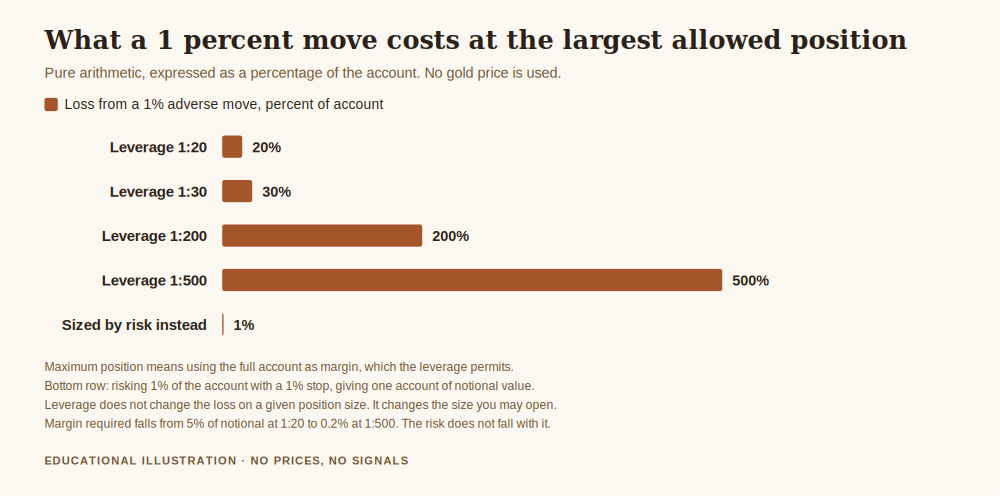
    Chart for choosing the best broker for gold trading in UAE, showing what a 1 percent adverse move costs at the largest position each leverage level allows
    Choosing the best broker for gold trading in UAE means reading the leverage column correctly: it sets the size you may open, not the risk you carry.

    Take an account and call its value A, and a position whose full contract value is V. Margin required is simply V divided by the leverage. At 1:20 you post 5 percent of V. At 1:500 you post 0.2 percent of V, twenty five times less cash for exactly the same position.

    Now the part the marketing omits. A 1 percent adverse move costs you 1 percent of V. That is true at every leverage level, because the loss is a property of the position, not of the financing. Leverage did not make the trade safer or riskier. It changed how much of your cash was tied up while the trade was open.

    What it did change is the size you are permitted to open. At 1:20 an account can support a position of about 20A. At 1:500 it can support 500A. Run the 1 percent move against those maximum positions and the arithmetic is brutal: 20 percent of the account at 1:20, and 500 percent of it at 1:500. The second number is larger than the account, which is a formal way of saying the account is gone and a debt may remain.

    Contrast that with sizing from risk instead of from permission. Decide to risk 1 percent of the account with a stop 1 percent away, and the position works out at about one account of contract value. That is roughly one five hundredth of what the leverage would have allowed. The leverage cap was never the constraint that was protecting you, because your own sizing rule binds hundreds of times earlier, and that arithmetic is set out in how much to risk per trade.

    Which reframes the whole column. High leverage is not dangerous because of what it forces you to do. It is dangerous because of what it permits on the day your judgement is poor, and everyone has those days.

    Then, and Only Then, Compare the Features

    Once two or three brokers have survived the register check, the remaining comparison is ordinary and worth doing properly.

    The total cost of a round turn on gold. Spread plus commission plus any overnight financing, quoted on the instrument you will actually trade, at the hours you will actually trade it. A tight spread advertised during the quietest hour of the day is a number about their marketing, not about your costs.

    Behaviour when it is busy. Everything works at 3pm on a Wednesday. What matters is the minute around a scheduled release, and the only way to learn it is a small live account and a few weeks of paying attention.

    Withdrawals before deposits. Test the exit path early with a small amount, while the stakes are low and while you are calm. A deposit is designed to be effortless. The withdrawal is the process that tells you what kind of firm you are dealing with.

    Whether local presence means local licence. An office in Dubai, an Arabic website and a UAE phone number are marketing facts, not regulatory ones. The register is the regulatory fact, and the two are frequently not the same.

    Free gold survival sheet

    Get the free Gold Empire survival sheet, a one page guide to sizing a gold position so the leverage your broker offers never becomes the size you actually carry. One email, no spam, unsubscribe anytime.

    Get the free survival sheet →

    Frequently asked questions

    Which regulator covers gold trading brokers in the UAE?

    It depends on where the broker is licensed, and that is the whole point. Onshore firms fall under the Securities and Commodities Authority. Firms in the Dubai International Financial Centre fall under the Dubai Financial Services Authority, and firms in Abu Dhabi Global Market fall under that free zone’s Financial Services Regulatory Authority. They are separate regimes with separate registers, so the useful question is never is it regulated but which authority, which licence and which number.

    Is an offshore broker with higher leverage a reasonable choice?

    It can be a considered choice, but it should be a priced one. You are trading away a register you can check and a complaints process that works in exchange for larger permitted positions and an easier sign up. Given that your own sizing rule should bind long before any leverage cap does, you are usually paying a real price for a permission you should never use.

    How do I actually verify a broker’s licence?

    Take the entity name and licence number from the broker’s legal page, then navigate to the regulator’s website independently and search its public register. Confirm the exact entity name, that the licence category covers holding retail client money for leveraged trading, and that the status is current. If any part of that does not line up, you have your answer without needing to resolve why.

    Does a Dubai office mean the broker is regulated in the UAE?

    No. A physical office, a local number and a local website are commercial facts. Plenty of firms maintain a presence in one country while holding their licence in another, and the licence is what determines your protections. Check the register rather than the address.

    How much leverage do I actually need for gold?

    Far less than is offered, and the arithmetic settles it rather than opinion. If you size from a risk rule, a 1 percent risk with a 1 percent stop produces a position of roughly one account of contract value, which even 1:20 accommodates comfortably. Everything above that is headroom you have no plan to use.

    Is my money protected if the broker fails?

    Do not assume it is, and do not assume any jurisdiction works like another you have read about. What matters in practice is whether client funds are held segregated from the firm’s own money and what your written agreement says about it. Ask directly, get the answer in writing, and treat a vague reply as an answer in itself.

    What is the single most common mistake here?

    Choosing on spread and leverage first and treating regulation as a tie breaker. That inverts the order of importance. Costs affect your returns. The licence affects whether you can get your money back, and no amount of skill later compensates for getting that one wrong at the start.

    A Short Checklist Before You Fund Anything

    • Identify the specific authority, licence category and reference number, from the broker’s own legal page.
    • Verify it on that regulator’s public register, reached independently rather than by following the broker’s link.
    • Confirm the exact legal entity you will contract with is the one on the register.
    • Get the client money arrangement in writing.
    • Fund a small amount, then test a withdrawal before the account matters.
    • Compare total round turn cost on gold at the hours you actually trade.
    • Ignore the maximum leverage figure, and size from your own risk rule instead.

    Where This Leaves You

    The honest answer to the question in the title is that there is no single best broker for gold trading in UAE, and anyone publishing that ranking is selling placement rather than judgement. What exists is a short list of firms whose licence you have personally verified with the right authority, from which you pick on cost and on how they behave when the market is busy.

    That is a duller answer than a ranked table and it is worth considerably more, because it is the one part of this decision that cannot be undone by trading well afterwards. Every other mistake in this business is recoverable given time and a surviving account. Handing your capital to a firm you could not verify is the one that removes the account itself, and with it every future decision you were planning to make better.

    Check the register. Then argue about spreads.

    Where Gold Empire Fits

    Gold Empire is a free Telegram channel where I post gold analysis with the reasoning stated before the move rather than after it, losing days included. There is nothing to buy in order to follow along, and an optional Kit if you want more structure later. I publish no profit claims, and I do not rank brokers for payment.

    The free survival sheet is the one page version of the sizing discipline that makes the leverage column irrelevant. If you are still at the account opening stage, how to open a gold trading account covers the mechanics, and the wider framework sits in risk management in gold trading.

    About the author. Matthew writes Gold Empire. He is interested in the unglamorous half of this business, cost, size, frequency and the arithmetic of staying solvent, on the view that most accounts are lost to ordinary errors repeated patiently rather than to any single dramatic trade.

    Disclaimer: This article is general educational content about how to verify a broker’s regulatory status and how leverage relates to position size. It is not financial advice, it is not a recommendation of any broker, and no firm is named or endorsed anywhere in it. Trading gold, CFDs and leveraged products carries a high risk of losing money rapidly. No entry, stop or target discussed should be treated as a signal. The regulatory descriptions are a general orientation and not legal advice; regimes change, and you should confirm current requirements with the relevant authority directly. The fraud figures are taken from the FBI Internet Crime Complaint Center 2024 annual report, which covers losses reported in the United States and therefore understates totals and does not measure the UAE; the report is linked so you can check it. The margin and leverage figures are pure arithmetic from the stated assumptions, offered as worked examples rather than as settings to copy. No gold price is quoted anywhere in this article.


  • Best Broker for Gold Trading in Canada: What Protection Actually Covers

    Best Broker for Gold Trading in Canada: What Protection Actually Covers

    If you are looking for the best broker for gold trading in canada, you have probably already found a dozen lists ranking them by spread, platform and bonus. I want to give you a different starting point, because those lists all skip the question that decides whether the other answers matter at all: if the firm holding your money fails tomorrow, what actually comes back to you?

    That question has a published answer in Canada, with numbers attached, and almost nobody reads it before funding an account. It is not a thrilling read. It is the single most consequential thing on this page. Before we go further, the standing line: no entry, stop or target discussed should be treated as a signal.

    So this article is about protection first and features second. What Canadian investor protection actually covers, what it explicitly does not, and the short list of checks worth doing before you send money anywhere.

    The Question Ranking Lists Never Ask

    A broker is not a strategy. It is a counterparty. When you fund an account, you are handing your capital to a company and trusting two separate things at once: that the company will still be there next year, and that if it is not, your property comes back.

    Those are different risks from the risk of being wrong about gold, and they are the ones a comparison table cannot help you with. A firm can have the tightest spread in the market and still be the wrong place to keep your money. The order of operations matters here. Survive the counterparty first, then optimise the costs.

    What Protection Actually Covers in Canada

    Canada has an investor protection fund that covers clients of member firms. The Canadian Investor Protection Fund publishes its coverage limits openly, and the wording is worth quoting rather than paraphrasing.

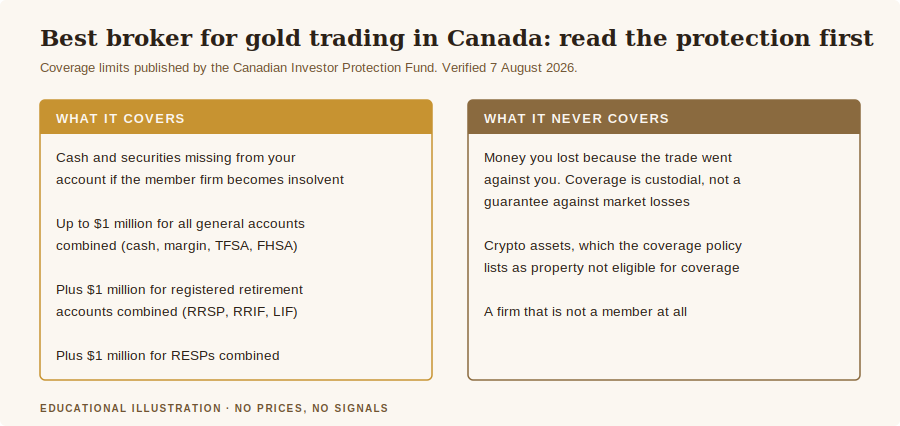
    For an individual holding accounts with a member firm, CIPF states the limits are generally: “$1 million for all general accounts combined (such as cash accounts, margin accounts, TFSAs and FHSAs), plus $1 million for all registered retirement accounts combined (such as RRSPs, RRIFs and LIFs), plus $1 million for all registered education savings plans (RESPs) combined where the client is the subscriber of the plan.”

    You can read the full policy summary on the CIPF coverage page.

    What investor protection covers for the best broker for gold trading in canada, and what it never covers
    Choosing the best broker for gold trading in canada starts with what the protection actually replaces, and what it leaves entirely to you.

    Three separate million dollar buckets, at one member firm, for one individual. For the overwhelming majority of retail gold traders, that ceiling is not the binding constraint. Almost nobody reading this has a million dollars in a margin account. Which means the number to worry about is not the limit. It is whether the firm is a member at all, a point I will come back to.

    What It Never Covers, and Why That Matters More

    Here is the part that gets misread constantly. CIPF describes its coverage as custodial in nature, and states directly that it does not provide protection against market losses.

    Read the mechanism rather than the phrase. What the fund does is compensate you for property that is missing from your account at the date the member firm becomes insolvent. If a hundred shares should be in your account and they are not, you are compensated based on their value on the day of the insolvency. It restores what should have been there.

    What it does not do is make you whole for a trade that went against you. If gold moves the wrong way and your account halves, nothing about that is a coverage event. It is simply the business you chose to be in.

    The coverage policy also lists property that is not eligible, crypto assets among them.

    I labour this because I have seen the confusion cause real damage. A trader hears “protected up to a million dollars”, relaxes, and sizes accordingly. The protection they are relying on has nothing to do with the risk they are actually running. Coverage protects you from the firm. It does not protect you from yourself, and it is your own position sizing that does that job, which is the whole argument in risk management for gold trading.

    Membership Is the Check That Actually Matters

    Since the dollar ceiling is irrelevant for most retail accounts and market losses are excluded, the entire practical value of Canadian investor protection collapses into one binary question. Is this specific firm a member?

    Not the group. Not the brand on the website. The legal entity your account will actually be opened with. Firms routinely operate several entities across different jurisdictions, and a name you recognise in Toronto may be a different company entirely on the account agreement you are about to sign. The protections attached to those entities are not the same, and the one that matters is the one named in your documents.

    So the check is: find the entity name in the account agreement, then confirm that exact entity on the regulator’s own register and on the protection fund’s member list. Not on the firm’s website. Regulator badges in a website footer are graphics, and graphics can say anything.

    The Offshore Trade-Off, Priced Honestly

    The pull toward an offshore firm is almost always leverage. Somewhere offering 500:1 looks generous next to a domestic account offering a fraction of that, and it feels like being handed more room to work.

    Here is why that reasoning usually fails. Leverage does not set your risk. Your position size and your stop distance set your risk. If you size from your stop, which is the correct order, then the leverage ceiling is a limit you rarely approach. Trading a risk-sized position with a sensible stop, most retail gold traders use a modest share of their available margin at ordinary leverage levels. The extra headroom offshore buys them nothing at all.

    What it costs, though, is concrete: weaker recourse, a protection fund that may not exist, and a legal entity in a jurisdiction where enforcing anything is impractical. You are trading away real protection for theoretical room you were never going to use. If the mechanics of leverage are still fuzzy, what leverage actually is in gold trading covers it properly.

    There is a second reason to be careful. The US Commodity Futures Trading Commission’s fraud advisory on foreign currency trading opens with a warning worth reading twice: “The forex market is volatile and carries substantial risks. It is not the place to put any money that you cannot afford to lose, such as retirement funds, as you can lose most or all it very quickly.” The advisory notes the regulator has seen a sharp rise in forex trading scams, and it is published on the CFTC’s fraud advisory page. Different country, identical lesson: the further from a real regulator you go, the more of that risk you carry alone.

    Then, and Only Then, Compare the Features

    Once a firm has passed the protection test, the ordinary comparison becomes worth doing. In rough order of how much they affect a gold account:

    • Total dealing cost on gold, spread plus any commission, measured at the hours you actually trade rather than the headline number.
    • Overnight financing, which quietly dominates the cost of anything held for days.
    • Execution behaviour around news, meaning how far fills drift when it matters.
    • Withdrawal record, which is the one thing you cannot test until you need it, so look for a long unremarkable history rather than promises.
    • Platform and instrument, whether gold is offered in a form you understand and at a contract size your account can size sensibly.

    Notice that spread is on the list but not at the top. A slightly wider spread at a firm that will still exist in five years is a better deal than a tight one at a firm you cannot verify. The general framework is in what actually matters when choosing a gold broker, and the account-opening mechanics are in how to open a gold trading account.

    A Short Checklist Before You Fund Anything

    1. Find the legal entity name on the account agreement, not the brand on the homepage.
    2. Confirm that entity on the regulator’s own register.
    3. Confirm that entity on the investor protection fund’s member list.
    4. Read what the coverage excludes, and accept that market losses are yours alone.
    5. Decide how much capital genuinely needs to sit at the firm, and leave the rest at your bank.
    6. Only then compare spreads, financing and platforms.

    The whole exercise takes about twenty minutes once. It is the cheapest twenty minutes in this business.

    Free gold survival sheet

    Get the free Gold Empire survival sheet, a one-page guide to protecting your account through the kind of market this article describes. One email, no spam, unsubscribe anytime.

    Get the free survival sheet →

    Frequently Asked Questions

    Is my gold trading account protected in Canada?

    Only if the firm holding it is a member of the Canadian Investor Protection Fund. Membership is per legal entity, so check the specific entity named in your account agreement rather than the brand. If it is a member, coverage applies to property missing from your account if the firm becomes insolvent, up to the published limits.

    How much does CIPF cover?

    For an individual, generally $1 million for all general accounts combined, plus $1 million for registered retirement accounts combined, plus $1 million for RESPs combined where the client is the subscriber. Exceptions exist and the coverage policy governs any actual claim, so read it rather than relying on a summary.

    Does investor protection cover my trading losses?

    No. Coverage is custodial. It addresses property missing from your account when a member firm fails. Money lost because a trade went against you is not covered by any investor protection scheme anywhere, and no broker feature changes that.

    Should I use an offshore broker for higher leverage on gold?

    For most risk-sized traders the leverage ceiling at a regulated firm is never the binding constraint, so the extra headroom buys nothing while the loss of protection and recourse is real. Work out the margin your normal position actually requires first. If you are nowhere near the ceiling, higher leverage is not a benefit you can use.

    How do I check whether a broker is really regulated?

    Look the entity up on the regulator’s own public register and match the exact legal name, registration number and address against your account documents. Never rely on logos or claims on the broker’s own site. If the entity you are signing with does not appear, treat that as the answer.

    How much money should I keep in my trading account?

    Enough to meet the margin your planned positions require, plus a sensible buffer, and not much more. Capital sitting idle at a broker is exposed to the firm for no return. This is a separate decision from position sizing and worth making deliberately.

    Choosing the Best Broker for Gold Trading in Canada

    The best broker for gold trading in canada is not the one with the tightest spread on a comparison table. It is the one that is still there in five years, that is a verified member of the protection scheme under the exact entity on your paperwork, and whose costs you have measured yourself at the hours you actually trade.

    Gold Empire is a free Telegram channel where we work through market context in public, including the days the read does not work out. There is no promise of profit here, because there honestly cannot be one. What there is, is a group of people trying to stay in the game long enough for competence to start paying.

    If this was useful, the free Gold Survival Sheet is the natural next step. It is a one page checklist that puts the size, the cost and the ceiling in front of you before you enter, and it is free to download with nothing to join.

    About the author. Matthew writes the Gold Empire market notes. He spends most of his time on the unglamorous half of trading, position size, dealing costs and the arithmetic of recovery, on the view that surviving the first two years is what makes the rest of it possible.

    Disclaimer: This article is general educational content about how leveraged markets and investor protection schemes work. It is not financial, legal or tax advice, and it is not a recommendation of any firm. Coverage rules change and the published coverage policy governs any actual claim, so verify current terms directly with the fund and your regulator. Trading leveraged products carries a high risk of losing money rapidly. No entry, stop or target discussed should be treated as a signal. Figures attributed to external sources are linked so you can check them.


  • What Is Swap in Gold Trading, and What Does Holding Overnight Cost?

    What Is Swap in Gold Trading, and What Does Holding Overnight Cost?

    There is a line on your account statement that most traders never read, and it is the only cost that grows while you sleep. It is usually called swap, sometimes rollover, sometimes overnight financing. Whatever your broker calls it, swap in gold trading is the charge for keeping a leveraged position open past the daily cut-off, and it is the reason a trade that looked right can still finish behind.

    Almost nobody explains it to beginners, partly because it is boring and partly because it is unflattering. So here it is: what it actually is, why it exists, what it costs, and the one feature of it that surprises people every single week.

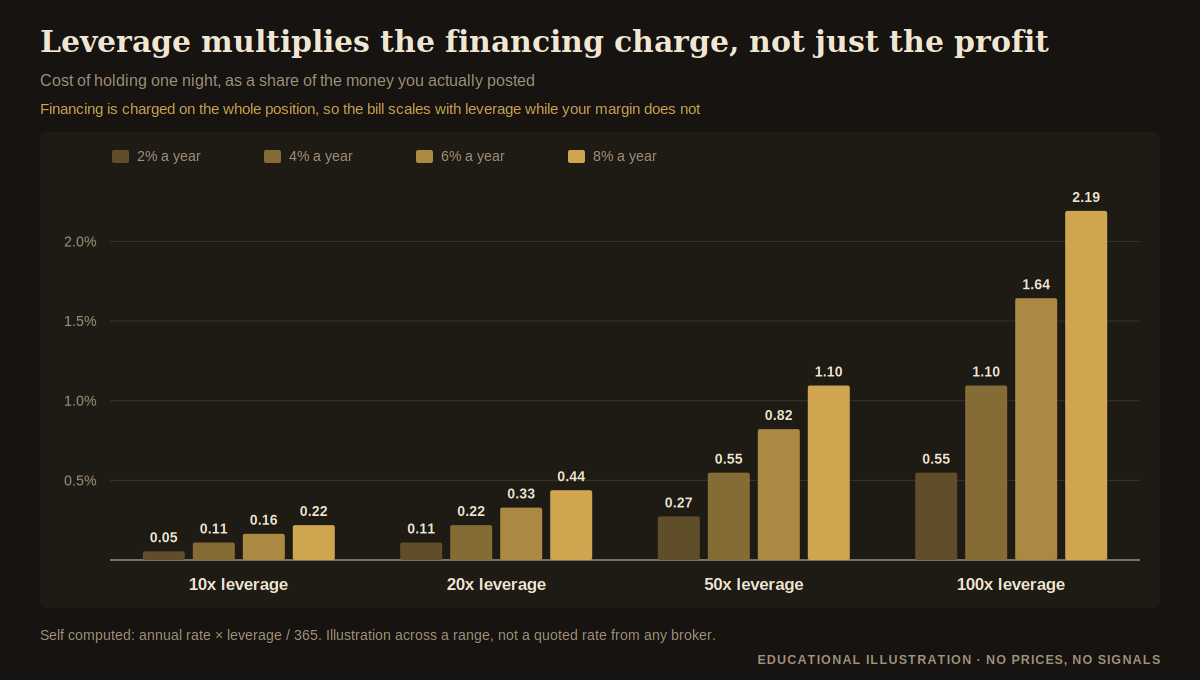
    Chart of nightly swap in gold trading as a share of posted margin across different leverage levels
    What swap in gold trading costs each night, as a share of the money you actually posted.

    What swap in gold trading actually is

    When you open a leveraged gold position, you are not paying for the whole thing. You post margin, a fraction of the position’s value, and your broker effectively finances the rest. That financing is a loan, and loans have interest.

    Swap is that interest, charged or occasionally paid, once per night, for as long as the position stays open. Close before the cut-off and you never see it. Hold for six weeks and you have paid it forty-two times.

    The rate is not arbitrary. It is built from short-term interest rates, plus your broker’s markup. The anchor underneath it is the overnight lending rate, which the Federal Reserve describes as the interest rate at which depository institutions lend reserve balances to other depository institutions overnight. When that rate is high, financing everything is more expensive, and the cost lands on you.

    One consequence worth stating plainly: because the rate depends on the direction you are holding and on your broker’s markup, swap can be a credit rather than a charge in some conditions. It usually is not, and you should never plan around receiving it. Check your own broker’s table rather than assuming anything from this article.

    The part that catches people: it is charged on the whole position

    Here is the mechanic that makes swap bigger than it looks.

    Financing is calculated on the full value of the position, not on the margin you posted. Your margin is what you risked. The position is what is being financed. Those two numbers are different by exactly your leverage.

    So the cost as a share of your own money is the annual rate multiplied by your leverage, divided by 365. That is the arithmetic behind the chart above, and the numbers are uncomfortable.

    At 10 times leverage and a 4 percent annual financing rate, one night costs about 0.11 percent of your margin. Barely noticeable. At 50 times leverage, the same rate costs about 0.55 percent of your margin per night. At 100 times leverage and 8 percent, it is roughly 2.19 percent of your posted money, every night, before the market has done anything at all.

    This is the honest counterweight to everything appealing about leverage, and it is why I wrote separately about what leverage actually is in gold trading. Leverage does not just multiply your profit and your loss. It multiplies your rent.

    The Wednesday surprise

    Now the feature that catches almost every new trader exactly once.

    Markets settle over two business days, so a position held over the weekend still accrues financing for Saturday and Sunday even though nothing trades. Brokers handle this by booking three nights of financing on a single weekday, most commonly Wednesday.

    The practical result is that a position held from Monday to Monday is charged for seven nights, not five. And if you happen to be holding across that one particular day, you get a charge roughly three times the size you have been seeing, on a day when nothing unusual happened.

    At a 4 percent annual rate, a full week of financing is about 0.077 percent of the position value. On 50 times leverage that is about 3.8 percent of your margin per week, purely for the privilege of still being in the trade.

    Nothing about this is hidden or improper. It is standard practice and your broker publishes the table. It just arrives as a surprise to anyone who never looked, which is most people.

    What it does to a winning trade

    The number that changed how I think about holding periods is this one.

    Suppose a trade eventually moves 2 percent of the position value in your favour, which for a leveraged account is a substantial win. Now suppose you held it for thirty days to get there.

    At a 2 percent annual financing rate, the cost over those thirty days is about 0.164 percent of the position, which is roughly 8 percent of your gain. At 4 percent it is about 16 percent of your gain. At 8 percent, financing has eaten nearly a third of the entire move before you count spread or commission.

    Push it further and the picture gets starker. At a 4 percent annual rate, financing equals a 2 percent target after about 182 days. If your thesis takes longer than that to play out, the financing has consumed the whole idea even if you were completely right about direction.

    That is not an argument against holding positions. It is an argument for knowing the clock is running, and for matching your holding period to your method rather than drifting into a long hold because you did not want to take a loss.

    It also quietly changes how you should think about waiting for a scheduled event. If you are carrying a position for a week because you want to be positioned before something like the monthly jobs report, the waiting itself has a price. That does not make it a bad decision. It makes it a decision with a cost attached, which is a different thing from a free one.

    The uncomfortable footnote to break-even stops

    This connects directly to something I wrote about recently, and the connection is not flattering.

    When you move your stop to your entry price, the trade is often described as risk-free. I already argued in the piece on what a break-even stop really protects that this is imprecise because of slippage and gaps. Financing adds a third reason.

    A position stopped out at exactly your entry price, after being held for two weeks, is not a break-even trade. It is a small loss, equal to the spread you paid on the way in plus every night of financing since. The screen says zero. The account says otherwise.

    For a day trade this is negligible. For a position carried for weeks at meaningful leverage, “break-even” can quietly be a real cost, and it will not appear anywhere in your win-loss statistics if you record that trade as a scratch.

    Where swap sits among your other costs

    It helps to see the full picture, because traders tend to obsess over one cost and ignore the others.

    • Spread is paid once, on entry and exit. It punishes frequency. I covered it in detail in what the spread is in gold trading.
    • Commission, where charged, also scales with frequency.
    • Swap is paid nightly. It punishes duration.

    That is the useful way to hold it in your head. Trading often is expensive in spread. Holding long is expensive in financing. A method that does both, many trades held for weeks, pays on both counts, and very few people ever add up the total.

    It also means swap is a genuine reason to care which broker you use, alongside execution quality. Financing rates and markups vary considerably between firms, and unlike spread, the difference compounds every night you stay in. It is one of the concrete things worth comparing when choosing a broker for gold trading.

    What to actually do about it

    Nothing exotic, and none of this is an instruction about what to trade.

    Find your broker’s swap table before you need it. It is published, usually buried in the contract specifications, and it lists the charge per lot per night for long and short separately. Knowing the number turns an invisible cost into a line item you can plan around.

    Know which day carries the triple charge on your account, because it is not the same everywhere. If you routinely hold positions for several days, that single fact changes your cost more than most of the things people spend their evenings optimising.

    And add financing to your trade record. If you hold anything beyond a day, the honest result of that trade includes the nights you paid for. A journal that records only price movement is telling you a slightly flattering story, and the flattery grows with your holding period.

    All of which is really one idea, the same one underneath everything on this site: the costs you do not measure are the ones that decide whether you are still here in a year. That is the argument I make at length in the risk management guide.

    A quick word before the questions

    If this is the kind of detail you find useful, the Gold Empire Telegram channel is where I post market context through the week, free, with no upsell. The free Gold Survival Sheet covers sizing and the costs worth checking before you open anything.

    Free gold survival sheet

    Get the free Gold Empire survival sheet, a one-page guide to protecting your account through the kind of market this article describes. One email, no spam, unsubscribe anytime.

    Get the free survival sheet →

    Frequently asked questions

    What is swap in gold trading in simple terms?

    It is the interest charged for holding a leveraged position overnight. Because you only posted part of the position’s value as margin, the rest is effectively financed, and swap is the nightly cost of that financing. Close the position within the day and you do not pay it.

    Why does Wednesday cost three times as much?

    Because settlement takes two business days, so weekend financing has to be collected on a weekday. Most brokers book three nights on Wednesday, though the specific day varies by firm, so check yours rather than assuming.

    Can swap ever pay me instead?

    In some conditions and directions it can be a credit rather than a charge, depending on rates and your broker’s markup. It would be unwise to build a plan around it, because the rate can change, the markup usually works against you, and a strategy that depends on receiving financing is exposed to something you do not control.

    Does swap apply if I close the same day?

    No. The charge is applied at a daily cut-off time, so positions opened and closed inside that window are not financed. This is one genuine cost advantage that shorter holding periods have, though they pay more in spread instead.

    How do I find my own swap rate?

    It is in your broker’s contract specifications, listed per lot per night with separate figures for long and short. If you cannot find it easily, that is itself worth noticing. A firm that makes its costs hard to locate is telling you something.

    Is swap a reason to avoid holding positions for weeks?

    Not by itself. It is a reason to know what the holding period costs and to check that your expected move is large enough to justify it. A method built on multi-week holds can absolutely work, provided the financing is in the calculation rather than discovered afterwards.

    Where this leaves you, and what we do about it

    Swap is a good example of the kind of thing that separates traders who last from traders who do not, and it has nothing to do with skill at reading charts. It is just a cost, published openly, that most people never look up, and that quietly rearranges their results over a year.

    You cannot control the rate. You can control how long you sit in a financed position, and whether the number is in your plan or a surprise on your statement.

    Gold Empire is a free Telegram channel where we work through market mechanics in public. There is no promise of profit here and there never will be, because nobody can honestly make one. What we can do is make sure the machinery is visible to you before it costs you money.

    If this was useful, the free Gold Survival Sheet is the natural next step. It is a one page checklist covering position size, stop placement and the costs worth checking before you open anything. It costs nothing and it does not require you to trade anything.

    About the author. Matthew writes the Gold Empire market notes and has spent his time in this market mostly learning what not to do. He is not a licensed adviser and does not want to be one. His interest is in the part of trading nobody posts screenshots of: staying in the game long enough for a method to matter.

    Disclaimer: This article is general educational content about trading costs. It is not financial advice, not a recommendation, and not a solicitation to trade. All cost figures are illustrations computed from stated assumptions across a range of rates, and are not quoted rates from any broker. Check your own broker’s published contract specifications. Trading leveraged products carries a high risk of losing money rapidly. No entry, stop or target discussed should be treated as a signal. Consider your own circumstances and seek independent regulated advice if you need it.


  • How to Get Signals for Forex Trading (and What Actually Decides the Outcome)

    How to Get Signals for Forex Trading (and What Actually Decides the Outcome)

    If you are searching for how to get signals for forex trading, I can answer the literal question in about thirty seconds, and then I want to spend the rest of this article on the part that actually decides what happens to your account. Because the getting is easy. Almost everyone gets that part right. It is the ninety seconds after the signal lands on your phone that separates the traders who are still here next year from the ones who are not.

    I run a gold signal channel. I am aware of how it sounds for me to tell you that signals are the least important input in this business. I am telling you anyway, because I blew up accounts of my own while holding a list of perfectly reasonable trade ideas, and the ideas were never the problem.

    How to Get Signals for Forex Trading, the Easy Part

    There are only a handful of routes, and none of them are hard to find.

    Free public channels

    Telegram, Discord and X are full of them. You join, and setups appear. This is the cheapest option and the most crowded one. The trade-off is that you usually cannot see a full history, the person posting has no obligation to you, and the incentive is to post frequently rather than to post well.

    Paid subscription services

    You pay monthly for a smaller room, and usually you get more explanation attached to each idea. The money changes the incentive slightly for the better, because now they have to keep you. It also changes it for the worse in one specific way: a service with nothing to show you this week is still charging you this week, which quietly pressures them to manufacture activity.

    Copy trading and signal marketplaces

    Platforms that connect your account to somebody else’s and mirror their trades automatically. The appeal is obvious. The catch is that the position size is decided by an algorithm reading your balance, not by anyone who knows what else you have going on in your life this month.

    Broker-provided research and autochartists

    Many brokers bundle in a signal tool. It is free, it is convenient, and it is generated by software scanning for patterns. Treat it as one more opinion rather than a decision.

    That is the complete map. You can be receiving forex signals within five minutes of finishing this paragraph, at no cost. Which is exactly why the ability to get signals has never been what separates a surviving account from a dead one.

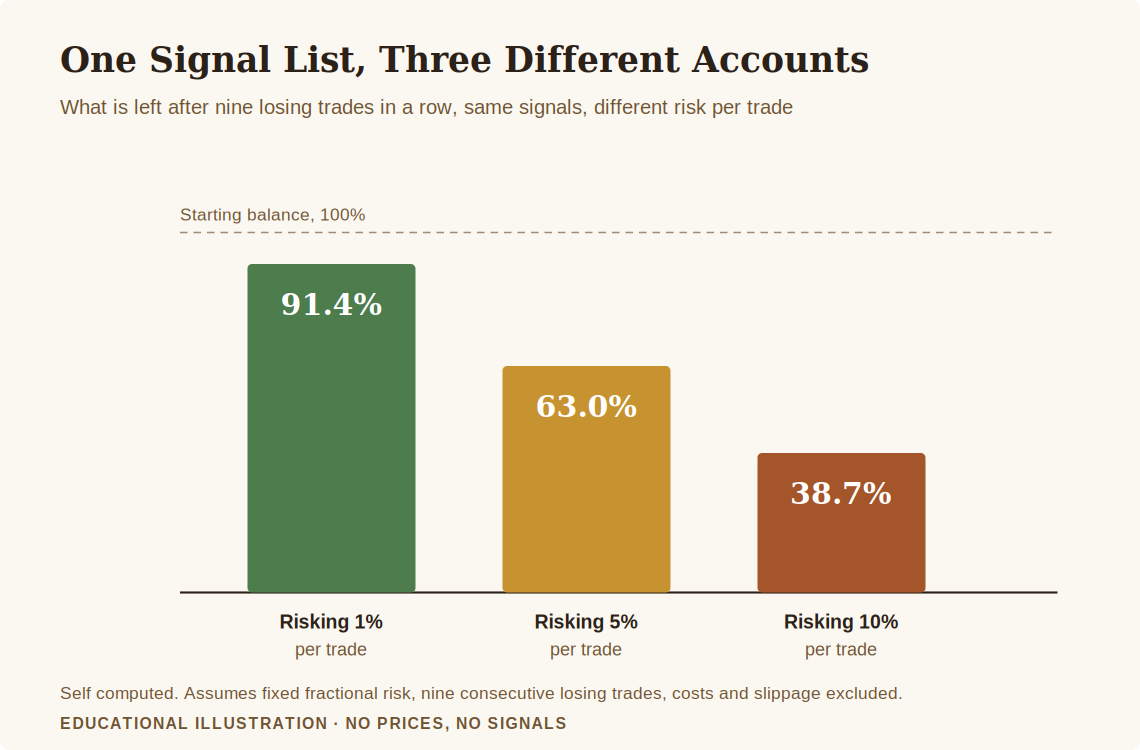
    How to get signals for forex trading, the same signal list with three different risk levels leaves very different accounts
    The same signals, three risk settings: what is left of the account after nine losing trades in a row.

    The Same List, Three Different Accounts

    Here is a piece of arithmetic that took me far too long to take seriously.

    Imagine three traders in the same room, reading the same channel, taking every single call at exactly the same moment. Identical entries. Identical exits. The only difference between them is how much of the account each one puts at risk on a trade.

    Now hand all three of them the same losing run, nine trades that do not work. This happens. It happens to good processes.

    • The trader risking 1 percent per trade finishes that run with 91.4 percent of the account intact.
    • The trader risking 5 percent finishes with 63.0 percent.
    • The trader risking 10 percent finishes with 38.7 percent.

    I calculated those figures directly, assuming fixed fractional risk, nine consecutive losses and no trading costs. You can reproduce them in a spreadsheet in a minute. The assumptions are simple on purpose, because the point does not need complexity to hold.

    Three traders. One signal provider. One set of trades. The first one has had an annoying fortnight. The third one now needs to more than double what is left simply to get back to where they started, and they will be trying to do that while frightened, which is the worst possible condition for decision making.

    The signal was identical in all three cases. The signal was not the variable. It never was.

    This is why I keep pointing people back to the one rule that keeps you in the game before they ask me anything about entries, and why how much to risk per trade matters more than any setup I could hand you. If you want the mechanics of turning a percentage into an actual lot size, position sizing for gold covers it.

    How Many Trades Before a Win Rate Means Anything

    Somebody advertises a 60 percent win rate. You want to know whether that is real or whether it is a coin flip with good marketing. This is a question statistics can answer precisely.

    Suppose the honest baseline is 50 percent, and you want to be reasonably confident that a claimed 60 percent is genuinely better than that, rather than an ordinary run of luck. Running the exact binomial test, at a 5 percent significance level and 80 percent power, you need roughly 158 trades before the difference can be distinguished from noise. If you want to be more confident than that, the number climbs past 200.

    Sit with that for a second. One hundred and fifty-eight trades. Most signal services have not shown you anything like that many verified results, and most subscribers make up their mind after about a dozen.

    Twelve trades is nothing. Twenty trades is nothing. A screenshot of a good week is worse than nothing, because it was selected precisely for being good. The honest position, after a month of following anyone, is that you still do not know very much, and any confidence you feel is manufactured.

    I would rather tell you that than sell you certainty I cannot back up.

    A Losing Run Is Not Proof of a Bad Signal

    The reverse error is just as expensive, and I see it constantly.

    Take a process that genuinely wins 55 percent of the time. Good, not spectacular, better than most. Over 100 trades, the probability of hitting a run of at least six losses in a row somewhere along the way is about 36 percent. Roughly a one in three chance. A run of eight straight losses still shows up about 8 percent of the time.

    Again, calculated directly, assuming independent trades and a fixed win rate. Real trading is messier, but messier tends to make streaks more likely, not less.

    So a six-loss streak is not evidence that something broke. It is an ordinary feature of a working process. Yet this is the exact moment when most people cancel the subscription, double their size to catch up, or go looking for a different channel. They quit a functioning process during a statistically unremarkable bad patch, and then repeat the cycle somewhere else.

    If you have lived through this, trading after a losing streak deals with the psychology of it, and the quiet loop that drains accounts maps how the cycle actually runs.

    If you want the setups, they are free. I post gold ideas daily on the Gold Empire Telegram channel, with the reasoning attached rather than just a level.

    And if you would rather fix the part that actually decides your outcome, take the free Survival Sheet instead. It is one page, it costs nothing, and it is the thing I wish someone had put in front of me first.

    How to Check Who You Are Actually Following

    If you are going to pay someone, or hand them influence over your money, spend twenty minutes on this. It is the least glamorous part of the job and the highest return on time you will find.

    Check the registration before you check the results

    In the United States, the CFTC maintains a public tool for exactly this purpose, and it takes a couple of minutes to use. You can look up whether a firm or an individual is registered, and whether there is a disciplinary history attached to them, through the CFTC’s check tool. Other jurisdictions run their own equivalents. Someone who is legitimately in this business will not mind you looking. Someone who minds has told you something useful.

    Understand the modern version of the con

    The old warning signs were bad grammar and obviously fake screenshots. Those are gone. The CFTC has published an advisory on how criminals now use generative AI, warning that they create “false images, voices, videos, live-streaming video chats, social media profiles, and malicious websites designed to look like financial trading platforms”, and that AI now cleans up the language errors that “may have raised suspicions in the past”. The advisory specifically flags fake profiles aimed at people looking for “friendship, trading information, or advice”. You can read it in full on the CFTC advisory page.

    Which means the surface has stopped being evidence. A polished website, a confident voice on a call, a track record chart, a room full of people agreeing with each other: all of that can now be produced cheaply by someone who has never traded anything.

    The questions worth asking

    • Are results published before the outcome is known, or only afterwards?
    • Are losing trades posted with the same visibility as winning ones?
    • Is anyone telling you what to risk, or only what to buy?
    • Does anyone guarantee a return, or describe an outcome as certain? Nobody honest does this.
    • Are you being rushed? Urgency is a sales technique, not a market condition.

    One more, and it is the one people skip: where is your money actually held? A signal provider should never be holding your funds. If the person giving you ideas is also the person you deposit with, you have a problem that no win rate can fix. Choosing a broker for gold trading covers what to look for, and opening an account properly walks through doing it in your own name.

    What a Signal Cannot Tell You

    A signal is a sentence about the market. It is not a sentence about you, and the gap between those two things is where accounts die.

    It does not know your account balance. It does not know that you are already holding two other positions in the same direction, so that what looks like three trades is really one large bet wearing three costumes. It does not know that your rent is due, that you lost money yesterday and are trying to get it back, or that you are reading this at work and will not be able to manage the position for the next four hours.

    It also cannot tell you what to do when the trade goes sideways, which is most of the time. A level is a starting point, not a plan. What happens after you are in is a separate skill, and managing a gold trade after you enter is the part almost nobody teaches, because it is far less exciting than the entry.

    Two more that matter for gold specifically. First, cost: a trade that looks flat can still be losing money overnight, and a stop moved to break even is often not actually break even once financing is counted. Second, timing: a signal that arrives ten minutes before a major economic release is a different proposition to the same signal on a quiet Tuesday, and what nonfarm payrolls does to gold explains why that gap matters.

    How I Would Use a Signal Channel If I Started Again

    Not as instructions. As a reading list.

    When a setup appears, the useful question is not “should I take this”. It is “why does this person think that”. If the reasoning is given, you get to compare your read of the chart against someone else’s, and disagree sometimes, and find out later who was closer. That is how you build judgement rather than dependency. If the reasoning is never given, you are not learning anything. You are just outsourcing, and the day the channel goes quiet you will be exactly where you started.

    The practical version looks like this. Decide your risk per trade before you look at anything. Take fewer of the ideas rather than all of them. Write down why you took the ones you took. Review that record monthly against your own notes, not against the provider’s marketing. And size every position as though the next nine are going to lose, because sometimes they are.

    To be completely clear, and this applies to my channel as much as anyone else’s: no entry, stop or target discussed should be treated as a signal.

    Free gold survival sheet

    Get the free Gold Empire survival sheet, a one-page guide to protecting your account through the kind of market this article describes. One email, no spam, unsubscribe anytime.

    Get the free survival sheet →

    Frequently Asked Questions

    Are free forex signals worse than paid ones?

    Not automatically. Price tells you about a business model, not about quality. Some free channels are run by people who trade their own ideas and post them as a byproduct. Some expensive ones are marketing operations. What matters is whether losses are shown, whether reasoning is attached, and whether anyone is talking to you about risk.

    How long should I follow a signal provider before deciding?

    Longer than feels necessary. As shown above, distinguishing a genuine 60 percent win rate from a coin flip takes around 158 trades. You will probably not wait that long, and that is understandable, but you should at least stop pretending that twenty trades told you something.

    Can I just copy the trades automatically?

    You can, and the position sizing is then decided by software that knows nothing about your circumstances. If you use copy trading, the risk settings are the part to obsess over. Everything else is somebody else’s decision applied to your money.

    What is the single biggest mistake people make with signals?

    Changing size based on confidence. Feeling sure about a trade because it came with a detailed explanation, and quietly doubling up. Confidence is not information, and the market has no idea how sure you were.

    Does a signal service need to be regulated?

    Rules vary by country, and pure education sits in a grey area in many of them. The check is still worth doing. Look up the name, look for a disciplinary history, and be far more careful with anyone who also wants to hold your deposit.

    Where This Leaves You

    Gold Empire is a free channel. I post gold setups with the reasoning attached, most days, and you can follow along on Telegram without paying for anything. There is a Survival Kit for people who want the structured version of the risk work, and it is entirely optional. The free channel is not a trial of it, and I am not going to pretend that people who pay get better market conditions.

    If you take one thing from this article, take the free Survival Sheet. One page, no cost, no promises about returns. It is about the only part of this business you can actually control.

    About the Author

    I am Matthew. I traded gold badly for a long time before I traded it acceptably, and the turning point had nothing to do with finding better setups. I had good setups for years while my account went in one direction. What changed was that I finally accepted that the size of the bet was the whole game, and that my job was to still be here in twelve months rather than to be right this afternoon. I run the Gold Empire channel now, which means I spend a lot of my week talking people out of the exact mistakes I made. More about how I work.

    Risk disclaimer: This article is educational and is not financial advice, not a recommendation, and not an offer to trade. Trading gold, CFDs and leveraged products carries a substantial risk of loss and is not suitable for everyone. Most retail accounts lose money. The figures in this article are either self-calculated illustrations with their assumptions stated, or are taken from the cited public sources, and none of them are a forecast. No entry, stop or target discussed should be treated as a signal. Never risk money you cannot afford to lose.


  • What Is the Spread in Gold Trading? A Beginner’s Guide to the Hidden Cost

    What Is the Spread in Gold Trading? A Beginner’s Guide to the Hidden Cost

    The First Cost Every Gold Trade Pays

    Before a single trade of yours moves a cent in your favour, it starts a small step behind. Not because you did anything wrong, but because of a cost so quiet that most beginners never notice it until it has quietly eaten into dozens of trades. That cost is the spread, and understanding it is one of the simplest, most useful things you can learn early in your gold trading journey.

    If you have ever opened a trade and watched it show a small loss the instant it was filled, even though the price had not moved, you have already met the spread. It is not a glitch, and it is not your broker cheating you. It is the built-in cost of doing business in any market, and gold is no exception. The good news is that once you understand what the spread is and why it behaves the way it does, you can stop being surprised by it and start treating it like the ordinary, manageable cost it really is.

    Let me walk you through it the plain way, the way I wish someone had explained it to me before I placed my first order.

    The bid, the ask, and the spread between themA diagram showing the sell price (bid) below the buy price (ask), with the gap between them labelled as the spread, and a note that a new trade starts slightly negative by the size of that gap.Two prices, not oneEvery market quotes a price to sell and a price to buyBIDprice you can SELL atASKprice you can BUY atTHE SPREADA new trade starts down by the spread, price must cover it before you are levelEDUCATIONAL ILLUSTRATION, NO PRICES, NO SIGNALS
    What is the spread in gold trading: the gap between the buy price and the sell price

    Two Prices, Not One

    Here is the idea that makes everything else click. In gold trading, there is never just one price. There are always two: the price at which you can buy, and the slightly lower price at which you can sell, quoted at the very same moment.

    The buy price is called the ask (sometimes the offer). The sell price is called the bid. The ask is always a touch higher than the bid, and the small gap between them is the spread. So when you glance at a gold quote on your platform, you are really looking at a pair of numbers sitting very close together, and the distance between them is the cost of entry.

    Think of it like a currency booth at an airport. The board shows one rate to buy dollars and a slightly worse rate to sell them back. Walk up, change your money, and immediately change it back, and you end up with a little less than you started with. You did not lose it to a scam. You paid the booth for the convenience of making the trade. The spread in gold works exactly the same way.

    This is why a fresh trade often shows a small loss the second it opens. You bought at the ask, but if you wanted to close right away you would have to sell at the lower bid. The price of gold has not moved at all, yet you are already down by the size of the spread. Price simply has to travel the width of that gap before your trade breaks even.

    How the Spread Is Measured

    For gold, spreads are usually measured in the same small units used to measure price movement. If you have read our guide on what a pip is in gold trading, this will feel familiar, because the spread is quoted in those same tiny increments.

    You do not need to memorise numbers here, and I am not going to throw specific figures at you as if they were a promise, because spreads change constantly and differ from broker to broker. What matters is the concept: a tight spread means the buy and sell prices sit close together, so your trade has a short distance to cover before it is level. A wide spread means they sit far apart, so your trade starts deeper in the hole and has further to climb.

    All else being equal, a tighter spread is friendlier to you, especially if you trade often. Each individual spread may look tiny, but they add up quietly across many trades, the way small fees quietly add up on a bank account. Nobody trade is ruined by the spread. It is the steady drip over hundreds of trades that deserves your respect.

    Why the Spread Widens and Narrows

    The spread is not a fixed toll. It breathes with the market, and knowing when it tends to widen protects you from paying more than you need to.

    The single biggest driver is liquidity, which just means how many buyers and sellers are active at once. When the gold market is busy and full of participants, buy and sell prices crowd close together and the spread stays tight. When the market thins out, there are fewer people willing to trade, and the gap opens up.

    That is why spreads tend to be tightest during the most active hours, when the major trading sessions overlap and volume is high. If you want the fuller picture on timing, our piece on the best time to trade gold walks through when the market is most alive. Spreads tend to widen in the quiet hours, in the gap between sessions, over weekends, and in the moments right around major news releases, when everyone pulls back and waits.

    The spread is widest at exactly the moments a beginner is most tempted to trade: late at night, over the weekend gap, and in the seconds after a big headline. Calm hours are cheap hours.

    Volatility matters too. When gold is lurching violently around a surprise announcement, brokers widen spreads to protect themselves from the chaos, and that cost gets passed to you. A market that looks exciting to jump into is often the most expensive one to enter. That alone is a quiet argument for patience.

    The Two Main Types of Spread

    You will run into two broad styles when you look at brokers, and it is worth knowing the difference.

    A fixed spread stays the same regardless of market conditions. Its appeal is predictability, you know your entry cost in advance, which some beginners find reassuring. A variable spread (also called floating) moves with the market, tightening when things are calm and widening when they are wild. In busy, liquid conditions a variable spread is often narrower than a fixed one, but it can jump wider during turmoil.

    Neither is automatically better. What matters is that you understand which one you are paying and that you read the conditions attached to it. The spread is one of the real, comparable costs of a broker, alongside commissions and swaps, and it deserves a place on your checklist when you choose where to trade. Our guide to choosing a broker for gold trading covers how to weigh it against everything else, and our VT Markets review shows what that comparison looks like in practice.

    Free beginner’s survival sheet

    Grab the free Gold Empire survival sheet, a one-page checklist of the costs, risks and habits every new gold trader should understand before risking real money. One email, no spam.

    Get the free survival sheet →

    How to Keep the Spread From Hurting You

    You cannot avoid the spread entirely, it is the price of admission, but you can keep it from quietly draining your account. A handful of simple habits do most of the work.

    • Trade in calm, liquid hours. Enter when the market is busy and spreads are tight, not in the dead of night or over the weekend gap when the gap yawns open.
    • Respect the news calendar. Spreads balloon around major releases. If you have no clear reason to be in the market during a high-impact event, the cost of entry alone is a reason to wait.
    • Trade less, not more. Every trade pays the spread. The trader who takes three considered trades pays it three times; the one who takes thirty impulsive trades pays it thirty times. Selectivity is not just good discipline, it is cheaper.
    • Factor it into your plan. When you think about where a trade needs to go to make sense, remember it starts down by the spread. A tiny scalp has to overcome that cost before it earns you anything, which is part of why very small, very frequent trades are so hard.

    Notice that none of these are clever tricks. They are the same calm, patient habits that protect you from every other risk in trading. The spread simply gives you one more reason to trade like an adult: fewer trades, better timing, and full awareness of what each one truly costs. That mindset is the whole foundation of our approach to risk management in gold trading.

    Frequently Asked Questions

    Why does my gold trade show a loss the moment I open it?

    Because you bought at the ask price and would have to close at the lower bid price. The gap between them is the spread, and it means every new trade starts slightly negative. Price has not moved against you; you are simply seeing the built-in cost of entering. Once price travels the width of the spread, you are back to break even.

    Is the spread the same as a commission?

    Not quite. The spread is the gap between the buy and sell price, and you pay it on every trade automatically. A commission is a separate flat fee some brokers charge on top. Some accounts have wider spreads and no commission; others have tighter spreads plus a commission. Both are real costs, so compare them together, not in isolation.

    What is a good spread for gold?

    There is no single magic number, and anyone who quotes you a guaranteed figure is overselling. What matters is that the spread is competitive for the conditions and consistent, and that you understand whether it is fixed or variable. Tighter is generally better for you, especially if you trade often, but it should be weighed alongside the broker’s reliability, regulation and other costs.

    Why is the spread wider at night and on weekends?

    Because liquidity is thinner. Fewer buyers and sellers are active outside the main sessions, so the buy and sell prices drift further apart. The market is quietest, and therefore most expensive to enter, in the small hours and over the weekend gap. Trading during the busy overlap of major sessions usually means a tighter spread.

    The Short Version

    Here is the whole thing, cut to the bone. Gold always has two prices, a lower one to sell at and a higher one to buy at, and the gap between them is the spread. It is the first cost every trade pays, which is why a fresh position often shows a small loss before price has moved at all. The spread widens when the market is thin or wild, and tightens when it is busy and calm. You keep it small by trading in liquid hours, respecting the news calendar, and simply trading less. Understand it, plan around it, and it becomes what it always was: an ordinary cost of doing business, not a mystery working against you.

    About the Author

    Matthew, founder of Gold Empire. Matthew writes for gold traders who are tired of hype and want the plain mechanics explained honestly. Across a community of everyday traders, he shares daily gold analysis and beginner-friendly education with one rule: understand the cost and the risk before you chase the reward. He would rather you learn slowly and keep your account than move fast and lose it. The channel is free to follow, and he never promises profit, only a clearer head.

    Risk disclaimer: This article is for educational purposes only and is not financial advice. Trading gold, CFDs and other leveraged products carries a substantial risk of loss, and most retail traders lose money. Nothing here is a recommendation to trade, and no entry, stop or target discussed should be treated as a signal. Past performance does not guarantee future results. Only trade with capital you can afford to lose.


  • Best Broker for Gold Trading: What Actually Matters

    Best Broker for Gold Trading: What Actually Matters

    Type “best broker for gold trading” and you drown. Every page shouts it’s number one. Every review earns a quiet cut on the answer it hands you. A broker, by the way, is just the company that stands between you and the market, the one that holds your money and fills your trades. So here’s the honest thing: the worst move I could make is hand you one more ranking. So I won’t. I’ll give you the ruler instead, and teach you to measure.

    I’ve picked wrong before. Paid for it in real money, the kind that doesn’t come back. And here’s what took me too long to see. There is no best broker for gold trading. There’s only the best broker for you, the one that clears the things you refuse to bend on, and fits the way you actually trade.

    Survive first, then grow.

    Why ‘Best Broker for Gold Trading’ Is the Wrong Question

    Here’s what nobody selling you a “top 5” will admit: there is no best broker for gold trading. Not for everyone. There’s only the one that clears the non-negotiables, the safety stuff you never bend on, and then fits the way you actually trade.

    Most new traders ask it backwards. “Who gives the highest leverage?” “Who’s got the biggest deposit bonus?” That’s not choosing a broker. That’s asking a stranger for directions and walking toward the finger pointing straight at the hole in the ground.

    So let me be straight about what this is, and what it isn’t.

    I won’t rank brokers for you. No leaderboard. No table of logos with little stars glued next to them. Anyone can build that, and most who do get paid when you click. Instead, I’ll teach you to choose a gold broker yourself. I’m handing you the ruler, not the answer.

    Because the real question was never “which broker is best.” It’s quieter than that. “Which one is genuinely safe, and which one fits me?” And under that, quieter still: have I earned the discipline to sit in front of any of them yet?

    Different question. Better question.

    What Actually Matters in a Gold Trading Broker, In Order

    Here’s what I wish someone had put in front of me before I funded my first account. Not a ranking. A checklist, in the order that keeps you alive.

    Go down this list in order. The top is not optional.

    1. Regulation and segregated funds. This is the floor. Regulation means an outside authority is supposed to be watching how the broker handles your money. Segregated funds means your cash sits in an account separate from the company’s own, not their piggy bank. I won’t tell you which regulator or which country is “safe.” Rules change, and you should read the broker’s current terms yourself. But this one does not bend. Without it, everything below is noise. A broker can have the prettiest platform on earth and still be a trapdoor. If you want a plain, neutral primer on why keeping client money separate matters, Investopedia’s explainer on segregated funds is a fine place to start.

    2. Can you get your money OUT, without a fight? Anyone lets you deposit. The door in is always propped open. Withdrawal is where the truth lives. When I size up a broker, this is what I test early, with a small amount. A clean, boring, no-drama withdrawal tells you more than every award badge on their homepage combined.

    3. Transparent XAU/USD costs, nothing hidden. XAU/USD is just the ticker for gold priced in US dollars. Every broker charges you something to trade it, fair enough. Hiding it is not. I won’t quote numbers here; they move, and they differ by account. Your job: compare how openly each broker shows its costs, and check the current terms before you fund a cent.

    4. Execution and platform when gold whips. Execution means how fast, and how honestly, your order gets filled. Gold can lurch hard in the minutes around US news, exactly when a weak platform freezes or slips. Most brokers run MT4 or MT5, the standard trading software. Open one on a busy hour and feel it. The bad broker shows its face right there, when you need it most.

    5. Real human support. Someone who answers when you’re stuck. Boring, until the day it’s the only thing that matters.

    6. Leverage is RISK, not a feature. Leverage lets you control a big position with a small deposit. It magnifies both sides, the win and the wound. It’s where small accounts die fastest. Never rank a broker by who hands out the most of it. That’s picking the sharpest knife and grabbing it by the blade.

    Survive first, then grow.

    The Traps That Pull New Traders Toward the Wrong Broker

    Let me be honest about the traps, because I walked into most of them myself.

    The first one is the deposit bonus. “Fund your account, we’ll match it.” It feels like free money. It isn’t. It’s bait on a hook, dressed up as a gift. I chased one once. The bonus was never the point. My money was.

    The second is the loudest: highest leverage wins. Leverage is borrowed size, it magnifies both directions. Picking a broker for offering the most is like choosing a knife by how sharp it is, then grabbing the blade. Feels powerful. Right up until it cuts you.

    Then the glossy stuff. Slick ads. A famous face beside the logo. None of that tells you where your money sits, or whether you can pull it back out. A celebrity got paid. That’s all you learned.

    And the profit screenshots. Someone’s green numbers, posted to make you feel slow. You can’t verify a single one. Most are bait.

    The last trap is the quiet one: skipping the boring checks. The regulation. The small test withdrawal. You skip them because you’re in a hurry to start, and hurry is exactly what the wrong broker is counting on.

    See the thread? Every one of these sells excitement. None of them protect your survival.

    So slow down. Run the boring checks first. Then decide.

    The Broker Is the Arena, Not Your Edge

    Here’s the thing nobody selling you a broker wants to say out loud. The best broker on earth can’t fix a bad plan. It can’t cool a hot head. Hand a reckless trader a flawless platform and you get the same crater. Same hole. Nicer walls.

    Your edge isn’t a logo. It’s risk discipline, the boring habit of deciding, before you click, how much you’re willing to lose.

    Let me show you my scars.

    I killed my early accounts. Not because I picked the wrong broker. Because of me. I’d take a loss, get angry, and stack the next position bigger to “win it back.” I’d drag my stop-loss, the safety order that closes a trade before a small loss becomes a deep one, further and further out, so I’d never have to admit I was wrong. I traded angry. I traded to feel better. That’s not trading. That’s bleeding on purpose.

    And here’s what stings. Switching brokers touched none of it. I could’ve moved to the cleanest, most regulated platform in the world and blown up exactly the same way. The account didn’t change me. Changing my behavior did.

    So look at where your attention actually goes. Three weeks reading broker reviews. Three minutes deciding how much you’ll risk per trade. Turn that around. Three minutes picking a broker that clears the gates. Three weeks learning to sit still when a trade goes against you.

    I’m wrong plenty. Still am. The difference now is I’m wrong small, because the rules protect me from myself.

    The broker is the arena. Your discipline is what you bring into it.

    Survive first, then grow.

    How Do You Actually Choose? A 4-Step Framework

    You’ve got the ruler now. So use it. Here’s the order I’d actually run, no magic, just a filter you can hold in one hand.

    Step 1: Cross off anyone who fails the first gate. Regulation and segregated funds, meaning the broker is supervised, and your money sits in a separate account from the firm’s own cash. If they can’t show you that in plain words, the name comes off the list. No debate. Not “but the fees look nice.” Off. This one move clears out most of the noise.

    Step 2: Test the exit before you trust the door in. From the ones left standing, put a little money in, then pull a little back out. Early. Anyone can make the way in feel smooth; that door’s always wide open. Getting your own money back out is where the truth shows up. If it feels heavy, you already have your answer.

    Step 3: Open a demo and make the platform sweat. A demo is a practice account, same platform, fake money, nothing real on the line. Open one. Place a few XAU/USD orders during a busy stretch, when gold is jumping around. Watch how it fills you. Does the order go through clean, or does it hang? Better to learn that now. Not with your rent on the table.

    Step 4: Pick the one that fits you, then start small. Among the brokers that cleared every gate, take the one that suits how you actually trade. Not the loudest. Not the shiniest. The one that sits right in your hand.

    Then start small.

    Before you fund anything, walk through the mechanics once. I wrote a plain guide on how to open a gold trading account so the paperwork step doesn’t trip you up.

    Here’s the whole thing in one breath: the best broker isn’t the one shouting hardest. It’s the one that clears every gate and fits you. That’s the ruler. Nothing else.

    Full Transparency: The Two Brokers I Use, and Why the Link Matters

    Time to show my hand.

    I trade gold on VT Markets. That’s my main door. PU Prime is my backup, for the days I want a second way in. Real money. Real trades. Not a chart in a slideshow.

    Did they clear the six checks I just walked you through? For me, yes. Read that again. For me. That is not “best for you.” I’m one guy, with one way of working, one set of scars. You’ve got the ruler now. Pick it up. Measure them yourself. Don’t borrow my answer, earn your own. If you want to see how I run one of them through the gates, I broke it down in my VT Markets review.

    Here’s the part people bury in the fine print, so I’ll put it up top. The links below are partner links, some call them IB links. Plain version: if you open an account through mine, the broker may pay me a commission. Not you. It costs you nothing. Same terms, same account, same price.

    Now sit with the twist. Because there’s money in it for me, I owe you more honesty, not less. So I’m not asking you to trust me. I’m handing you the filter and telling you to check everything yourself, mine included.

    Confirm their terms directly. I won’t state where they’re licensed as fixed fact, because that stuff changes and you should verify it, not take my word. Open a demo first. Move a small withdrawal early, before it matters. Start small.

    Survive first, then grow.

    Your Move

    You didn’t come here short on answers. You came short on a filter. Now you have one. Use it.

    Cross off every broker that fails regulation and segregated funds, the rule that your money is watched and kept separate from the company’s. No debate. No exceptions. From what’s left, pull a small withdrawal early. Anyone lets you deposit. You learn who they are when money leaves.

    Then open a demo, a practice account with fake money, and place a few XAU/USD orders during a busy gold hour, when price is jumping and the platform has to prove it can keep up. Then start small. Not the size that excites you. The size you can afford to be wrong about.

    VT Markets and PU Prime are the two I trade on. Linked above. Those are partner links, open through them and I may earn a commission, at no extra cost to you. Check their current terms yourself anyway. My link is not your filter.

    Want to watch me work? I post real trades, green and red, no cherry-picking, over on Gold Empire on Telegram: t.me/GoldEmpire

    The broker is the arena. Your discipline is the edge. Survive first, then grow.

    Free gold survival sheet

    Get the free Gold Empire survival sheet, a one-page guide to protecting your account through the kind of market this article describes. One email, no spam, unsubscribe anytime.

    Get the free survival sheet →

    FAQ

    Is there a single best broker for gold? No. Only the one that clears the non-negotiables and fits how you trade. Anyone who hands you one name is selling you something. Score them yourself.

    Is high leverage good for beginners? No. Leverage magnifies both sides, the win and the loss. It’s where small accounts die fastest. A risk to manage, not a feature to chase.

    How do I test a broker before funding? Regulation and segregated funds first. Then a demo, a few gold orders in a busy hour, to feel the execution. Once you fund, pull a small withdrawal early to see how they behave when money leaves.

    What’s the difference between a demo and a live account? A demo runs on fake money, so you can feel the platform with nothing at stake. A live account puts your real money on the line, where fear and greed actually show up. Spend real time in demo first. Then go live small.


    About the author

    Matthew trades XAU/USD daily, VT Markets as my primary, PU Prime as backup, and runs the Gold Empire Telegram, where I post real trades as they happen, wins and losses both. No credentials on my wall. No profit screenshots. What I know, I learned the expensive way. I paid for it, account by account.

    This article is educational, not financial or investment advice. I’m not telling you to open an account anywhere, that’s your call, on your money. Trading gold with leverage carries real risk: you can lose money, and you can lose it fast. Check every broker’s current terms yourself, and never risk money you can’t afford to lose.


    Slug: `best-broker-for-gold-trading`

    Meta description: There is no single best broker for gold trading, only the one that clears the non-negotiables and fits you. A trader’s honest 6-point ruler, 4-step filter, and full partner-link transparency.

    πŸŽ“ Lesson 13 of 14 Β· The Survival School

    You reached the end. Nice work. πŸ‘

    Read the lesson through, then claim your 100 XP and climb a rank in the Survival School. Progress saves on this device, no sign-up, no email.

    πŸŽ‰ Lesson 13 of 14 complete, progress saved to your Survival School.
    Read the lesson to unlock this.


    Related from Gold Empire

  • How to Open a Gold Trading Account, Step by Step (Without Blowing It in Week One)

    How to Open a Gold Trading Account, Step by Step (Without Blowing It in Week One)

    You’re Scared? Good. A Gold Account Is a Door, Not a Jackpot

    You’re scared. Good. Keep it.

    If you want to learn how to open a gold trading account, the two fears chewing on you right now are the correct two. One: some slick broker takes your money and vanishes. Two: you do this in the wrong order and blow the account with your own hands. Both are real. Both are survivable. I know, because I lived the second one.

    Here’s the reframe I wish someone had slid across the table to me: a gold account is a door, not a jackpot. You’re not walking into a prize. You’re walking into a room. What happens in that room is on you, and that’s the good news, because order is something you can control. Luck isn’t. Order is.

    I burned accounts. Not the market. Me. Wrong order, every time.

    So take the order first, plain, before anything else. Pick a regulated broker. Register. Verify who you are. Fund it small. Practice on a demo, fake money, real buttons, before you touch a cent for real. Then place one small trade with a stop-loss set before you click. Six steps. In that sequence, week one doesn’t eat you alive.

    I’ll walk each one below, what it is, why it matters, the trap curled up inside it.

    One thing first: this is education, not financial advice. Gold trades on leverage, and leverage can drain real money fast. Hold that.

    Survive first, then grow.

    What You Actually Need to Trade Gold (Broker, Platform, Regulation, in Plain Words)

    Before I walk you through the steps, let me clear three words off the table. This is where most people quit, buried in jargon before they’ve placed a single trade.

    Start with XAU/USD. That’s just the price of one ounce of gold, in US dollars. That’s the whole mystery. And here’s what throws people: you’re not buying a gold bar to bury in the yard. Nobody ships you metal. You’re trading the number. The one moving up and down on the screen. That’s it. Brand new to all this? I wrote a plainer starting point over here: Gold Trading for Beginners.

    To do that, you need three things.

    A broker. The door into the market. A company that hands you a way in and holds your account. You can’t walk up to gold and buy the price yourself. You go through a broker. If you’ve never had one, Investopedia’s plain definition of a broker is a clean, neutral read, nobody there is selling you anything.

    A platform. The software where you actually place trades, usually MT4 or MT5. That’s MetaTrader, two versions of the same tool. Your broker gives it to you. It’s your steering wheel, buttons, charts, your open trades, all in one place.

    And regulation. This is the one people skip. It’s also the one that guards your money. A regulated broker answers to a financial authority, something like ASIC in Australia. That’s your first fence. It means when something goes wrong, you’re not shouting into an empty room. Somebody’s watching them.

    Three words. Broker. Platform. Regulation. Now we build.

    The 6 Steps to Open a Gold Trading Account (In the Order That Keeps You Alive)

    Here they are. The order matters more than the steps themselves. I did step six on day one and skipped four and five, that’s the whole story of how I burned account after account with my own two hands.

    1. Choose a regulated broker. This is the one I got lazy about. A broker is your door into the market, nothing more, nothing less. “Regulated” means a financial authority, like ASIC in Australia, is watching over its shoulder, so your money has somewhere to turn if things go sideways. Check three things and only three: is it regulated, does it trade XAU/USD, can you pull your money back out when you want it. The trap is choosing a broker for a shiny promotion instead of the boring stuff that keeps your cash breathing. I trade through VT Markets every day, and PU Prime as my backup, the links below are partner links, so if you open through me the broker may pay me a commission. Costs you nothing extra. Your fees don’t move a cent.

    2. Register your account. The easy one. Fill in your basic details on the broker’s site or app. A few minutes, done before your coffee goes cold. Just don’t rush so fast that you sign off on things you never read.

    3. Verify your identity (KYC). The one people grumble about. KYC means “Know Your Customer”, you send a photo of your ID and something that proves where you live. Feels like a hassle. It isn’t. It’s the good sign. A serious broker makes you verify. A broker that waves you through? That’s the door you run from.

    4. Fund the account, small. The one that burned me worst. You move some money in. Here’s the rule that would have saved me years: only deposit what you could lose without your life changing shape. Start small. The trap is going big to get rich faster. That’s exactly how a small account vanishes in week one, I know, because mine did.

    5. Download the platform and open a demo first. The one I was too impatient for. MT4 or MT5 is the software you place trades on, the broker hands it to you free. A demo account lets you practice with pretend money. Learn the buttons. Watch how gold moves, how fast it turns on you. Do all of it before one real dollar is on the line.

    6. Place a small first trade, with a stop-loss. The one I got backwards. A stop-loss is a cut-off you set in advance, so a bad trade closes itself before it drains you dry. Go in small. Have a plan before you click. Don’t put it all on one bet, that’s not trading, that’s a coin toss with your rent money. When you’re ready to think about protecting what’s in the account, I go deeper here: Risk Management for Gold Trading.

    Survive first, then grow.

    VT Markets, vtm.pro/la-com/en/Matthew. PU Prime (backup), puvip.co/la-partners/Matthew.

    Choosing a Broker for Gold: What Actually Matters (and the Leverage Trap)

    I just told you to choose a regulated broker in one line. Now let me slow down on it, because this is the part people rush. They pick a broker the way you’d grab gum at the checkout, whatever’s closest, done in five seconds. Don’t. This choice sits under everything else. Get it wrong and the six clean steps above collapse.

    A broker is the company that hands you the door into the market. Some doors open onto a real room. Some open onto a painted wall. Your whole job here is telling one from the other.

    Start with regulation. That’s the first thing I check, is this broker watched by an actual financial authority, someone it has to answer to? Right beside it: are your funds segregated? That just means your money sits in its own account, separate from the broker’s cash, so it isn’t part of their grocery money. Those two, regulation and segregated funds, outweigh everything else on the page. The rest is comfort. These two are survival.

    Then the plain stuff. Does it actually trade XAU/USD, and are the costs reasonable and out in the open, no fog, no fine print you’d need a lawyer to read? Can you get your money OUT without a fight? That’s the real tell. A good broker lets you leave. Does the platform hold steady and fill your orders cleanly when gold is thrashing around during news, not freezing at the worst second? And is there a real person on support who picks up?

    Now the one I’ll say out loud, once. Leverage.

    Leverage lets you control a big position with little money. Sounds like a gift. It isn’t. It magnifies wins AND losses, same knife, both edges. It’s the fastest way a small account dies. Never pick a broker because it dangles high leverage at you. That’s the risk wearing a bow.

    I know because I stood right there, chasing the big number. It cost me. Regulation first. Withdrawals second. Leverage comes last, quiet, and you keep it small.

    Survive first, then grow.

    Let Me Be Straight: These Are Partner Links

    I’ve dropped those two links twice now. Before you click either, here’s the part most people slip past you. Not me.

    Those two brokers, VT Markets and PU Prime, I trade through them. Both. Every day. VT Markets is where my XAU/USD lives; PU Prime is the spare key under the mat, there when I need it. I didn’t pull these off some affiliate list. My own money sits in them. It has for a long time.

    Now the plain part. The links I hand you are partner links, introducing-broker links. Open an account through mine, and the broker may pay me a commission.

    Here’s what that means for you. Nothing. Not a cent more. Your spread doesn’t widen, your fees don’t budge, your account runs exactly the same as if you’d walked in the front door yourself. The broker pays me from their side of the table, never yours. That commission is what keeps this channel breathing, the lights on, the trades public, green and red, nothing hidden.

    I won’t pretend I’m some neutral referee with no stake here. I’ve got a stake. But I only point you at a broker I trade through myself. That’s the line. I won’t send you somewhere I wouldn’t park my own money.

    That’s the whole of it. Here they are:

    The Traps That Catch New Traders (I Fell Into Most of Them)

    I didn’t read about these traps. I dug them, climbed in, and pulled the dirt over my own head. So when I list them, I’m not pointing down from somewhere clean. I’m pointing at holes I’ve slept in.

    Here’s the anti-checklist. Each one is a step done wrong.

    Going big to get rich fast. I funded an account and threw a heavy first trade at it, because small felt slow and I was in a hurry. Small accounts don’t survive that. Mine evaporated inside the first week. The market didn’t take it. My impatience did.

    Skipping the demo. Too itchy to practice with pretend money. I wanted the real thing now, so I learned the buttons, and how gold lurches around the news, with cash I couldn’t spare. Expensive classroom.

    Picking a broker for the wrong reason. Loud leverage. Shiny promo. I chased the noise instead of asking the boring questions: is it regulated, can I actually get my money out. Those two questions are the whole door. I asked them last. You should ask them first, it’s the one place a partner link like mine still costs you nothing to walk through, and I only send you to brokers I trade on myself.

    No stop-loss on the first trade. No line drawn before I entered. So when it turned, I watched and hoped. Hope is not a plan.

    Believing anyone who promises “sure profit.” Even the ones flashing wins. Especially them. Nobody knows what gold does next. I’m wrong plenty, anyone honest tells you the same.

    What I wish I’d had was small and dull: someone to sit me down and say do it in order. Start small. Demo first. Not a secret. Just an order I refused to follow.

    Survive first, then grow.

    Free gold survival sheet

    Get the free Gold Empire survival sheet, a one-page guide to protecting your account through the kind of market this article describes. One email, no spam, unsubscribe anytime.

    Get the free survival sheet →

    Open Your Account the Right Way, Start Here (with FAQ, Author & Risk Note)

    So here’s where you stop reading and start doing. Not tomorrow. Today, before the coffee goes cold.

    Open your account with a broker that’s actually regulated, watched over by a real financial authority, so your money has somewhere to turn if things go sideways. I use two, every day, for XAU/USD. VT Markets is my main door: vtm.pro/la-com/en/Matthew. PU Prime is my backup: puvip.co/la-partners/Matthew. Both are partner links. Open through them and the broker may pay me a commission, costs you nothing extra, your fees don’t move a cent. That’s how this channel keeps its lights on. I’d rather say it to your face than bury it.

    Then do it in order. Verify your identity. Fund small, money that, if it vanished, wouldn’t change your life. Open a demo first. Place your first real trade small, with a stop-loss set before you click. That’s the whole map. Skip a step and you’re digging your own hole.

    Want to see if I do what I say? The live trades, green ones and red ones, go up in public on Telegram: t.me/GoldEmpire.

    A few honest questions people ask me

    Do I really need to verify my identity? Yes. It’s not the broker being nosy, it’s the mark of one that’s serious. The broker that skips it is the one I’d walk away from.

    Is high leverage good for a beginner? No. Leverage magnifies your losses just as fast as your gains, a two-edged blade. For a small account starting out, it’s the fastest road to zero. Treat it as a risk, not a gift.

    What’s a demo account? A practice account with fake money. Same platform, same gold moving the same way, none of your real cash on the line. Learn the buttons there first.

    How much should I deposit first? Small. An amount that, if it vanished, wouldn’t touch your week. You can always add later. You can’t un-lose it.

    How long does opening the account take? The registration itself is a few minutes. Verification can take a day or two while the broker checks your ID, that wait is normal, and it’s a good sign, not a red flag.

    Who’s telling you this

    I’m Matthew. I trade XAU/USD every day through VT Markets and PU Prime, and I run the Gold Empire Telegram channel where the real trades go up, green and red, nothing hidden. No certificate on my wall. No profit screenshots to wave around. I burned my own accounts learning this, one at a time. I learned it by paying for it.

    One last thing, straight: this is education, not financial advice. Leveraged gold can take your money, and it can take it fast, a small account can hit zero quicker than you’d believe. Trade a demo first. Start small. Keep a stop on. Only ever risk money you can afford to lose.

    Survive first, then grow.

    πŸŽ“ Lesson 12 of 14 Β· The Survival School

    You reached the end. Nice work. πŸ‘

    Read the lesson through, then claim your 100 XP and climb a rank in the Survival School. Progress saves on this device, no sign-up, no email.

    πŸŽ‰ Lesson 12 of 14 complete, progress saved to your Survival School.
    Read the lesson to unlock this.


    Related from Gold Empire

  • VT Markets Review: An Honest Look From a Daily Gold Trader

    VT Markets Review: An Honest Look From a Daily Gold Trader

    Before You Read One Word: Yes, There’s a Partner Link

    It’s US-news hour. The price ladder on gold stops ticking and starts jumping, whole handles gone in a blink, the number you wanted already ten dollars gone. My finger’s over the button. Then the thing nobody screenshots happens.

    The fill.

    Order goes live. Real money, real market, no take-backs. I trade gold, XAU/USD, on VT Markets every single day, PU Prime as backup. Green orders and red ones. Both.

    So before you read further, let me put the ugly thing on the table. This is a VT Markets review, and I won’t pretend it’s cleaner than it is. Yes, there’s a partner link in it. Open a VT Markets account through that link and the broker may pay me a commission. It costs you nothing extra. Your fees don’t move. Not by a cent.

    Here’s the part most people hide in gray text at the bottom of the page. I’m saying it up top, because it changes how you read the rest. A review that’s all praise isn’t a review, it’s an ad in a review’s clothes. And because I might get paid, I’m going to be harder on this broker than any ad ever will. What I genuinely like, you’ll hear it. What I won’t sugarcoat, that too.

    One more thing, so we’re square. This is education, not financial advice. I’m not telling you to open anything. Trading gold with leverage, borrowed money that magnifies every move, can cost you real cash, and fast.

    What you get here is the lived version. Someone who actually uses the thing. Not a spec sheet, not a pitch. And the line I live by, the one you’ll hear again before we’re done:

    Survive first, then grow.

    What VT Markets Actually Is (In Plain Words)

    VT Markets is an online broker, the company that stands between you and the market, for forex and CFD trading, gold (XAU/USD) included. You don’t walk onto a trading floor. You tap a button on your screen, and the broker carries that order to the market for you. That’s the whole job.

    It runs on MT4 and MT5, MetaTrader, the software you actually place your trades in, on laptop and phone. It’s what most gold traders already know. Charts, orders, all of it. If you’ve traded before, it’ll feel familiar the second you open it.

    VT is a regulated broker. Here’s where I slow down and pick my words. Regulated means a financial authority is supposed to watch how the broker operates. But which authority, and what it actually covers, depends on where you live, and it shifts over time. So I won’t name a country or a body and hand it to you as gospel. Go to VT’s official site and check the regulation that applies to your region. Your region, not mine.

    Same with any number. Spreads, fees, leverage, I’m not quoting figures, because they move and differ by account and location. When you need a number, pull it straight from the current terms on the official page. VT is my main broker for gold; PU Prime is my backup. Nothing hidden.

    The Six Things I Judge Any Gold Broker On

    Before I tell you what I think of VT Markets, let me hand you the ruler I measure it with. A review you can’t check is just me talking, this one, you carry to any broker’s door.

    Six things, in order, the order matters.

    1. Is my money safe? Nothing else counts until this passes. I want a regulated broker that keeps your deposit in segregated funds: your money in a separate bank account from the company’s own cash. Their money here, yours there, never mixed. If a broker fails this one, close the tab.

    2. Can I get my money OUT? Anyone takes your deposit with a smile. The real test is the day you ask for it back. Getting out is where the truth lives.

    3. Does it hold when gold goes wild? Come US-news hour, price stops ticking and starts jumping, chunks gone in a blink. That’s the exact moment a weak platform freezes or spins. A broker earns its keep in those minutes.

    4. What does XAU/USD cost to trade? Fair, and honest about it. I won’t quote a number, costs and terms shift, and differ by region. Just make sure you can see what you’re paying.

    5. Does the platform stay standing? MT4/MT5 should run smooth on desktop and phone, no mystery crash the one hour you need it.

    6. Is there a real human when I need one? Not a bot loop. A person who answers.

    Six tests. Any broker worth your money passes all six.

    What I Genuinely Like About VT Markets

    Let me hold this against the six tests I just laid out, “I like it” is worth nothing without a yardstick.

    Start with money coming out. Withdrawals have been smooth for me. I ask for my money, it shows up. No runaround, no “pending” limbo dragging on for a week while support goes quiet. That’s my experience, not a promise for your account, in your country, under whatever terms are live when you read this.

    The platform is MT4/MT5. Same MetaTrader I already knew, no clunky in-house app to relearn at the worst possible moment. I open a chart, and everything sits where my hands expect it.

    Then the part that actually matters. The fills. When gold goes wild during US-news hour and price is jumping, not ticking, that’s when a weak broker shows its cracks. In my experience, it held. My orders went through when I needed them through. I won’t promise it’ll be flawless forever. I’m telling you what happened at my desk.

    Support answers, too. Real question, real person, got back to me. Low bar, maybe, you’d be surprised how many places trip over it.

    That’s the honest list. Four things, lived, not sold to me, not read off a brochure. And I’m wrong plenty in this game. This isn’t one of those times. Not so far. Your mileage will differ, terms change, check for yourself.

    Now the Part the Paid Ads Leave Out

    No broker saves an undisciplined trader. VT Markets didn’t fix me, and it won’t fix you. It’s a good venue, that’s all it is. Not a shortcut. And anyone selling you a broker as the reason you’ll finally win is selling you a lie.

    Then there’s leverage, the broker letting you control a big position with a small slice of your own money. Sounds like a gift. It’s a knife with two edges: it swells your wins and your losses with the exact same force, and doesn’t care which you get. So don’t pick a broker for its leverage. That’s picking a car for how fast it crashes.

    Next: the fine print moves. Terms, spreads, promotions, what’s even offered, they shift over time, and differ from one country to the next. What’s true the day I write this could be wrong by the day you read it. And not everyone, everywhere, can even open an account or qualify, depends on your region. So don’t take my word as the current word. Pull up the live terms yourself.

    Here’s the plain truth under all of it. A good broker doesn’t make you win. It just stays out of your way. That’s the ceiling on any broker, VT or otherwise. How you handle risk when a trade turns against you matters more than the logo on the screen, I wrote a whole guide on risk management for gold trading, because that’s the part that actually decides who survives.

    The Bigger Truth: A Broker Is the Arena, Not Your Edge

    Here’s the part nobody selling you a broker wants to say out loud. The best broker in the world can’t fix a bad plan or cool a hot head. It can’t stop your finger from doing the stupid thing at the worst moment. A broker is the arena, the floor you fight on. It is not the fighter.

    Let me tell you how I learned that. The hard way, the only way I ever seem to learn anything.

    Early on, I blew up an account. And I want to be clear, because it would be easy to point a finger somewhere else. It wasn’t the broker. It was me. I lost, so I doubled the next size to win it all back. Then price came for my stop, and instead of taking the hit, I dragged the stop further away. Gave the loss more room. Told myself it’d turn around. It didn’t.

    A good broker sat right there beside me the whole time, filling every order I asked for. Clean. It couldn’t save me. Nothing could, until I sat down and fixed the guy pressing the buttons.

    So if you’re broker-hunting right now, quietly hoping to find the one that finally makes you profitable, stop. You’re solving the wrong problem. A good broker is necessary. It is not sufficient. The arena can be fair, level, honest. Whether you walk out standing is on you. I learned that by paying for it, so you don’t have to.

    Who VT Markets Is For, And Who Should Walk Away

    Let me do the thing ads never do, let me talk you out of this.

    VT fits you if you want a regulated broker with your money held apart from the company’s own. Check which regulation covers your region before you trust that word. It fits if you already know MT4 or MT5 and don’t want to hunt for the buttons again. And it fits if you trade gold, XAU/USD, and care more about clean withdrawals and getting filled when the candle is running than about anything printed on a banner. In my experience, VT does those well. Yours may differ.

    Now the other side.

    Walk away if you’re hunting the “highest-leverage broker to get rich fast.” That’s not a broker search, it’s a countdown to a blown account, and no logo saves you from it.

    Walk away if you’ve never opened a demo, a practice account, live prices, fake money, nothing real at risk. Go do that first.

    And walk away if you think picking the right broker matters more than learning discipline. It doesn’t.

    Yes, there’s a partner link below, and opening through it costs you nothing extra. But I’d rather you close this tab than sign up for the wrong reasons.

    Free gold survival sheet

    Get the free Gold Empire survival sheet, a one-page guide to protecting your account through the kind of market this article describes. One email, no spam, unsubscribe anytime.

    Get the free survival sheet →

    If VT Fits: The Honest Way to Open, Plus FAQ, Disclaimer & Who I Am

    If VT fits your situation, and only if, here’s the honest way in.

    Not today. Not because I said so. First you go read the current terms yourself, and check what regulation actually applies where you live, on the broker’s own official site. Don’t trust my word for it. If you’ve never done this, I walked through the whole process step by step in how to open a gold trading account, read that first. Then you open a demo and trade it until the platform bores you. Boring is good. Boring means you know where every button is before a dollar of yours is on the line.

    Only then, if it still fits, do you fund. Small. Smaller than your gut wants. Then, and not one minute before: VT Markets, vtm.pro/la-com/en/Matthew. PU Prime backup, puvip.co/la-partners/Matthew.

    Now the part I won’t hide. Those are partner links. Open through them and the broker may pay me a commission. It costs you nothing, your fees don’t move a cent. That’s the whole reason I showed you the ugly side too: a review that’s all praise is an ad in a review’s coat.

    Frequently Asked Questions

    Is VT Markets legit and regulated? It’s a regulated broker. But regulation differs by country and shifts over time, so don’t take my word, or anyone’s. Check what applies to your region on the official site first.

    Is VT Markets good for gold trading? In my experience, steady fills, familiar MT4/MT5, clean withdrawals. In mine. Yours is yours to test on a demo before you risk a cent.

    Does opening through your link cost me more? No. Not a cent. It’s a partner link, the broker may pay me a commission, but your fees don’t change. That’s exactly why I made this review harder on VT, not softer.

    What does trading gold on VT Markets cost? I won’t quote a number, costs and terms move, and differ by region and account. Pull the current figures straight from the official site before you decide anything.

    If you’re new to any of this, understand what a broker actually is before you sign anywhere, Investopedia’s plain-English explainer on what a broker is is a neutral place to start.

    Want to see what daily gold trading really looks like, the green orders and the red ones, in public? Gold Empire on Telegram: t.me/GoldEmpire. No promise. Just the raw thing.


    A word on risk, before you go. Trading gold with leverage means borrowed money magnifies every move, up and down. You can lose real money, fast, sometimes more than you planned. Nothing here is financial advice or a recommendation to open an account. Read the current terms and the regulation for your region on the broker’s official site, practice on a demo first, and if you ever fund an account, start smaller than your gut wants.

    Matthew, I trade XAU/USD daily on VT Markets, PU Prime as backup, and I run the Gold Empire Telegram where the real orders go up, green and red, in public. No certificates. No profit screenshots. My only authority is that I’ve lived this and I tell you the whole of it, partner links included.

    Survive first, then grow.

    πŸŽ“ Lesson 14 of 14 Β· The Survival School

    You reached the end. Nice work. πŸ‘

    You just finished the final lesson. Read it through, then claim your 100 XP and unlock your graduation in the Survival School. Progress saves on this device, no sign-up, no email.

    πŸŽ‰ Final lesson complete, you finished all 14. Head to the School to see your graduation.
    Read the lesson to unlock this.


    Related from Gold Empire