Here is a question that arrives in my inbox in a dozen different phrasings, always from someone who has been staring at a screen too long: how to get gold price alert notifications that actually reach you, so you can stop sitting there refreshing a chart. It sounds like a technical question about which button to press. It is not. It is a question about how much of your life this is going to take, and whether the answer to that is going to be decided by you or by the market.
I want to answer the button part properly, because it deserves a proper answer. But I want to do the arithmetic first, because the arithmetic is what tells you how many alerts to set and where, and almost nobody does it.
What a price alert actually is, and what it is not
An alert is a message. That is the whole of it. When a condition you specified becomes true, something tells you. Nothing is bought, nothing is sold, nothing changes in your account.
That sounds obvious written down, and yet the confusion between an alert and an order is the single most expensive misunderstanding in this whole topic. An order is an instruction sitting at your broker that will execute whether you are awake or not. An alert is a tap on the shoulder that does nothing at all unless you are there to receive it and act.
Which means an alert cannot protect a position. Only an order can do that. If you find yourself thinking of an alert as a sort of soft stop loss, a way to keep an eye on things without committing to an exit, stop and reread that sentence, because it is the shape of a very common way to lose money slowly.
What an alert is genuinely good for is the opposite job. It buys you permission to be absent. It lets you close the platform, do your actual work, sleep properly, and still be told when the one thing you were waiting for happens. That is a survival tool, not an analysis tool, and it is why I care about it.
How to get gold price alert coverage for the hours you cannot watch
Let me show you why this matters more than it sounds, with numbers I worked out myself and assumptions you can check.
Spot gold quotes from roughly Sunday evening to Friday evening. Taking a common broker window of Sunday 22:00 UTC to Friday 21:00 UTC, that is 119 hours of quoting in a 168 hour week. Now put a human being into it. Assume they sleep from 23:00 to 07:00 every night, and hold down a job from 09:00 to 17:00, Monday to Friday.
Count the hours where the market is open and that person is both awake and not at work. The answer is 39. That is 32.8 percent of the time gold is quoting.
Which means 67.2 percent of the open week has nobody on it. Eighty hours a week. Across a year, that is 4,160 hours of live gold market that you were never going to see, the equivalent of 173 complete days.
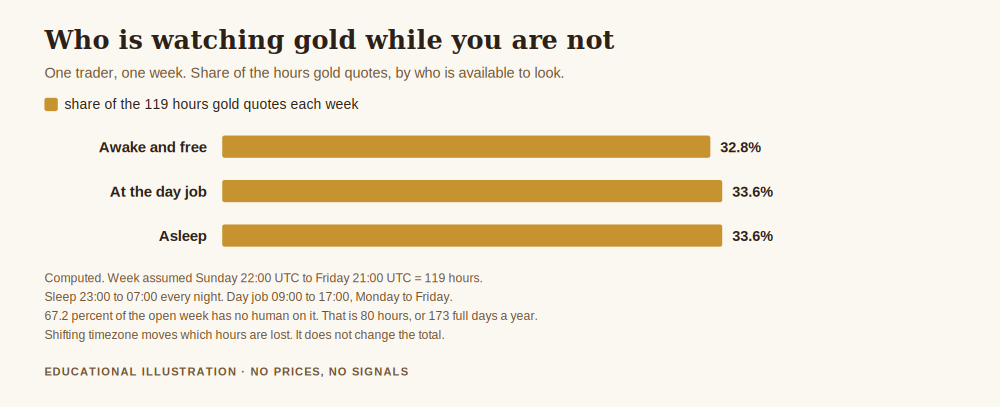
Split the loss and it is almost perfectly even. The day job takes 40 of those open hours, 33.6 percent. Sleep takes another 40, another 33.6 percent. Neither is optional, and I am not going to pretend otherwise. Shifting your timezone changes which hours you lose. It does not change the total by a single hour.
So the honest framing is not “how do I watch more.” You cannot watch more, not sustainably, and the people who try are the ones I meet later with a story about a bad month. The framing is: given that two thirds of this is happening without me, what do I want to be told about, and what am I happy to miss?
Where you can actually set one
There are four places, and they are not interchangeable.
In the trading platform itself. MetaTrader has a built in alerts tab, and it also exposes alerts to code. The MetaQuotes reference for the Alert function describes it plainly as displaying a message in a separate window, and notes one limitation worth knowing before you rely on it: it does not work in the strategy tester. The catch with all platform alerts is that the platform has to be running. Close the terminal and the alert dies with it.
Push to your phone. This is the one that matters, because it survives the terminal being closed on that machine. MetaTrader supports it through SendNotification, and the documented pattern is instructive: the code is supposed to check whether the terminal actually has permission to send notifications before it tries, because if that permission was never granted the message goes nowhere silently. That failure mode is worth internalising. An alert you believe is armed and is not is worse than no alert at all, because you have stopped watching on the strength of it.
Your broker’s own app. Most now have price alerts built in, running on their servers rather than your machine, which makes them the most robust of the lot. Whether they are reliable is a question about your broker rather than about alerts, and if you are still choosing one, the broker comparison is where I would start.
A charting site. TradingView and similar tools have well built alert systems that run in their cloud. If you already live in a chart package, this is often the least friction. If you are weighing the platforms up, TradingView versus MetaTrader covers the wider trade off.
Whichever you pick, test it once, deliberately, by setting an alert you know will fire in the next few minutes. Then go and confirm the message actually arrived on the device you will be holding. Do not skip this. Untested alerts are the most common quiet failure in this entire subject, and you discover the problem at the exact moment you needed it to work.
The most valuable alert is not a price alert at all
Now the part I actually wanted to write.
A lot of what moves gold hardest is not a surprise. It is scheduled, published months ahead, and available free. The Federal Reserve says so on its own FOMC calendar page: the committee holds eight regularly scheduled meetings during the year, plus others as needed, and the minutes of those regularly scheduled meetings are released three weeks after the date of the policy decision.
Read that as an operator rather than a reader. Eight meetings, each with a minutes release three weeks later, is sixteen dated events every year that you can know about today. My arithmetic on a 252 day trading year puts that at one every 15.8 trading days, or roughly every 22.8 calendar days.
Sixteen entries in a calendar. That is the entire setup cost. No price level, no platform, no code, nothing that can silently fail because a permission was not granted. And it tells you something a price alert structurally cannot: not that something has already happened, but that something is about to.
The difference between those two is the difference between reacting and preparing. A price alert always arrives after the move started. A calendar entry arrives before it. If you want the fuller picture of what the meeting itself does to gold, what the FOMC is and why gold reacts is the companion piece, and nonfarm payrolls covers the other big scheduled one.
How many alerts is too many
Here is where most people go wrong once they discover alerts work. They set forty of them.
The relevant number is not how many alerts you have. It is what fraction of them lead to you doing anything. Assume a patient process that takes two trades a week, which is not an unusual pace for someone trading gold around a job. My arithmetic on that assumption:
- 5 alerts a week: 40 percent lead to a trade, 3 interruptions bought nothing, 156 a year.
- 10 alerts a week: 20 percent lead to a trade, 8 wasted, 416 a year.
- 20 alerts a week: 10 percent lead to a trade, 18 wasted, 936 a year.
- 40 alerts a week: 5 percent lead to a trade, 38 wasted, 1,976 a year.
- 80 alerts a week: 2.5 percent lead to a trade, 78 wasted, 4,056 a year.
Put a time cost on it. Say each alert costs five minutes to open the platform, look, decide nothing is there, and put the phone down. At 10 alerts a week that is 34.7 hours a year spent on alerts that led nowhere. At 40 a week it is 164.7 hours. At 80 a week it is 338 hours, which is more than eight full working weeks, spent looking at a chart to conclude nothing.
The spacing you choose controls this directly, and the arithmetic is simple ratio work with no price in it at all. If your levels sit 0.25 percent apart and a day travels a 1.0 percent range, the day touches about four of them. Tighten the spacing to 0.10 percent and that same day touches ten. Widen it to 0.50 percent and it touches two. You are not measuring the market when you set spacing. You are choosing how often it is allowed to interrupt you.
The alert that quietly hurts you
One warning, and it is the reason I framed this article around absence rather than coverage.
Alerts can become a mechanism for being at the chart more, not less. It happens gradually. You set a few, they fire, you look. You set more so you do not miss anything. Now your phone buzzes eleven times a day and each buzz is an invitation to open the platform and have an opinion. You have not automated your attention. You have outsourced the decision about when to pay attention to a set of price levels you chose last Tuesday.
The test I would apply is simple. Does this alert correspond to something in my plan that I would act on? If yes, keep it. If it is there because I am curious, delete it, because curiosity that costs you a look at the chart on a day you had decided not to trade is not free. I have written about the version of this that ends badly in how to stop overtrading and revenge trading, and the path there usually starts somewhere this innocent.
The good version looks like this. A handful of alerts, spaced widely enough that they fire rarely, on levels that matter to a plan you wrote down when the market was closed. A calendar with sixteen Fed dates in it. And a stop order resting at the broker doing the actual protecting, because that is the thing that works while you are asleep for those 40 hours a week. Position sizing that lets you sleep is the foundation under all of it, and risk management in gold trading is the piece I would read next.
Get the free Gold Empire survival sheet, a one-page guide to protecting your account through the kind of market this article describes. One email, no spam, unsubscribe anytime.
Frequently asked questions
How to get gold price alert notifications on my phone?
Use a channel that does not depend on your desktop staying open. In MetaTrader that means push notifications rather than the terminal alert window, and the documentation makes clear the terminal must have been granted permission to send them or the message goes nowhere. Broker apps and charting sites run their alerts on their own servers, which is more robust again. Whichever you use, fire one test alert and confirm it arrives on the device you actually carry.
Will a price alert close my trade for me?
No. An alert is a message and nothing else. Only an order resting at your broker can act on your position while you are away. Treating an alert as a substitute for a stop order is the most expensive mistake in this topic, and it is a common one.
How many alerts should I set?
Fewer than feels natural. On the assumption of two trades a week, ten alerts a week means eight of them bought you nothing, which works out at about 35 hours a year of looking at charts to conclude there was nothing to do. Forty a week costs 165 hours. The right number is the number that matches the plan you wrote down, not the number of levels you find interesting.
Is a free alert good enough?
For this purpose, generally yes. Nothing in the arithmetic above improves because you paid for the alert. The reliability question is whether the alert runs somewhere that stays on when your computer does not, and plenty of free options do.
What about a calendar instead of a price alert?
That is the recommendation, alongside rather than instead. Sixteen dated Fed events a year are published in advance and cost nothing to record, and unlike a price alert they warn you before a move rather than after it starts.
Where did the figures in this article come from?
The eight regularly scheduled meetings and the three week minutes lag are quoted from the Federal Reserve’s own FOMC calendar page, linked above, and the two platform notes are from the MetaQuotes references also linked above. Every other figure is my own arithmetic, computed in Python from the assumptions stated in the text: a quoting week of Sunday 22:00 UTC to Friday 21:00 UTC, sleep from 23:00 to 07:00, work from 09:00 to 17:00 Monday to Friday, two trades a week, five minutes per interruption, and a 252 day trading year. No gold price appears anywhere in this article, and none is needed, because every figure is a count, a share or a ratio.
Where Gold Empire fits
Gold Empire is a free place to learn how gold actually behaves and how accounts actually die, written for people who would rather survive the first two years than have a spectacular first month. Everything on the site is free to read. If you are new here, start here is the guided way in, and it explains who writes this and why. There is a free survival sheet if you want the one page version, and an optional kit for people who want the whole framework in order. Nothing here promises you a return, because nobody honest can.
About the author
Matthew has spent a long time around gold, most of it learning things the slow way, and now writes them down so other people can learn them the fast way. He is more interested in the mechanics that quietly drain accounts than in the setups that fill timelines. Nothing in this article is personal advice, and no entry, stop or target discussed should be treated as a signal.
This article is educational content about how price alerts and notifications work, and about the arithmetic of attention. It is not investment advice, not a recommendation of any platform, broker or product, and not a solicitation to trade. Trading gold carries a real risk of losing money, including more than you deposit in some account types. The FOMC meeting count and the minutes release lag are quoted from the Federal Reserve, and the two platform behaviours from the MetaQuotes documentation, both linked in the text. Every other number is my own arithmetic on the assumptions stated in the article and is not a measurement of any market or of anyone’s results. No gold price level is quoted anywhere here. Nothing accounts for your personal circumstances, and no entry, stop or target discussed should be treated as a signal. If you are unsure, speak to someone properly qualified in your own jurisdiction before you risk anything.
One step first
Where should we send the Gold Survival Sheet?
Leave your email and we will send the free one page checklist, then take you straight to the Telegram channel.
No cost and no obligation. Educational only, not financial advice, and nothing here promises a return. Unsubscribe any time in one click.